

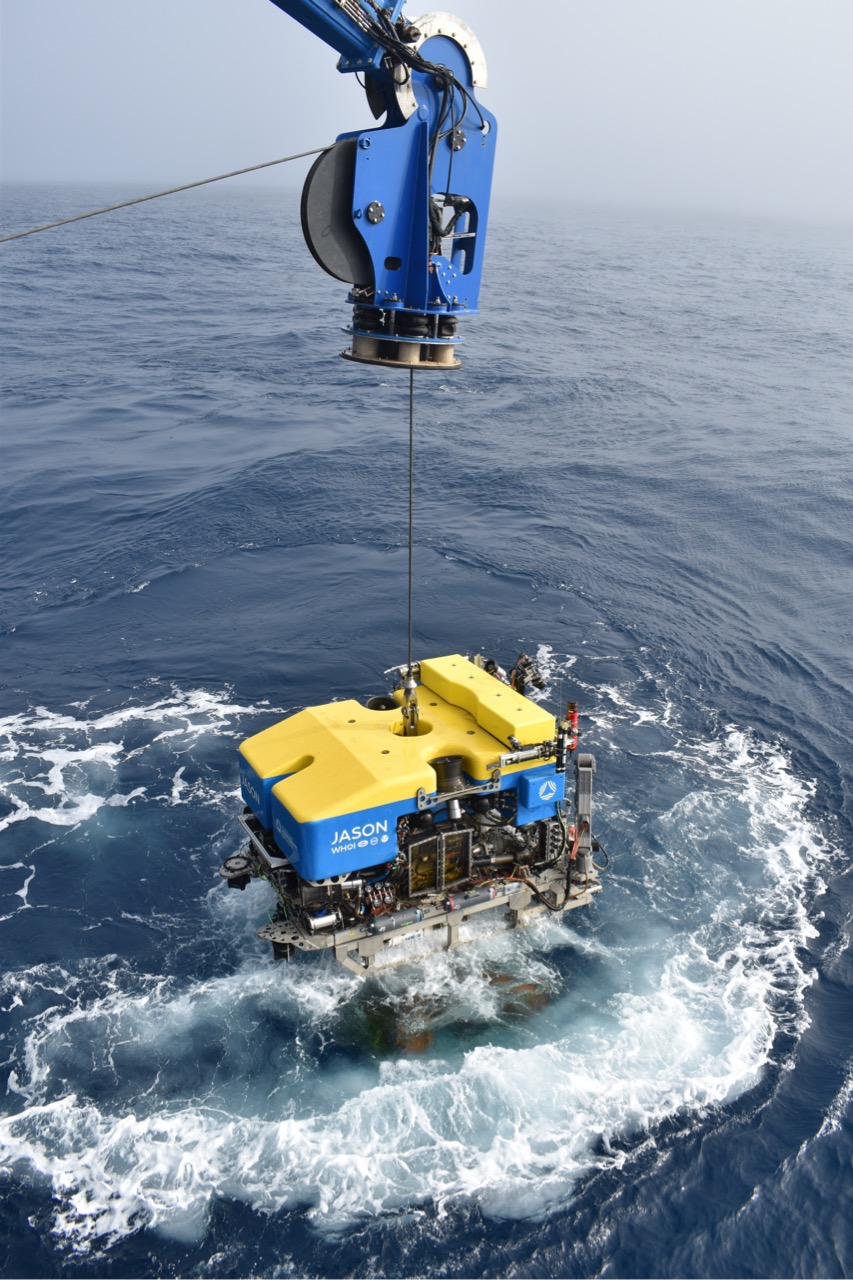
We are looking for students interested in participating on the VISIONS’26 at-sea experiential learning program and UW Sea-Going Research and Discovery course (OCEAN 411) Fall Quarter 2026. The VISIONS’26 at-sea program will provide you the opportunity to sail on a global-class research ship using a state-of the-art underwater robotic vehicle (ROV). The expedition will take place ~August 8 to September 4, 2026 aboard the 274-foot R/V Roger Revelle and will utilize the deep diving ROV Jason. We will be working at depths of up to 9500 ft beneath the ocean’s surface and >300 miles offshore in some of the most extreme environments on Earth. Live video from the ROV will be streamed to shore, and you will be able to share your experience through Daily Blogs. The expedition will include two ~11-day Legs leaving from and returning to Newport, OR, with two days in port between Legs. You may participate on one or more Legs.
The expedition, as part of the underwater Regional Cabled Array observatory (one the most advanced observatories in the worlds’ oceans), includes tens of dives at key worksites that will include methane seeps off the Oregon margin teaming with life; Axial Seamount (the largest and most active submarine volcano off our coast) – which is poised to erupt this year; active hydrothermal vents hosting novel animal and microbial communities; and highly productive coastal environments off Newport, OR.

Working in the Jason control van alongside the pilots, engineers, and scientists, you will “see” places rarely observed and animal communities that thrive in perpetual darkness. Other opportunities include working on the deck of the ship, helping with instrumentation, conducting water sampling to full ocean depths, and learning to both process and analyze ocean water.
During the cruise you will formulate your own/or group research and/or engagement projects using data and stunning imagery collected with these advanced technologies. During Fall Quarter 2026, you will have the opportunity to finish your individual and/or team projects and present your results in a symposium at the end of the quarter. The course will emphasize the importance of science communication during your time at sea. Longer term projects are available as well, which may turn into senior thesis or capstone projects, presentations at national meetings, and publications.

As a member of this oceanographic expedition and class, you will be taking part in maintenance of the US’s high-power and high-bandwidth underwater ocean observatory that is directly connected to the Internet – the Regional Cabled Array – funded by the National Science Foundation as part of the Ocean Observatories Initiative. Here, over 150 instruments are streaming data and imagery live to shore 24/7/365 that are available for you to explore and to make your own discoveries. You will be participating in a truly groundbreaking effort that continues to transform ocean sciences and exploration.
There are no costs to participate in this program, and no expectations of prior sea-going experience or knowledge about the ocean. All transportation to and from the ship is provided by the program. The goal is to share with you the excitement of sea-going research and the importance of the ocean.
Please submit the application via email by April 15, 2026 to Dr. Deb Kelley (dskelley@uw.edu; 206-685-9556) or drop off at Room 261, Ocean Teaching Building. If you have any questions, please e-mail Dr. Kelley.