This blue shark was the highlight of the Deep Profiler Dive at Slope as it moved in an out from in front of the ROV’s camera.Credit: UW/NSF-OOI/WHOI; Dive J2-1367; V21.
Mysterious fish prowling around the Slope Base CTD deployment site. Possibly the snailfish Genioliparis ferox. Photo Credit: UW/NSF-OOI/WHOI, V19.
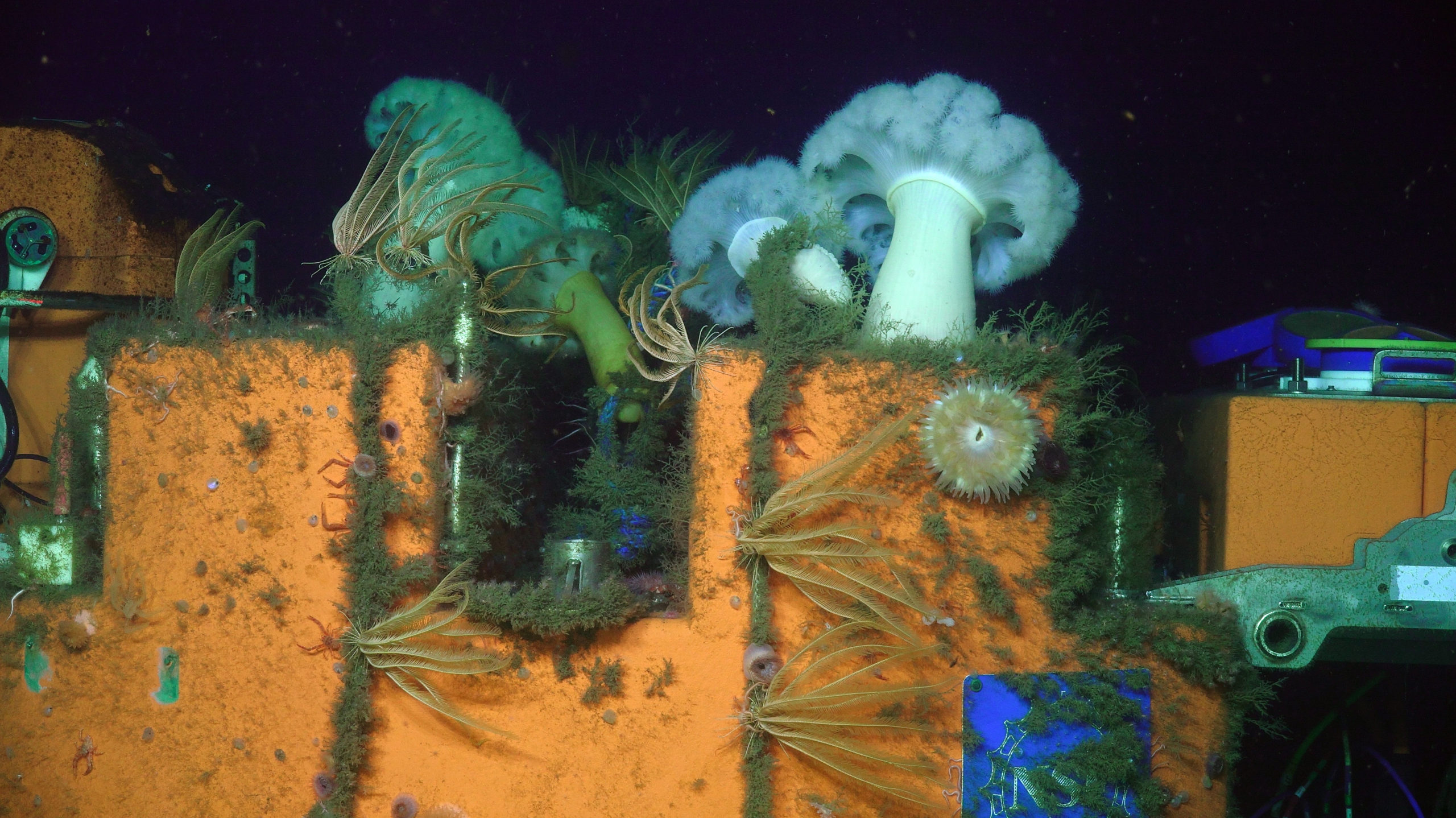
The weird fish (Genioliparis ferox) explores inside the MJ01A junction box at 2900 m. Credit: UW/NSF-OOI/WHOI; V21.
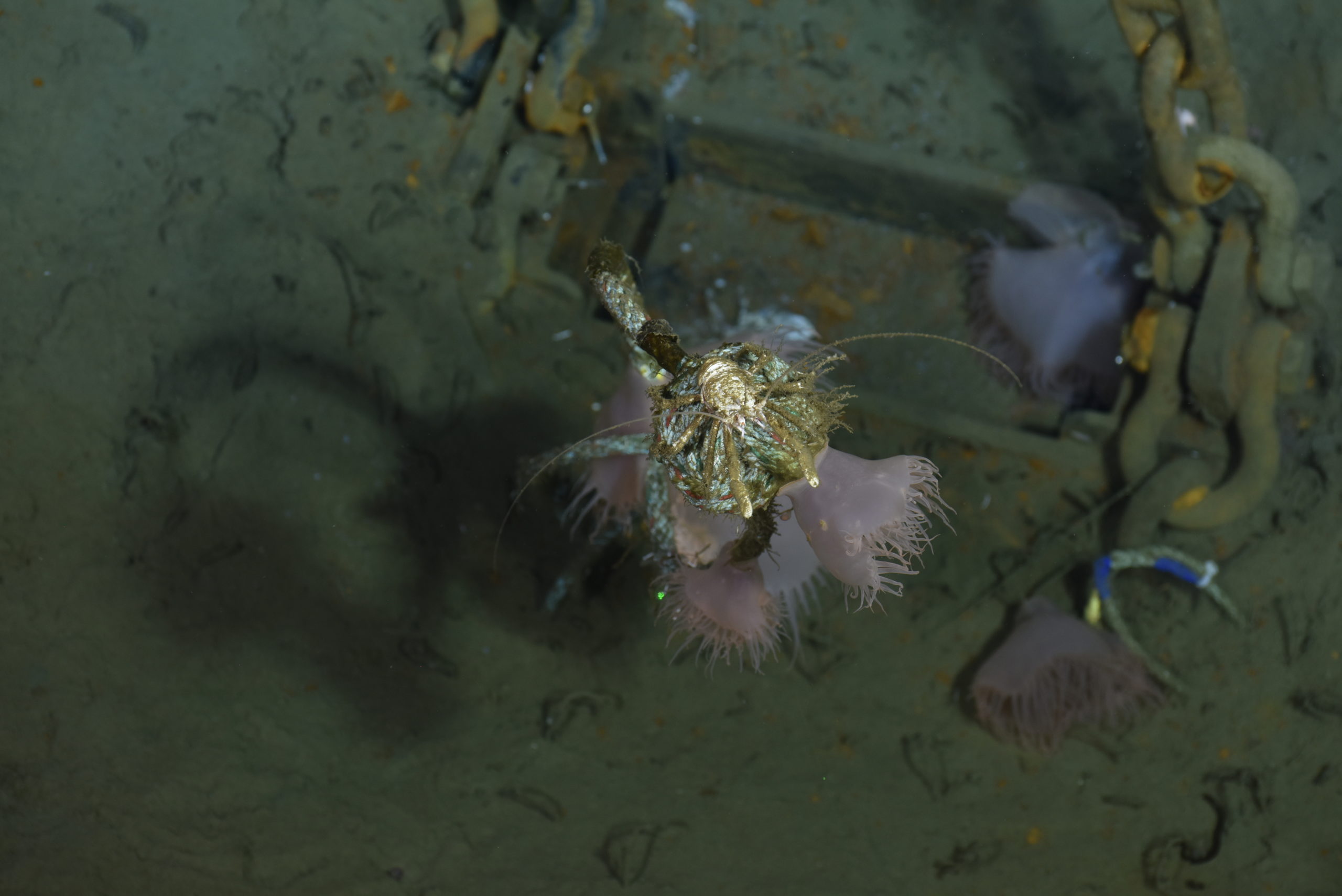
Looking down on a galatheid crab sitting on the rope attached to a marker next to the anchor of the Slope Base profiler mooring in 2900 meters (~9500 feet) of water. A number of venus flytrap anemones are also attached to the hard surfaces here. Photo credit: NSF-OOI/UW/CSSF, Dive R2258, V22
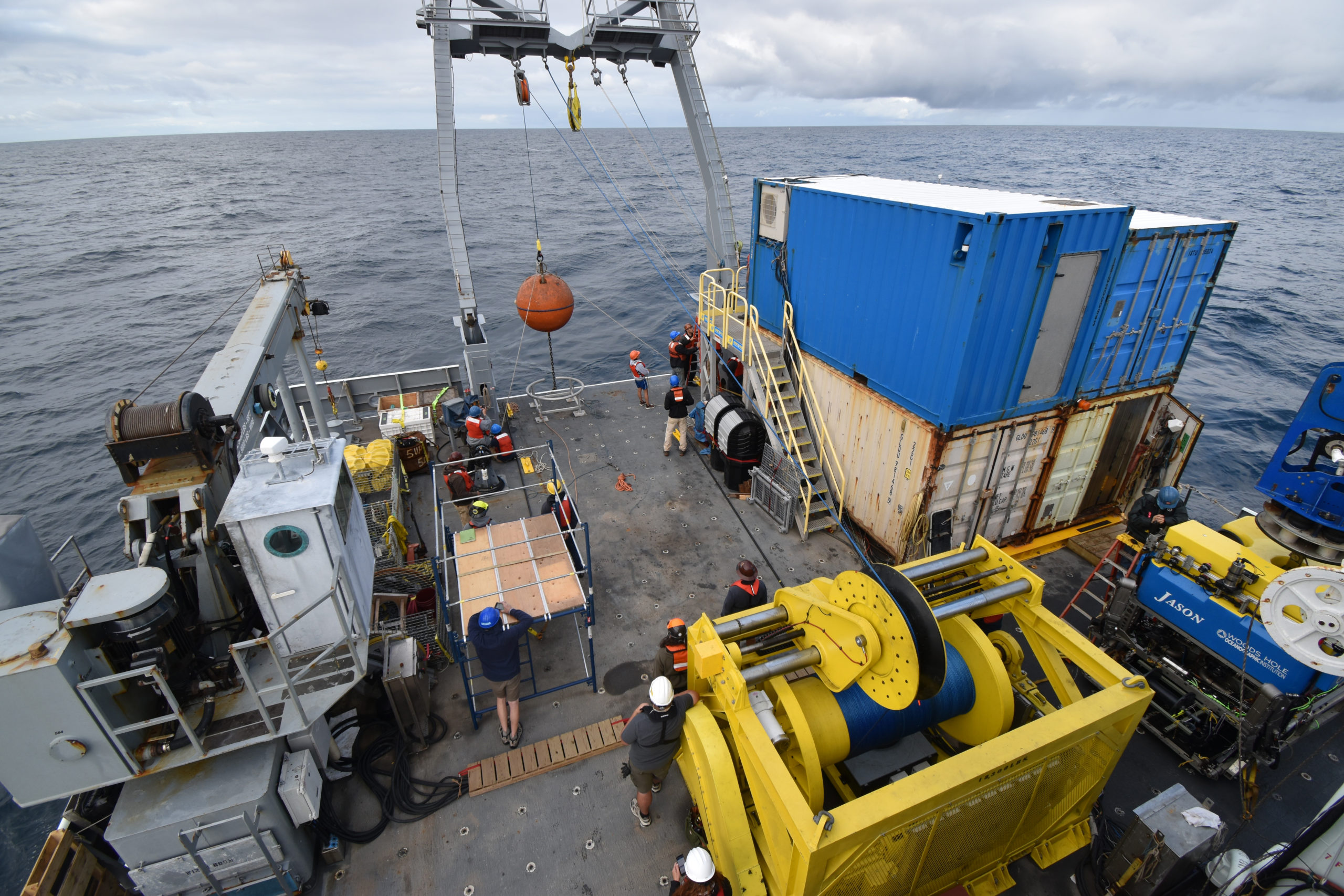
The Slope Base Shallow Profiler platform comes thought the A-frame on the Thompson. P. Correa, University of Washington, V22.
The CTD-O2 sensor and fluorometer rise on a stand on the Shallow Profiler Mooring at Slope Base. Credit: UW/NSF-OOI/WHOI; V20.
During ROPOS Dive 1629 of the VISIONS'13 Expedition, a current meter (tripod with red legs) and pressure sensor (were powered up and tested using through the medium powered J-box MJ01A. The ROV ROPOS provided power and communications and the data were streamed live up to the R/V Thompson through ROPOS's fiber optic tether. Here , the water depth was 2900 m. Credit: UW/NSF-OOI/CSSF, V13.
An HPIES instrument deployed off the starboard side of the R/V Sikuliaq ~ 125 km offshore Newport Oregon near the base of the Subduction Zone at Slope Base. The instrument was released and free fell 2900 m to land softly on the seafloor - the extended legs insure a softer landing and that is stays nearly horizontal as it travels through the water column. This instrument utilizes a bottom pressure sensor, an inverted echosounder and a horizontal electrometer to provide insights into the vertical structure of current fields, near-bottom water currents, and water properties including temperature, salinity, and specific volume anomalies. It was built at the Applied Physics Laboratory. Credit: M. Elend, University of Washington, V16.