This catalog is designed as a growing archive, and updates from knowledgeable individuals will help to improve the quality of the information presented here. Have an addition or revision? Get in touch via our Contact Page.
This catalog is the product of a VISIONS’26 student project by UW Earth & Space Sciences undergraduate Avery Wolf.
Calderas are found in terrestrial and submarine volcanic environments, where the magma chamber(s) that feed a volcano partially empties during eruptions, causing the rocks above it to collapse.
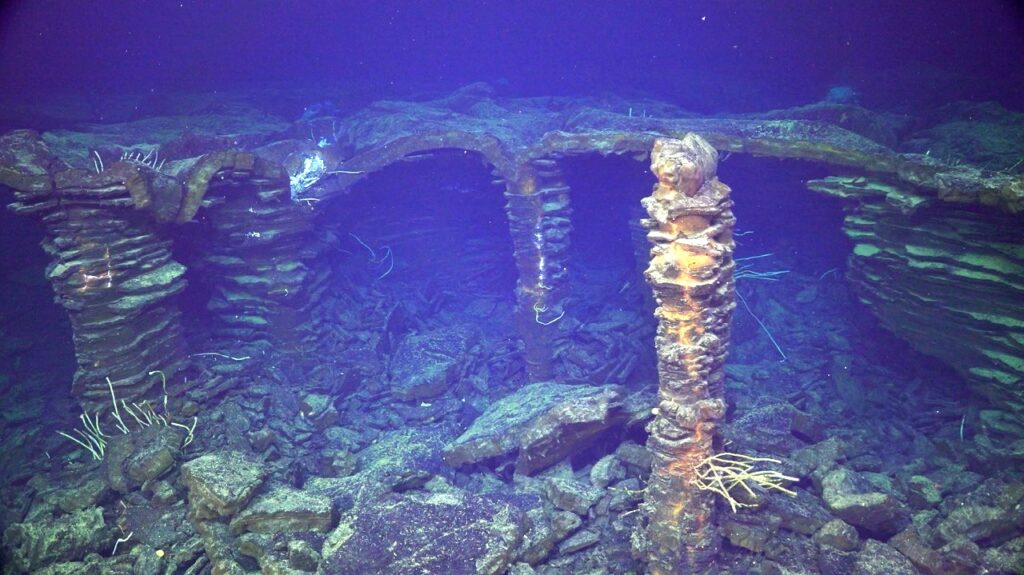
The caldera at the summit of Axial Seamount is a classic example. Sitting beside the Juan de Fuca mid-ocean ridge spreading center, the caldera forms an oblong depression bounded by about 100 meters near vertical walls It is ~ 3 kilometers in width and 8 kilometers in length. The walls mark the boundary of a ring fault that is highly seismically active. The eastern portion of the caldera is marked by an extensive network of eruptive fissures. The floor of the caldera hosts multiple generations of lava flows and multiple sites of hydrothermal flow.
Axial magma chambers are fed by the Cobb hotspot, which causes the summit of the caldera to rise centimeters each year. During the 1998, 2011, 2015 eruptions the seafloor rose about 3.5 meters and rapidly collapsed as lava spilled onto the seafloor. In 2015, the eruption was marked by thousands of earthquakes over a 24 hr period, concomitant with an ~ 2.4 m collapse of the seafloor. The summit is now inflating again, surpassing the inflation height of the previous 3 eruptions. .
References:
Nooner and Chadwick Science 2016
Wilcock et al., 2016
Clague et al., 2013 – G3 Geologic history of Axial Seamount
Embley et al., 1990
Faulting
Lorem ipsum dolor sit amet, consectetur adipiscing elit. Ut elit tellus, luctus nec ullamcorper mattis, pulvinar dapibus leo.