
August 18, 2026
Reflections:
Going on VISIONS’26 has been a life changing experience. I am extremely grateful to Professor Deb Kelley and everyone else on the cruise who made it so special. You go through all levels of school reading about scientists doing groundbreaking work, and it all seems like it happens far away and unreachable. Yet for the past 10 days I have lived on a boat and witnessed firsthand what publicly funded science looks like. I was amazed at how friendly everyone was. Sitting down in the galley for meals or standing out on the back deck, everyone was open to having a conversation about anything, whether it be their professional path, life at home, or personal hobbies. I asked hundreds of questions about all the instruments, about the ROV Jason, about how the ship worked, about what the scientists were doing with the samples or the data, and every time there was someone who was willing to explain it to me. I came aboard knowing only Professor Kelley, and now at the end of the trip I know all the science team and Jason team by name, and a good amount of the crew.
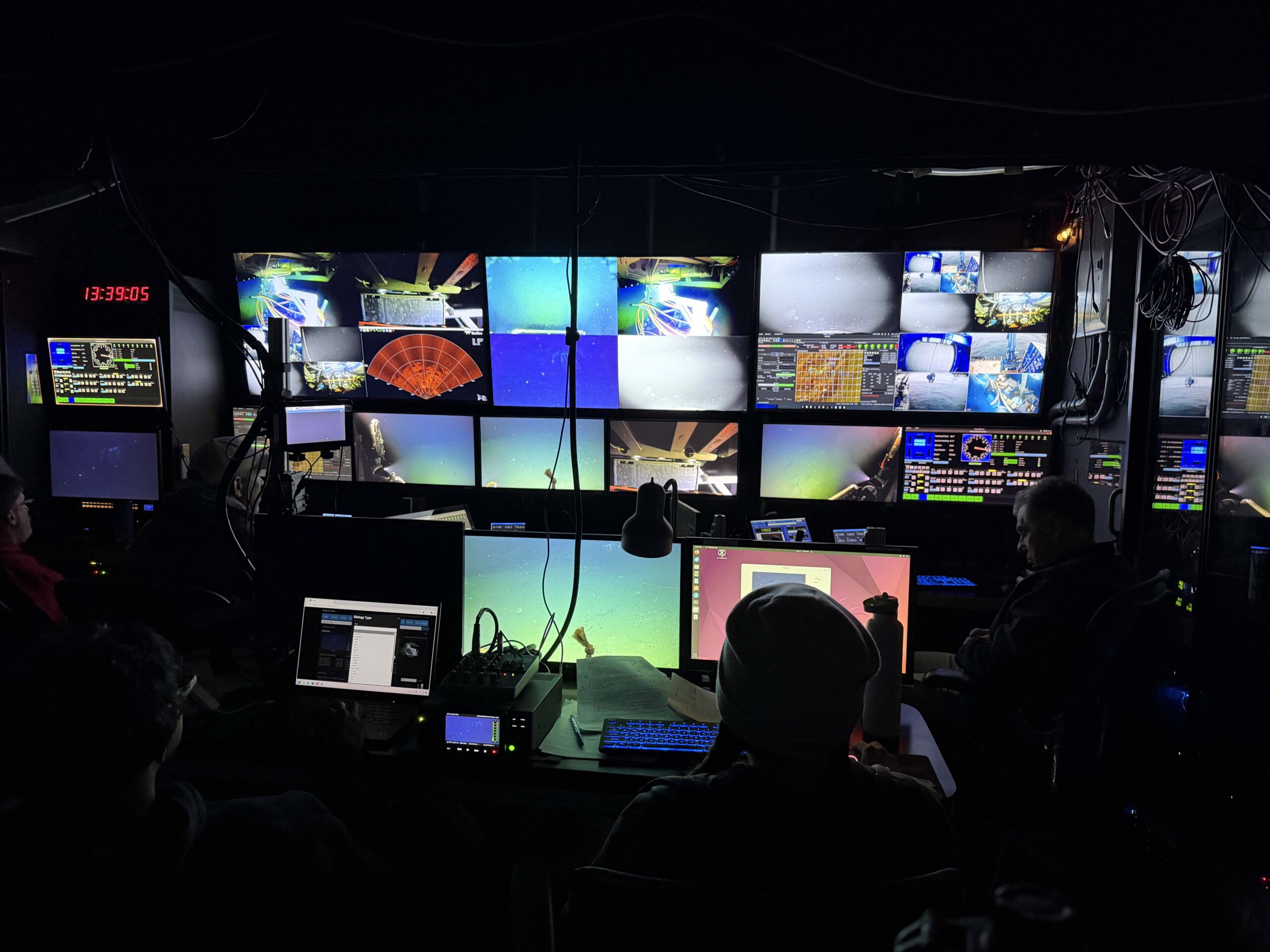
Some of the things that I saw on this trip I will remember forever. Being in the Jason control van and watching the Jason team and whoever was in the hot seat work was fascinating. And the images on the monitors from the Jason cameras looked like they were from another world. I had seen some of these things in pictures in Professor Kelley’s class, but seeing them here was something else entirely. Seeing the tubeworms and palm worms, the jellies, the fish, and the sharks was incredible. The hydrothermal vents and lava formations look like they belong on another planet.
I loved seeing and learning about all the different sensors that are cabled together and seeing the real instruments that collect the data that I had worked with in class. There were countless times when I would be off shift, maybe even supposed to be sleeping, and instead would be sitting in the back of the control van and watching the operations. My favorite parts were the scientific surveys, when one of the scientists would get into the hot seat and we would drive around looking at the deep-sea floor. I also loved getting to see the bridge and engine room on the ship. The engine room was cool because one of the oilers explained how the ship is powered by the diesel engines, but the propellors are powered by electricity generated by the engines, not the engines directly, making it more fuel efficient.
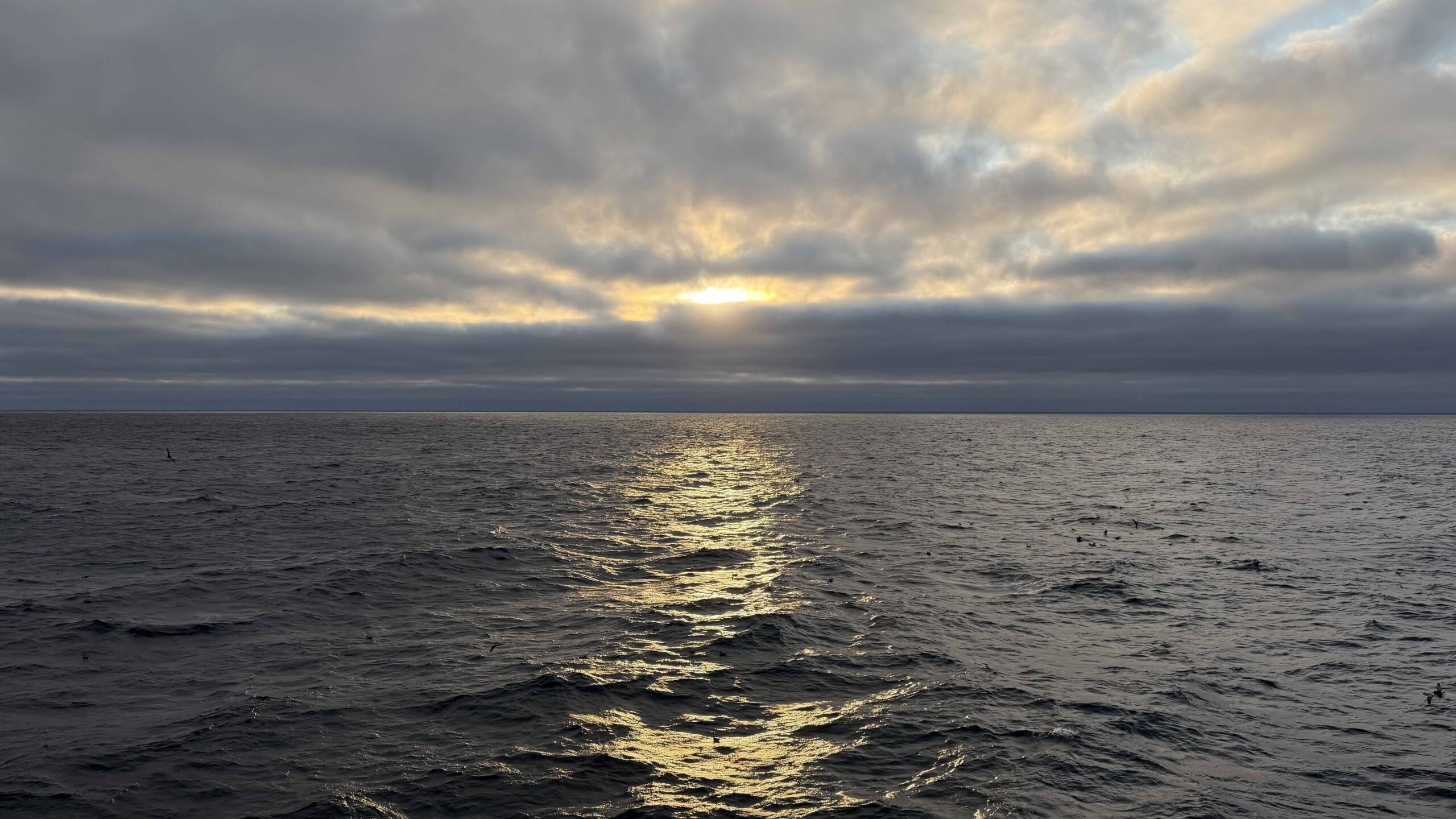
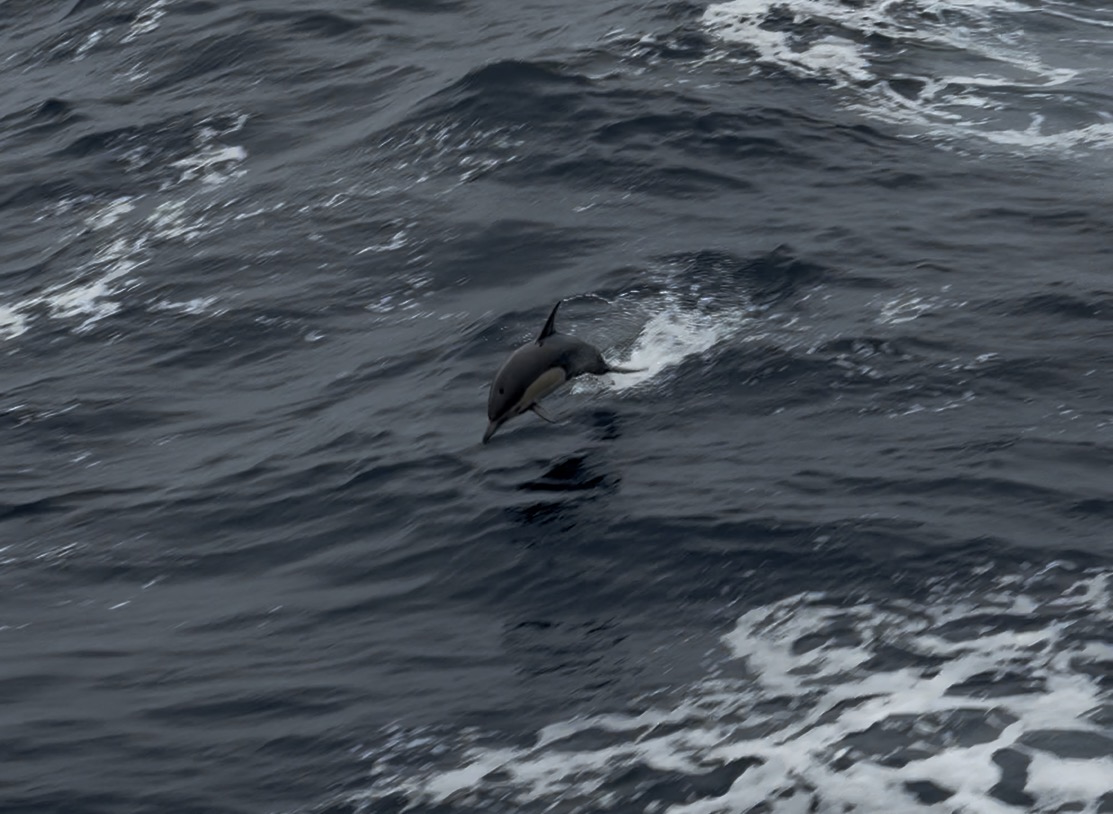
I was also just impressed with how hard everyone was working. People working long hours and even outside of their shifts, making sure all the operations were running smoothly and helping when they could. I got to see dolphins jumping out of the waves and a shark circling Jason as we pulled it out of the water in the middle of the night.
My family members have loved reading the blogs and watching the livestream. They also loved learning about the deep sea and the OOI science operations and texted me a bunch of questions they had about what they were seeing. For myself, I feel even more motivated to continue studying oceanography, knowing that I could get to do this as a job.
August 17, 2026
Sharks!
The early morning dive turned out to be quite entertaining. Jason was going into the water right as my shift was beginning. We were picking up a shallow profiler package. It is a hosted on a 12 ft across platform 200 meters below the surface that is connected to the sea floor by 2 long anchored cables. The package includes an oblong "pod" hosting lots of sensors that traverses to just below the surface and back to the main platform taking measurements with multidisciplinary instruments. A few months ago, the cable connecting the pod to the platform broke and floated away. The leading theory is that a shark bit the cable.
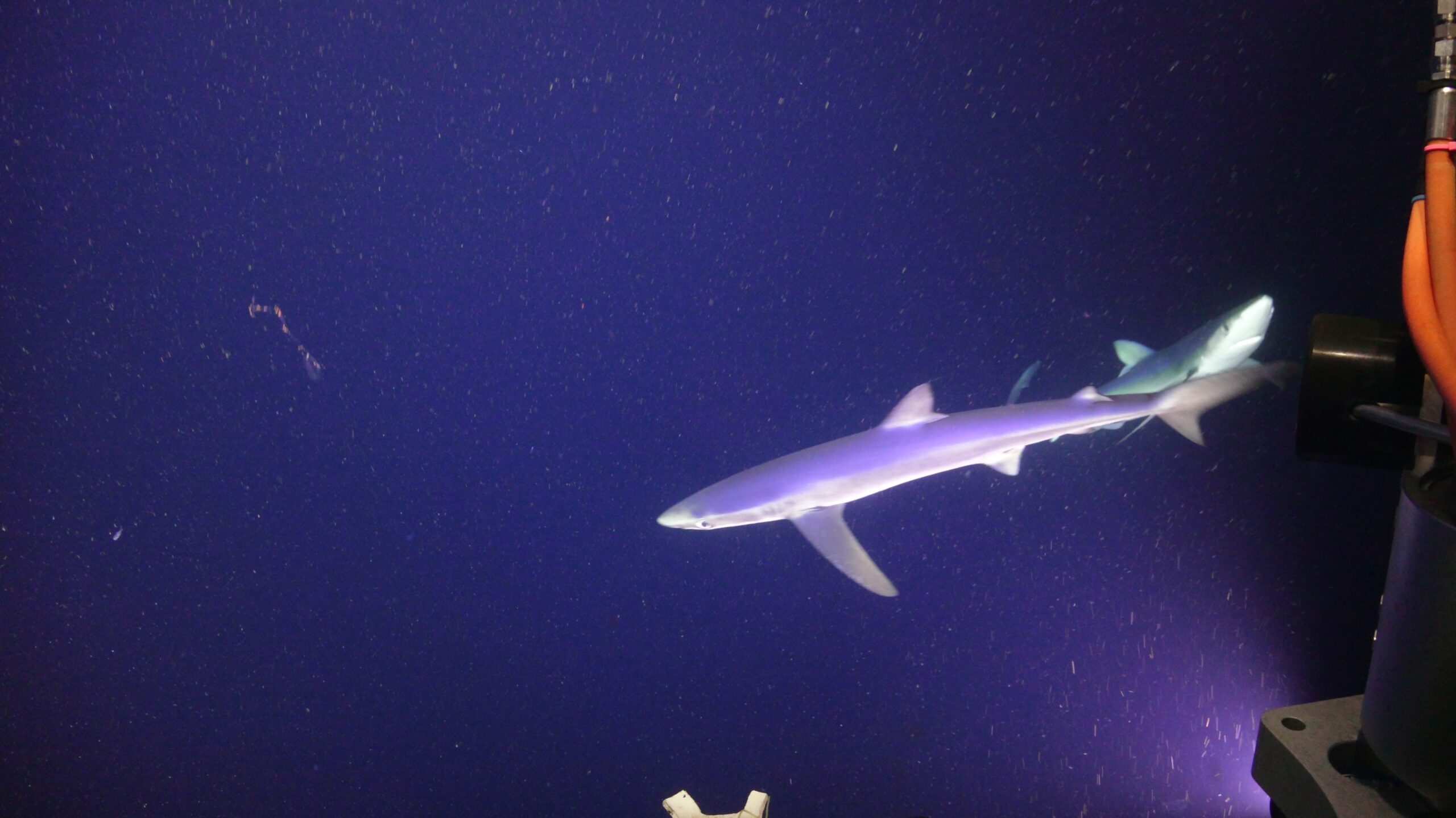
As Jason is starting its decent, we noticed something flash by the camera. Someone came into the van and yelled, “Shark!” We took turns looking down at the water off the side of the ship, and we saw it both with our own eyes at first, and then in the cameras as it got further down. There were two Blue Sharks, and one of them took out one the of the lights on the top of Jason.
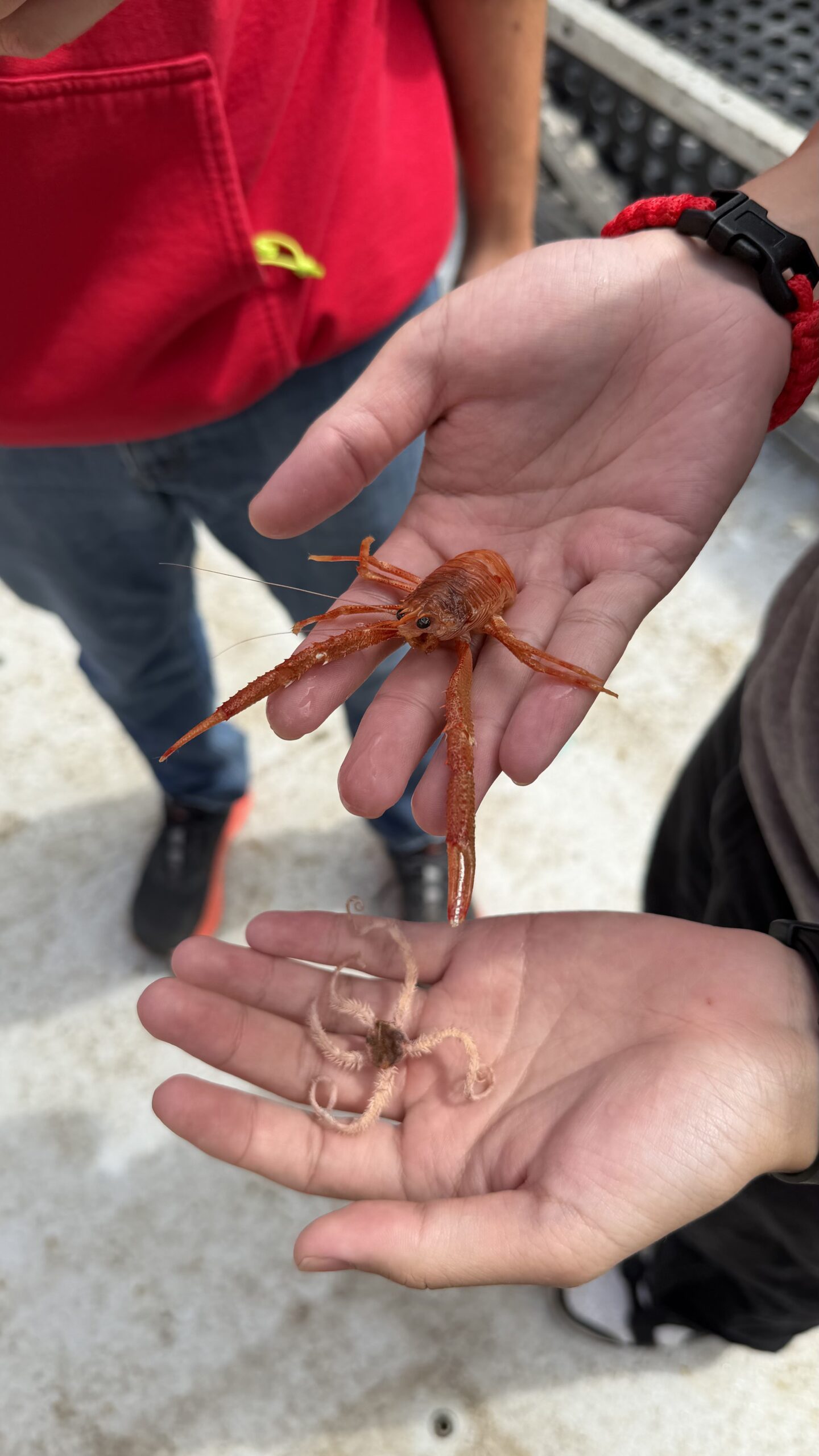
When we got down to 200-meter depth, the shallow profiler platform and pod was covered with sea life, including anemones, mini lobsters, and other biology. Jason undid the latches connecting it to the platform, and we recovered what was left of the package back to the surface. On the way back up we saw the sharks again. They were swimming back and forth, inspecting the ROV. At the surface, there was a school of fish, and I got one last glimpse of the shark before it disappeared into the night.
After breakfast I took my last morning nap of the trip, and it was just as glorious as the first. I woke up right before lunch and headed up to the galley.
After lunch, the crew opened the merch locker, and we got to buy R/V Revelle clothing. They had hoodies, crewnecks, shirts, hats, mugs, collectable coins, and even playing cards. I got a hat and a t-shirt and proceeded to wear the hat the rest of the day. I got a couple of hours of work done on the computer, until one of the lab techs came over and told us they had some educational experience for us to gain. She then handed us over to one of the APL engineers, who gave us scrubbing equipment to wipe down the recovered instruments. One of the pilots of Jason came out on the back deck to talk with us while we scrubbed away.
The air smelled like a mix of fish and wet dog, but it was a really nice day with some of the first blue sky we had in a few days, so it was worth it. Plus, as the lab tech said, we were gaining valuable maritime experience. Besides one of the students who left to go to the control van once the task was clear, I got slack from the others from being the first person to leave the deck. But I was hungry, so I went into the leftovers fridge and grabbed a pulled pork sandwich from the previous day’s lunch. It was incredible, even with a soggy bun and only partially reheated.
After my pm shift, I grabbed a pair of expensive binoculars that Professor Kelley brought on board and headed to one of the higher decks to go look for marine mammals. They were some REALLY nice binoculars used previously to watch for whales during installation of the main RCA cable. There were a handful of other boats around, and I could see the fishing nets and cranes. I also got to see a lone dolphin (I think it was a dolphin) jump up out of the waves a handful of times. It was one of those stunning moments in nature that made me appreciative of this opportunity I was given.
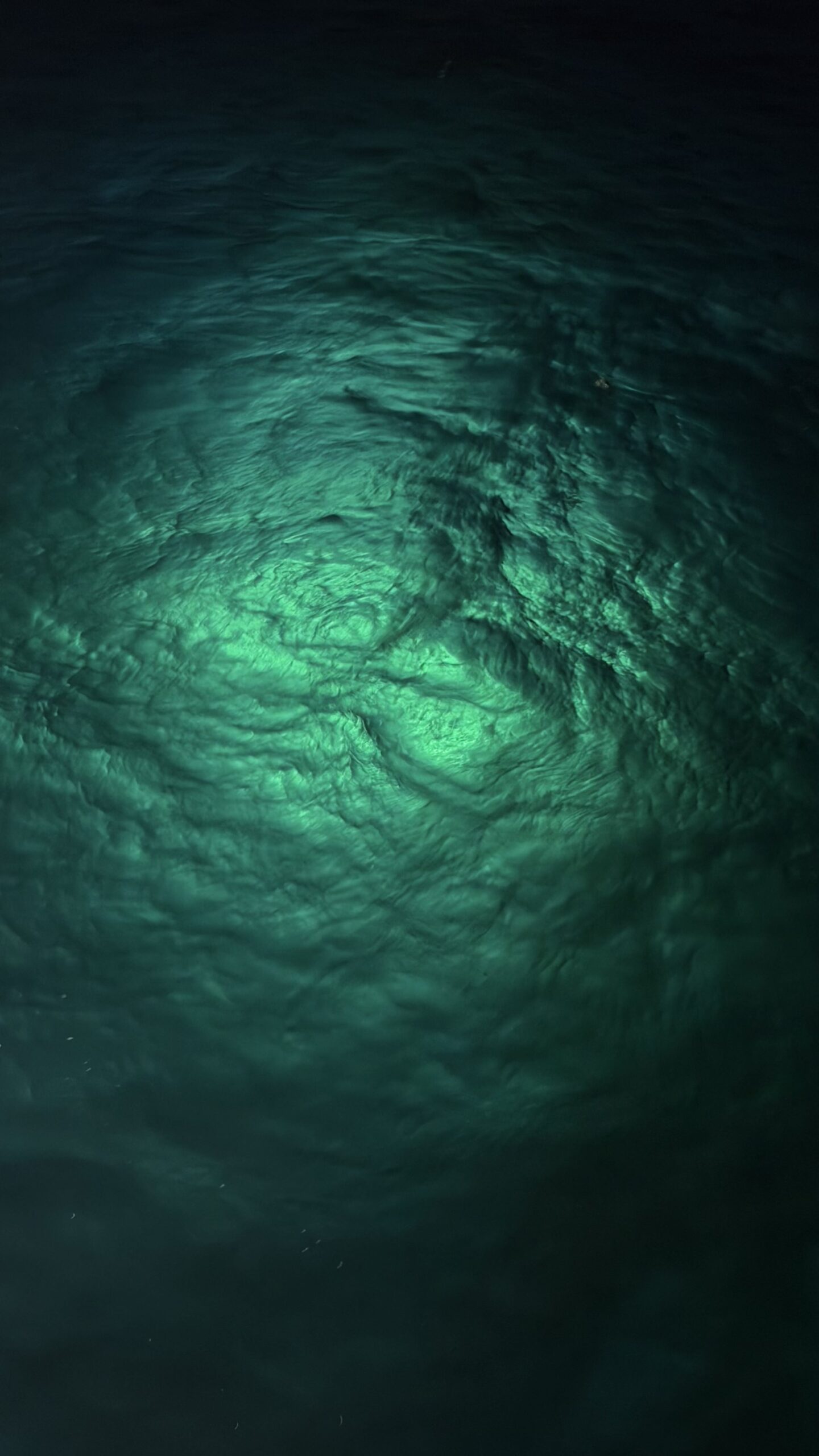
There was an issue with the last Jason dive, so Alex and I watched as Jason rose up out of the water, and the lights lit up otherwise pitch-black water. Right before I fell asleep, I saw a text saying that we didn’t have to wake up for our morning shifts, which was music to my ears (technically eyes but the meaning is the same). Tomorrow we will come into port and then head back to Seattle on Wednesday.
August 16th, 2026
Not too much happened during the morning shift today. As I got into the control van, the operation on the seafloor was wrapping up, and within minutes it was time for the long trip back to the surface. We were at Axial Base, or the base of the volcano, so at over 2,600 meters below the surface it takes around an hour and a half to come back up. After the dive, we went to the Main Lab until breakfast. After breakfast I took an amazing and much needed nap and woke up just before lunch.
During lunch I got to talk to a couple of crew members. One told me about how he had worked on around 30 other ships before the R/V Roger Revelle. We also talked about hikes in Washington state, and another crew member told me about his passion for photography. After lunch, we had our second safety drill of the trip. The alarm went off, and then the first mate got on the intercom and announced that it was a fire drill. We all got our life jackets and immersion suits, and the science party mustered (gathered) in the Main Lab while the crew practiced putting out a fire.
The ship had started its’ transit soon after the morning dive ended. We had 16 hours of sailing east to the Slope Base site, closer to the shore. That meant an unusually large amount of free time. I was going to start working on writing the blog, but it took little persuasion to convince me to play table tennis with another student, TJ. I also spent a lot of time out on the deck of the ship, looking for whales or dolphins.
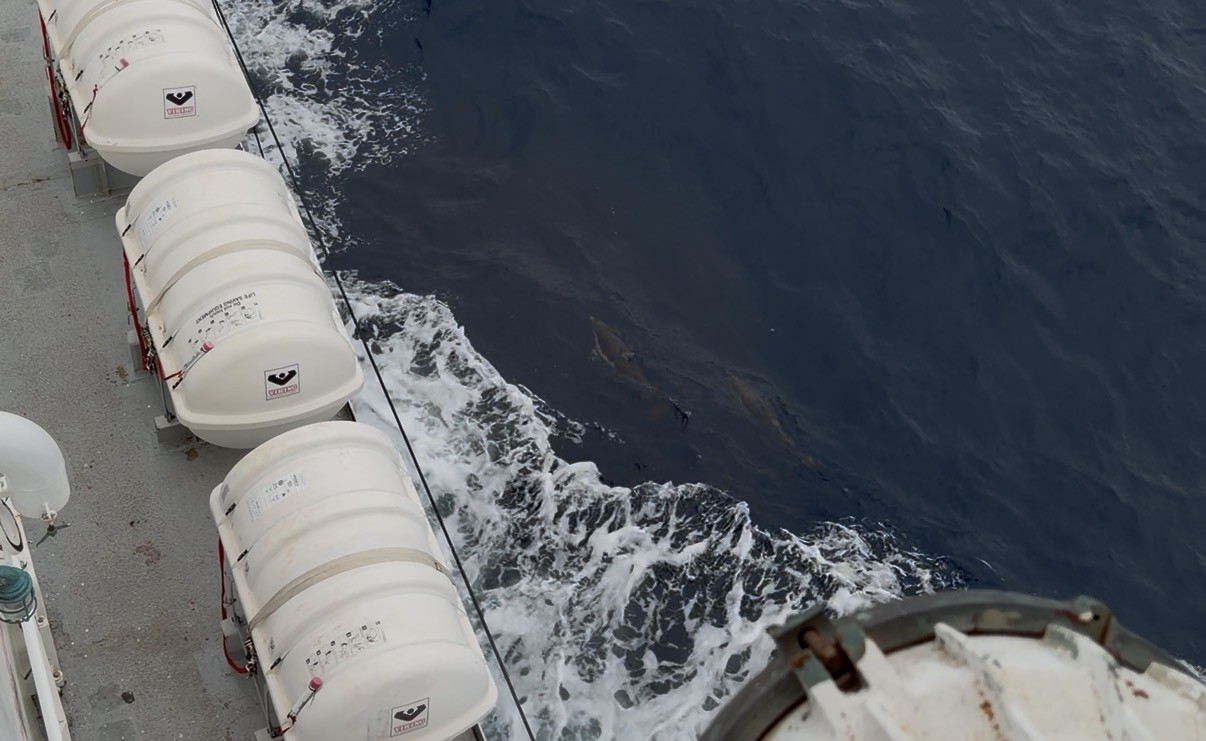
A couple times during the trip I had been either asleep or in the lab when someone would report seeing dolphins, and I was determined that today was going to be my turn. After looking out at the open ocean for quite a while, I gave up in defeat and headed back inside to write. I had some forms I had to fill out for school as well, and a few other tasks that felt good to finish. When another person reportedly saw dolphins just of the side of the ship, I hurried outside to watch, but by the time I got there they were gone. I went back inside to finish my task but then went back out with headphones and the intension to watch for as long as I could.
One of the crew, the Bosun, brought out a barbeque on back deck, and started grilling tri-tip for the Sunday diner. I was looking out at the water on the back deck, still searching for dolphins, with BBQ smoke in the air and the sun shining through the clouds. The lead engineer of the trip, James, came out on the back deck with a pair of binoculars. I talked to him for a few minutes while looking out at the water. He works at the UW Applied Physics Lab and spends most of his time working on the Regional Cabled Array project. He is also really into photography. He showed me his some of his photos from previous VISIONS trips. Last year a whale came up less than a hundred feet from the ship, and he got a great shot of it. He also got a bunch of dolphins jumping out of the water at the same time. Again, no wildlife sightings.
After dinner the student split into two groups and got tours of the bridge and the engine room. I went to the bridge first, and as soon as we got up the first mate told us there were dolphins off the side of the ship! We all hurried to the side and had an amazing view of the dolphins jumping out of the water and surfing in the wake of the ship. The bridge runs the width of the ship and is only a couple of meters long and has windows all around. After we finished admiring the dolphins, the first mate showed us around, and explained what all the different screens and instruments were for. I had come up to the bridge all ready, but this time I got the detailed explanation of everything, which was pretty cool. The ship can be driven manually from many locations throughout the ship, but also has multiple autopilot modes of varying complexity driven by the computer.
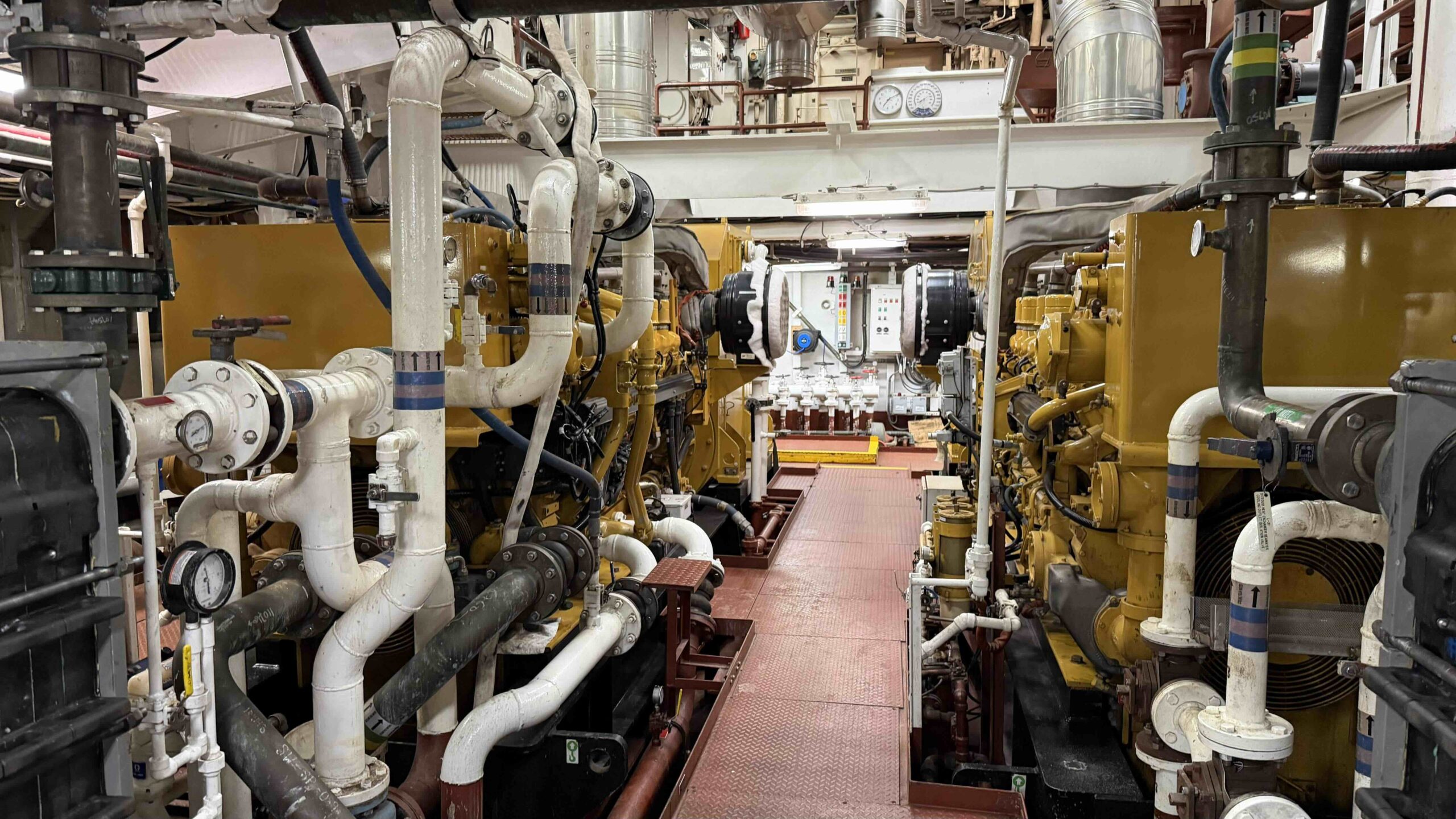
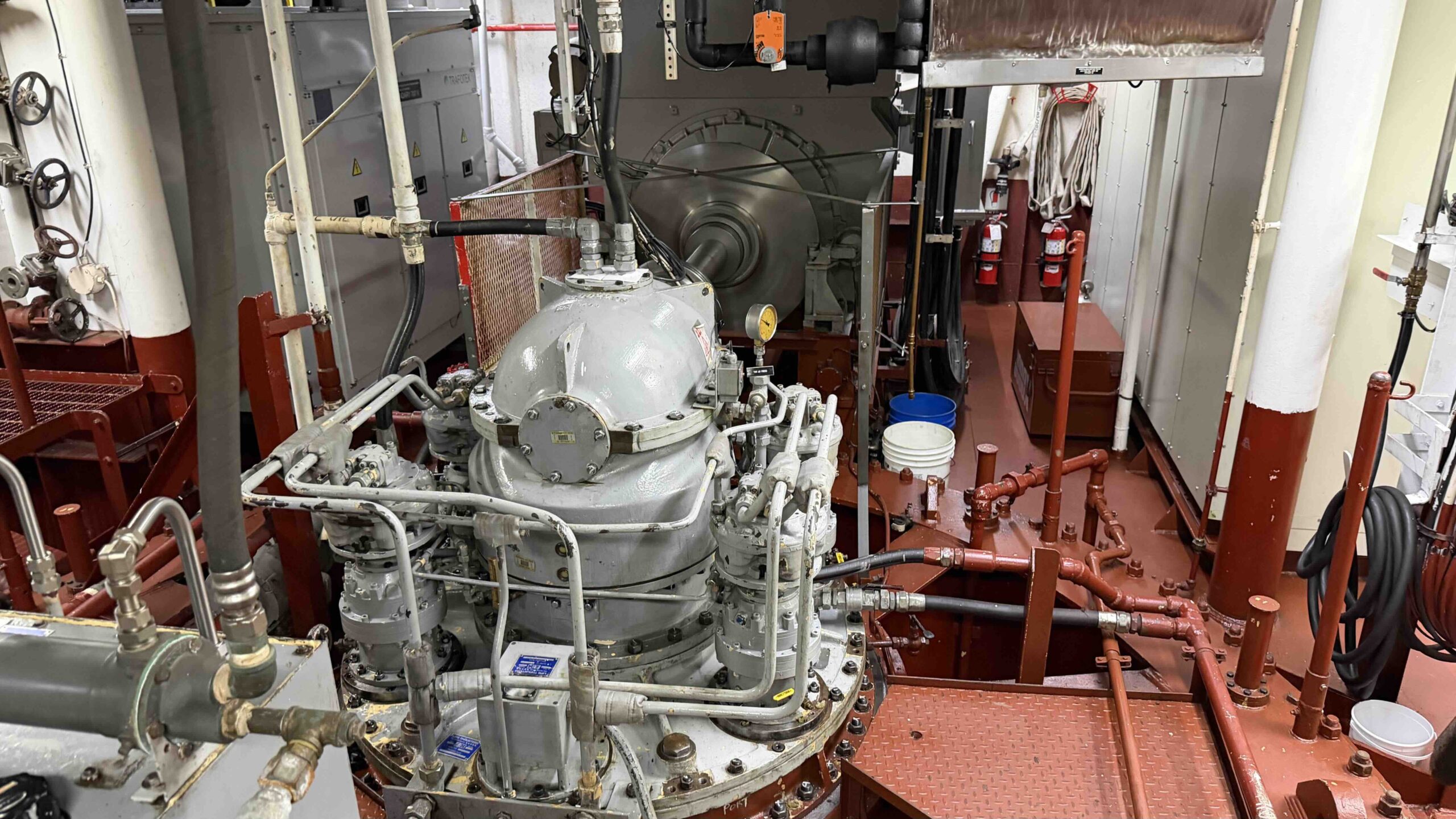
After the bridge, we headed back down to the galley, where the groups swapped. One of the oilers took us down all the way to the bottom floor. We were given both earplugs and noise canceling earmuffs for the tour, as the engine room is extremely loud. He took us through the engine room, pointing at different things and writing short explanation on a white board because talking was pointless. He also showed us the control panels and the workshop. The ship has 4 diesel electric engines, two big and two small. This means that the engines are used only to generate electricity, which powers the rest of the ship. This includes the propellers, which we also got to see the top of the system connected to the power. This makes the ship very energy efficient compared to a normal diesel ship. The oiler also explained how the ship usually only uses two engines at a time, and that this ship has so much power that if it tried to go full speed with all four generators, the drag and the integrity of the hull would be the limiting factor, not engine power. There are two propellors towards the back of the ship, and a blower that provides another source of push at the front of the boat. All three can come down and rotate 360°, so that the ship can do complex maneuvers. The ship also has the ability to stay in exactly the same place, with all three pointing different directions and firing occasionally.
After the tour we went back to the Main Lab. A couple of students and I talked to the other members of the science party about their undergrad experiences, internships, and other oceanographic matters. It was really nice to sit back and learn, but also joke around with everyone after lots of very stressful and tiring moments. I then made myself head to my stateroom and go to sleep, because I had another shift at 4 am. I loved seeing the dolphins, and now it’s time to see a whale properly. Ive been told the chances will be better as we get closer to shore. I am very hopeful.
August 15th 2026
I have been relying on naps to get me through the last 24 hours. I went to sleep around 8:30 pm on the 14th, but then woke up at 9:30, 9:40, 10:00, and then got out of bed at 10:30. As per my last blog, the dive over night was going to be poking into a hydrothermal vent, testing the temperature, and then using an IGT (isobaric gas tight). An IGT is a device used to sample fluid from the vents and keep it at the pressure of the seafloor, which at this site is with 1500 meters of water overhead. The keeps the gases in solution. When the ROV Jason tested the temperature of the hydrothermal vent with a temperature probe, it read 341°C, or 646 °F.
While I got up at 10:30, that part of the dive didn’t happen for a few hours. So I go back in bed around 1:30, then woke back up for my 4 am shift. The part of the dive during my shift was less exciting that the previous parts, as the engineers were connecting cables and moving equipment around. It was a bit of a struggle staying focused, but I made it to breakfast at 8:00 am. Along with the normal offerings of fresh fruit, eggs, sausage, and bacon, was French toast, which was a great way to end the early morning. I went to bed, and slept for another hour and a half, until another exciting dive was underway.
This dive included a dedicated 3 hour time frame to drive around the site. We were back at International District. We checked back on Diva, the name of the vent hosting the resititivity probe, before moving on into the blue. Here, the seafloor is basalt that was formed when the lava from the eruption of the seamount in 2011 cooled. When the lava was moving at high speeds, similar to a river, it formed sheets of the rock by rapidly cooling. These sheets are very brittle due to quenching as the 2000°F lava hit near freezing seawater, look similar to obsidian in that it is very glassy, and easily shatter.
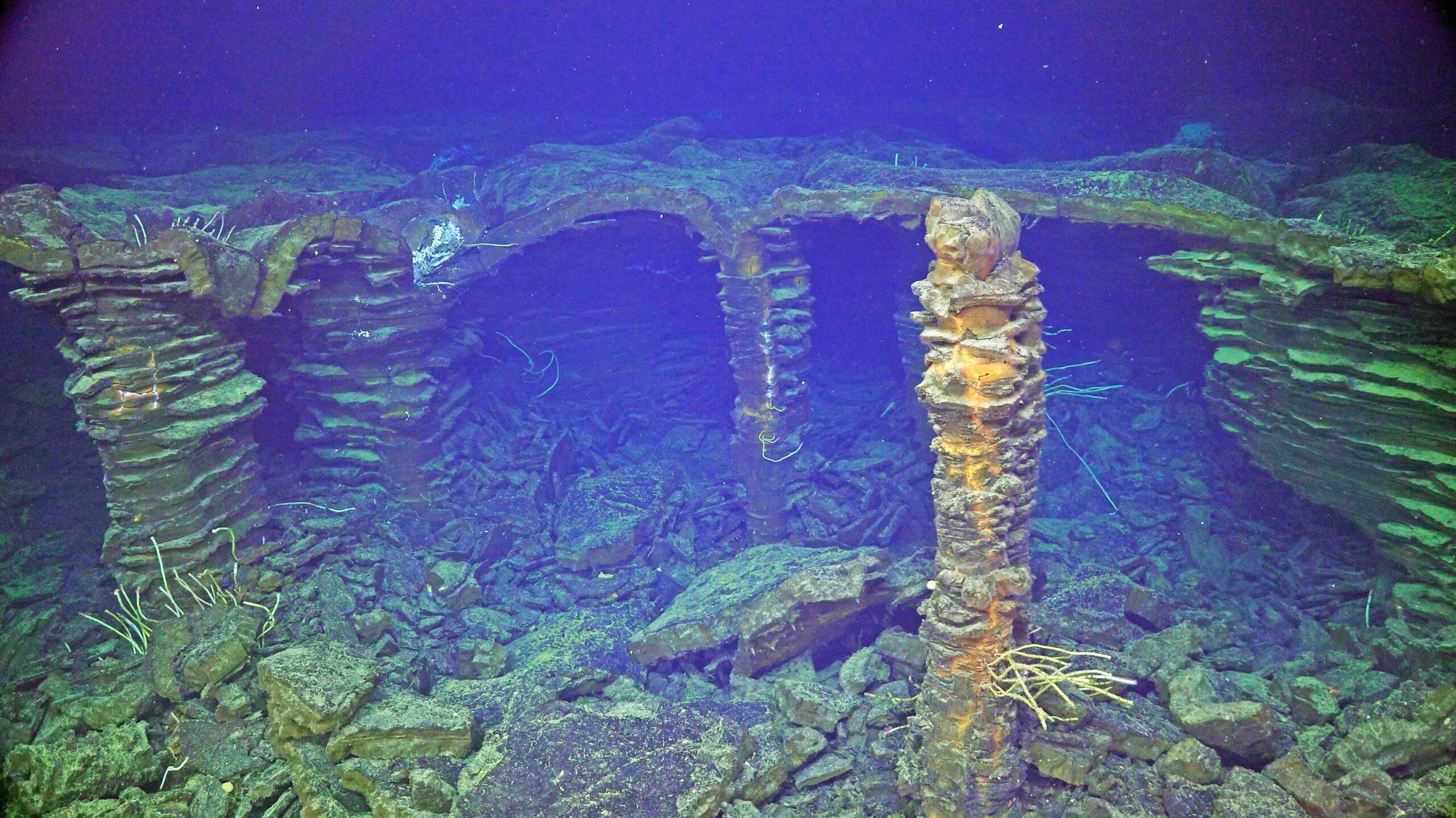
When the river of lava fills depressions forming a lava lake and the top layer cools into the rock, the lava below can drain elsewhere, creating caves and arches out of basalt that look like they were manmade, called collapsed lava flows.
When the lava cools slowly, allowing larger crystals to form, the rock is called pillow basalts due to its pillow-like shape. Driving around, there were lots of fascinating rocks everywhere. There were also many new vents that we got to see. Some were no longer active, and either sparse or covered in dead worms. There was one vent that was covered in blue, furry-looking bacteria. El Guapo is the name of the largest vent in Axial Caldera that stands about 18 meters tall and was covered in life. At the top, there were multiple orifices shooting out the extremely hot vent fluid.
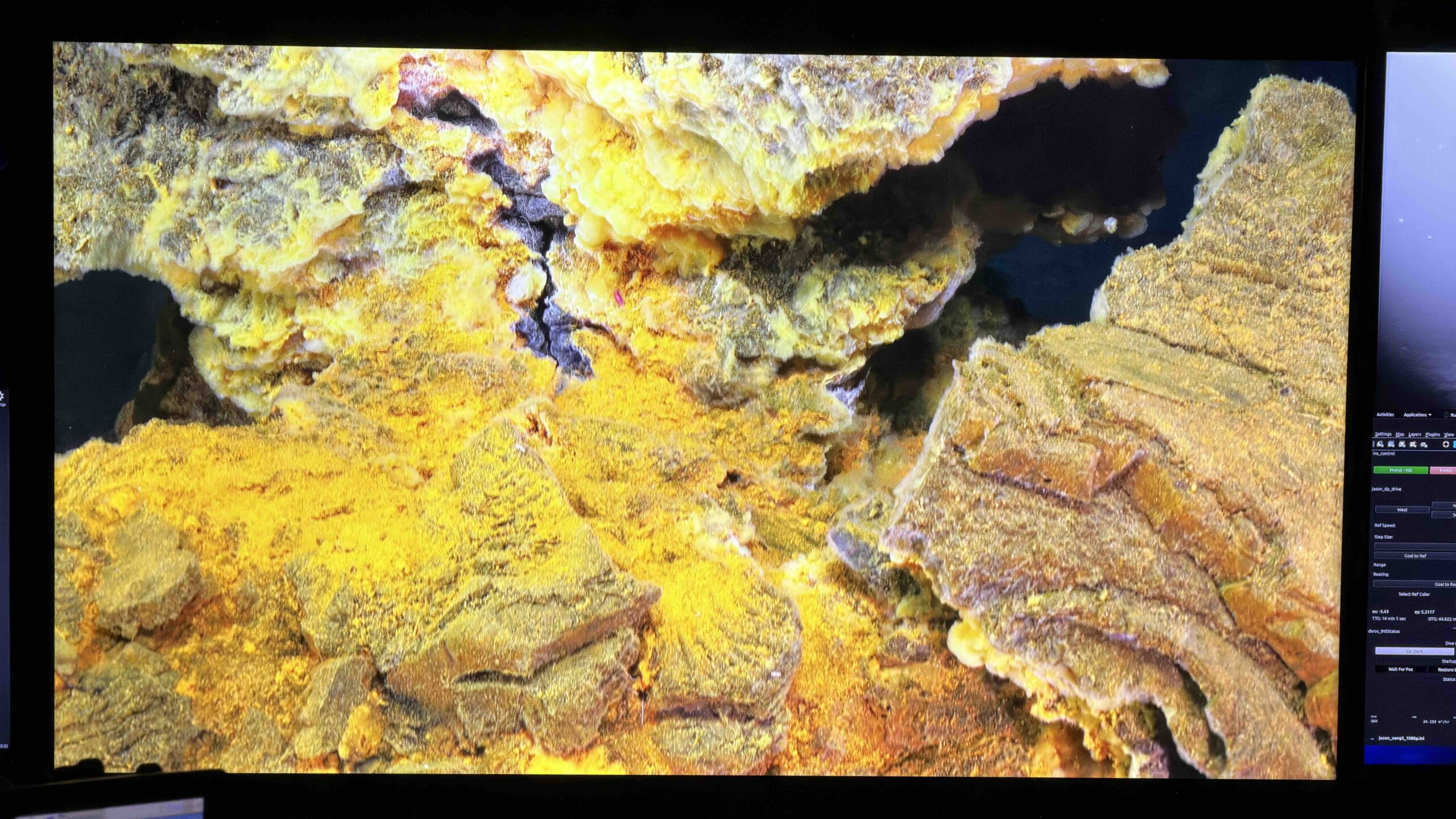
During the survey, we saw the collapsed lava flows, with its pillars and arches. We saw a vent covered in bright yellow bacteria, with a deep purple vein running through it. Then we got to the lava cavern, which is the cooled river of lava. It was so wide we could drive through the middle and not see either edge. The lava had been moving so fast that it had cooled into a perfectly flat layer of rock with ridges running straight with the flow of the lava – a sheet flow. There were yellow bacteria in all of the cracks. In some parts, where vent fluid was seeping up, there were tubeworms and even clams growing, and spider crabs walking around looking for dinner.
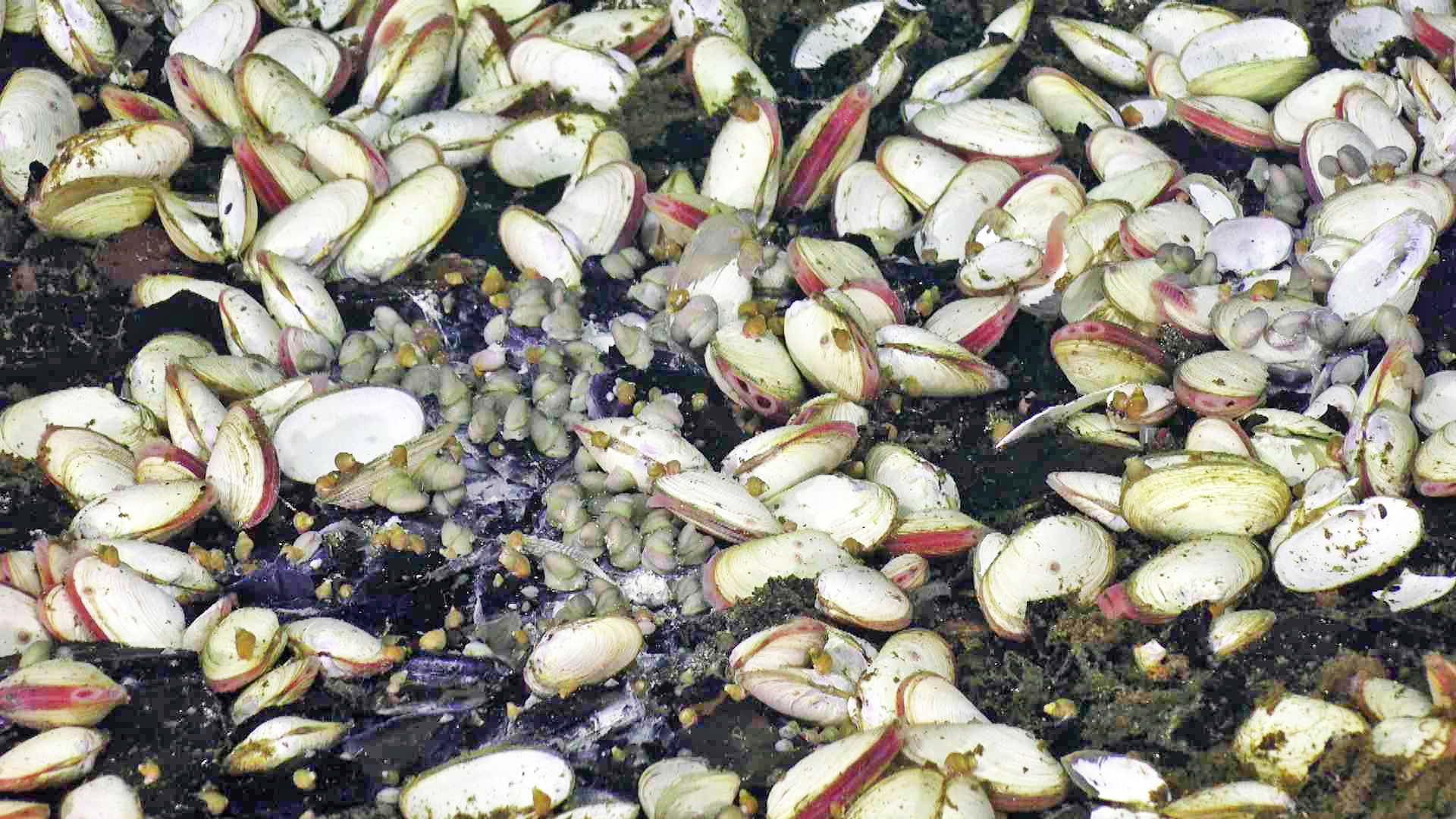
The clams growing here was the biggest and most alive looking clams out of all the sites we have been to. The tour ended with the vent called Skadi, named after a Norse god of winter. Right after the last eruption, the vent was pumping out billions of snow-white bacteria, so much so that it looked like a snow blower. It had stopped blowing out bacteria a handful of years ago, but I had seen pictures of it when I had taken Professor Kelley’s class back at UW, and it was cool to see the actual location.
The tour eventually had to end, and I headed back to the Main Lab for the student meeting. One of the instruments collected yesterday, the RAS/PPS had water samples that needed to be collected, so six of us along with Mitch, an RCA oceanographer, spent three hours processing and preparing samples to be later analyzed in a lab. My role was weighing all of the samples. A normal electronic scale could not be used due to the gentle rocking of the ship, so we used a balancing scale with weights, which worked for a long time until the rocking intensified as we were transiting to a new dive site.
The pm shift was uneventful, as the dive started an hour and half into the shift, so most of it was spent descending the 1500 meters, and then the long process of finding a safe, flat place to place down equipment followed by lots of moving cables around.
I got a game of ping pong in before sitting down to write the blog, and I am quite excited for bed. I will double check my alarm before going to sleep, but I am looking forward to sleeping for longer than 2 hours at a time. Tomorrow there will be a few dives before we have an 18-hour transit to the Slope Base site, which will take up most of the day. It is crazy to think that the cruise is already coming to an end. I have met so many talented, nice, funny people, form the science team, the Jason team, and the crew. Talking to one of the science team members who has been on these cruises many times before, was sharing how it is always sad getting off the boat and going back to everyday life, without interacting with so many of the people that you get really close to sharing 24 hours a day in close quarters. I will miss a lot of these people, and I hope to make the last few days count.
August 14th, 2026
I got to sleep in today! For the first time in a few days, I slept in until 3:40 am. After getting ready, I went up to the control van expecting it to be almost time to start the dive where we would get to see more hydrothermal vents. Unfortunately, Adrian, one of the students on the shift before me, informed me that the prior dive was still ongoing. The new junction box at the Central Caldera site that acts as the power module for all the cabled instruments had been put in a position that put too much tension on one of the cables, so it needed to be moved a bit. However, this was only realized after a few cables had already been attached. And even disconnecting or connecting one cable takes a while. In a multi hour detour, they had to detach three cables, relocate the junction box, reattach those three cables, and then get the other three cables attached to the old junction box and connect them to the new box. So, the dive that I was looking forward to starting at 4:15 am began as I woke up from a nap at 11:00 am. Time is built into the cruise plan for complications such as these, so it is not a major issue, but by the end of my shift the Jason crew and the lead engineer from UW were exhausted after being up all night.
That is one of the things that I have been very impressive on this cruise. The entire science party is constantly working during this shift, and often even beyond. People definitely look tired from odd and short sleep schedules, yet everyone is pushing through as best as they can and working incredibly hard. Especially the chief engineer on the science team, who seems to be working at all hours of the day.
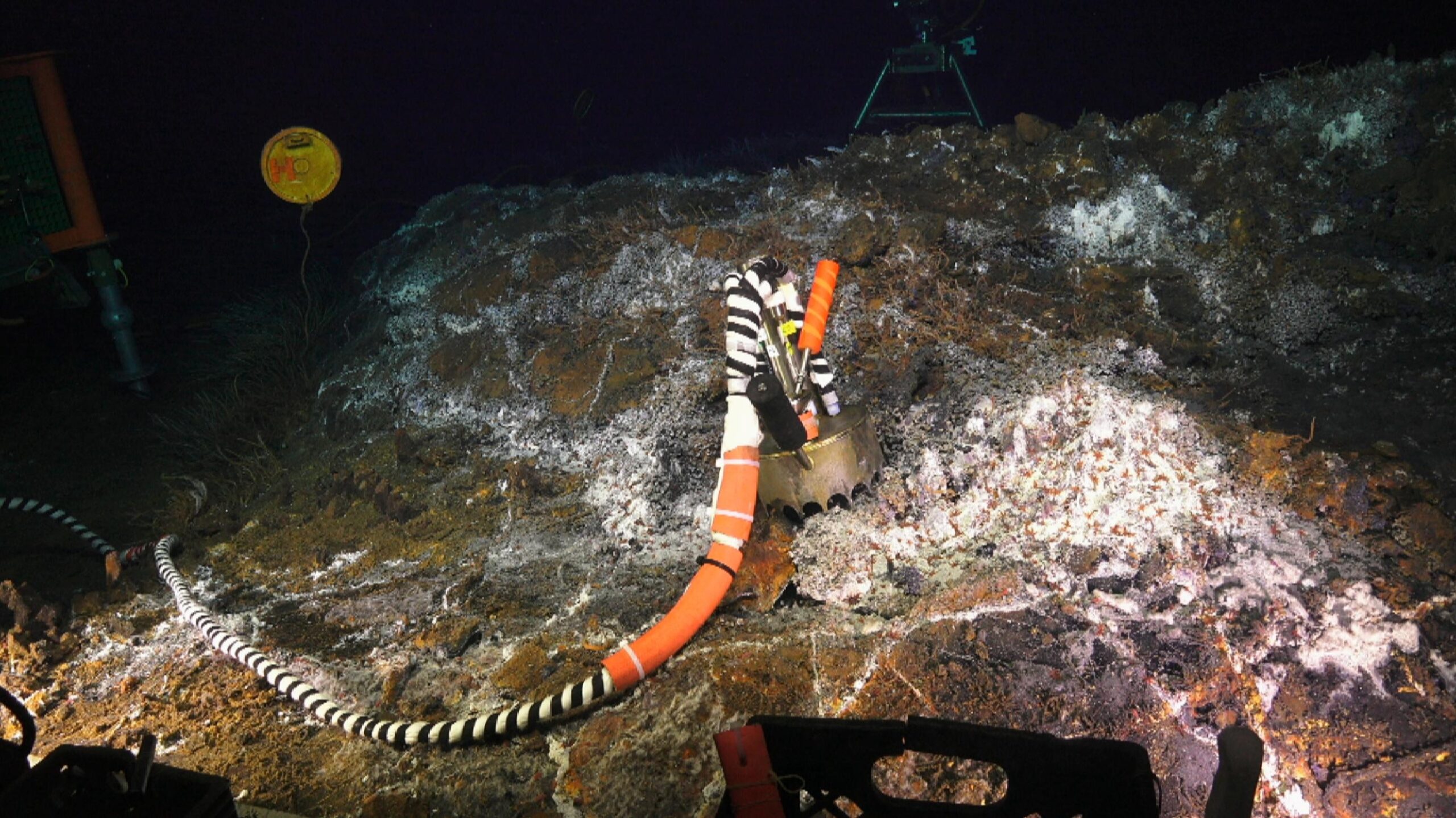
After lunch I headed to the control van to watch the dive. We were diving at the International District site, where there are multiple hydrothermal vents. The goal of this dive is to replace a complicated instrument called a Particulate DNA & Hydrothermal Fluid Sampler. It takes in water from the vents, but because vent fluid can reach 350°C, which would melt the plastic in the sampler, it takes a long time to find a seep of fluid coming from the seafloor that is within the acceptable range.
I also got my laundry done for the first time on the boat. If you go two levels below the main deck and briefly get lost, a laundry room exists with two washes and four driers (as the drier takes over twice as long). I had to come back 15 minutes after finding the room to get an open machine, but a laundry machine on a boat 300 miles off the coast of Oregon works the same as a washing machine most everywhere else. I had timed everything so that the dryer would finish at 3:45, giving myself plenty of time to grab it and still make it to my shift early. But as I opened the door and reached inside, it was still wet, and my heart sank. Luckily there two other students on my shift and only two of us are doing work in the Jason van at a time. I was able to tell them, and everything was fine, but my genius plan had failed.
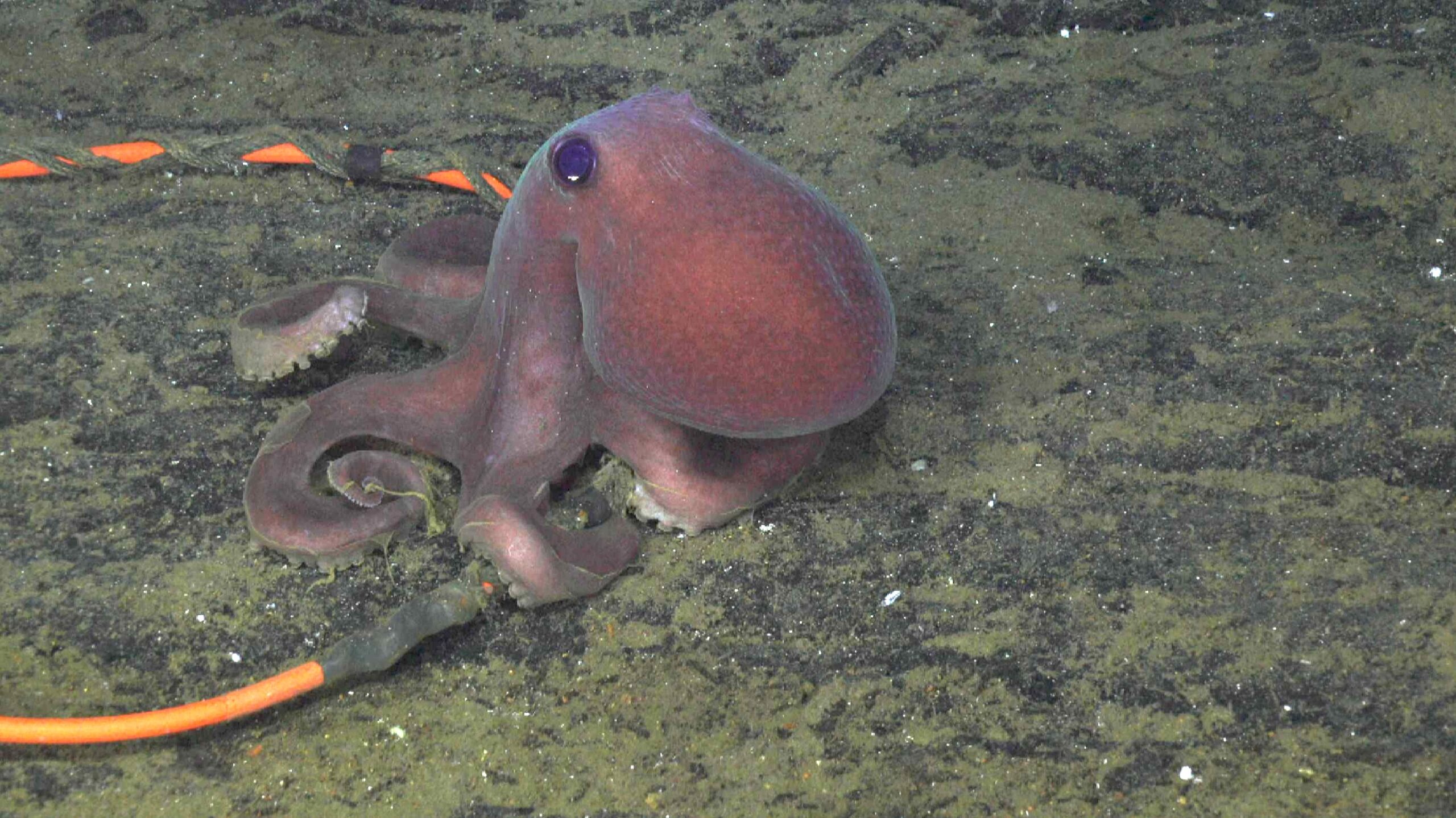
The site that we were diving at is called International District. In the dive during the pm shift, the goal was still to find a vent seep that was around 20 to 50°C that we could sample. I had been looking at the monitor in the lab since lunch and by the time we got into the control van, they were still searching. During our shift, there were three viable spots that the cable connected to the instrument could reach to, and besides the vent that was hundreds of degrees, there were only three strong seeps with the strongest only reaching around 10°. There was also an Octopus that came up to the ROV. It was big and reddish-purple, and stared at us with its giant eyes.
I am going to try to get an hour or so of sleep. The next dive will include poking a vent with a stick. I am very excited. They say there is a reason to poke it with a stick, something about clearing out space for a delicate sensor, but I am looking forward to the stick part.
August 13th, 2026
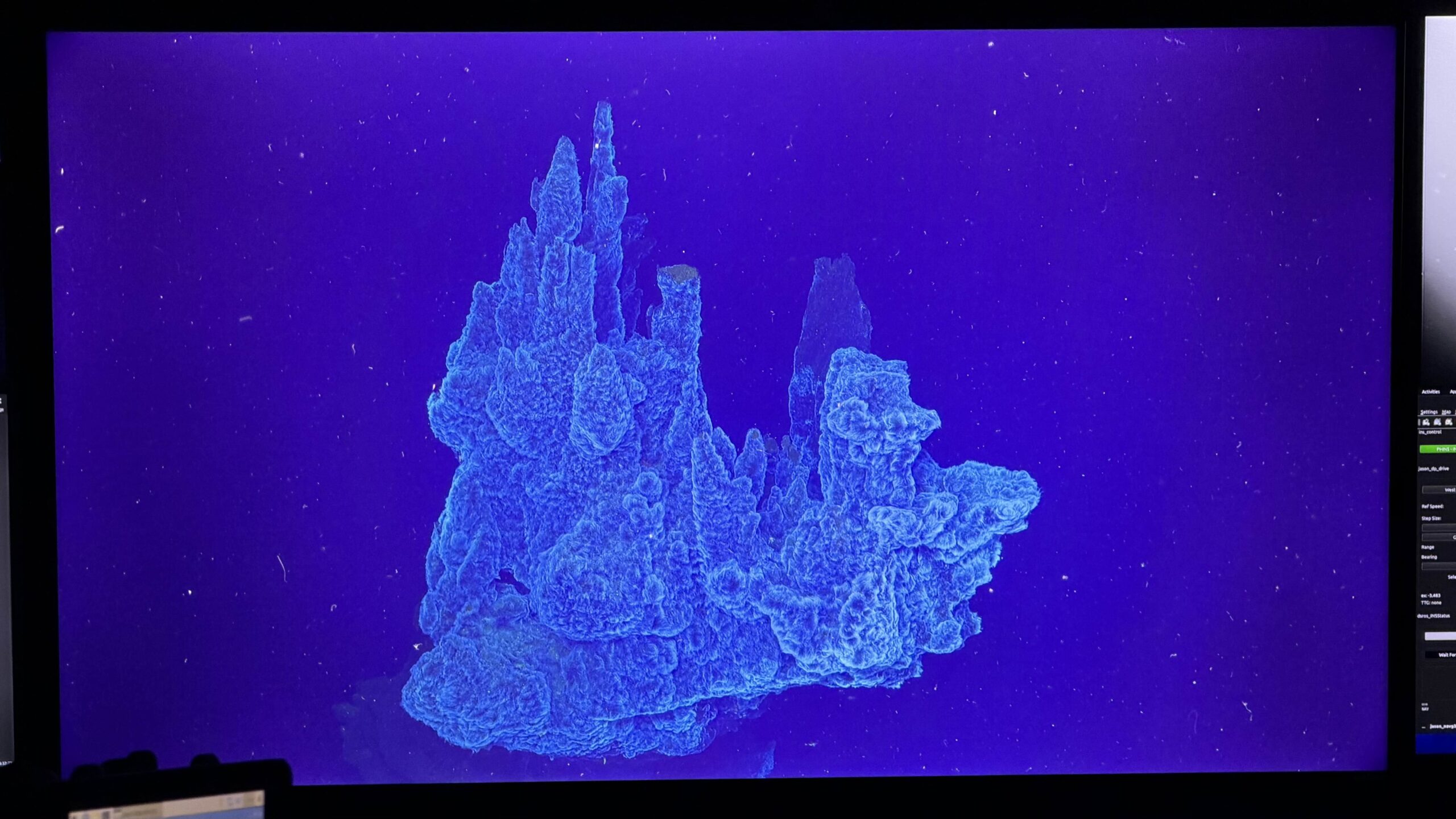
We have officially reached the caldera of Axial Seamount. At 2:40am, I was woken up (as I had asked to be) as the dive to replace one of the CTD instruments on the floor was underway. By the time I got up to the control van, the part of the dive I was most interested in was underway. We were doing another scientific survey, and this time it was of one of the hydrothermal vents, or a black smoker. This one is called the Mushroom vent in ASHES hydrothermal field. It is about 4 meters/~14 feet tall, and maybe 1-2 meters in diameter. It was covered with tubeworms, which have long wide casings/tubes with bright red plumes on the end of the tubes. The worms have no digestive system and rely on chemosynthetic bacteria for energy inside of them. This means that the bacteria use carbon dioxide, sulfur-rich gasses, and oxygen for energy, instead sunlight that photosynthetic organisms use for energy.
Hydrothermal vents are one of the most extreme environments on Earth that life thrives in. The surrounding sea water is near freezing, and the fluids coming out are extremely hot. As seawater migrates through cracks in the seafloor, it is heated up the magma chamber below. As temperatures increase, the fluids become acidic and metals are leached out of the rocks the fluids are flowing through. Gases such as CO2 rising from the magma are entrained in the hydrothermal fluids. When the dissolved metal- and CO2-rich fluids enter the cold ocean water, fine-grained metal sulfide minerals (such as pyrite) precipitate out of the fluids, forming the black smoke appearance, as well as continuing to build up the vent.
I got to watch as Jason slowly surveyed the vent, recording in 4K and taking stills. Then my shift began, and as I got into the sea to begin logging the ROV’s actions, the job shifted to turning of a CTD and returning to the surface. We were working at 1,500 m depth, so it took around an 45 minutes to get pulled back up.
The rest of the morning shift was quiet as we were transiting to a different site. After breakfast I took a needed three hour nap and woke up just before lunch. The afternoon was relatively uneventful. I got some work done on my laptop, played a bit of ping pong, and spent some time on deck looking out at the ocean. I still haven’t had any other sightings of whales or dolphins, but there are still a few days left.
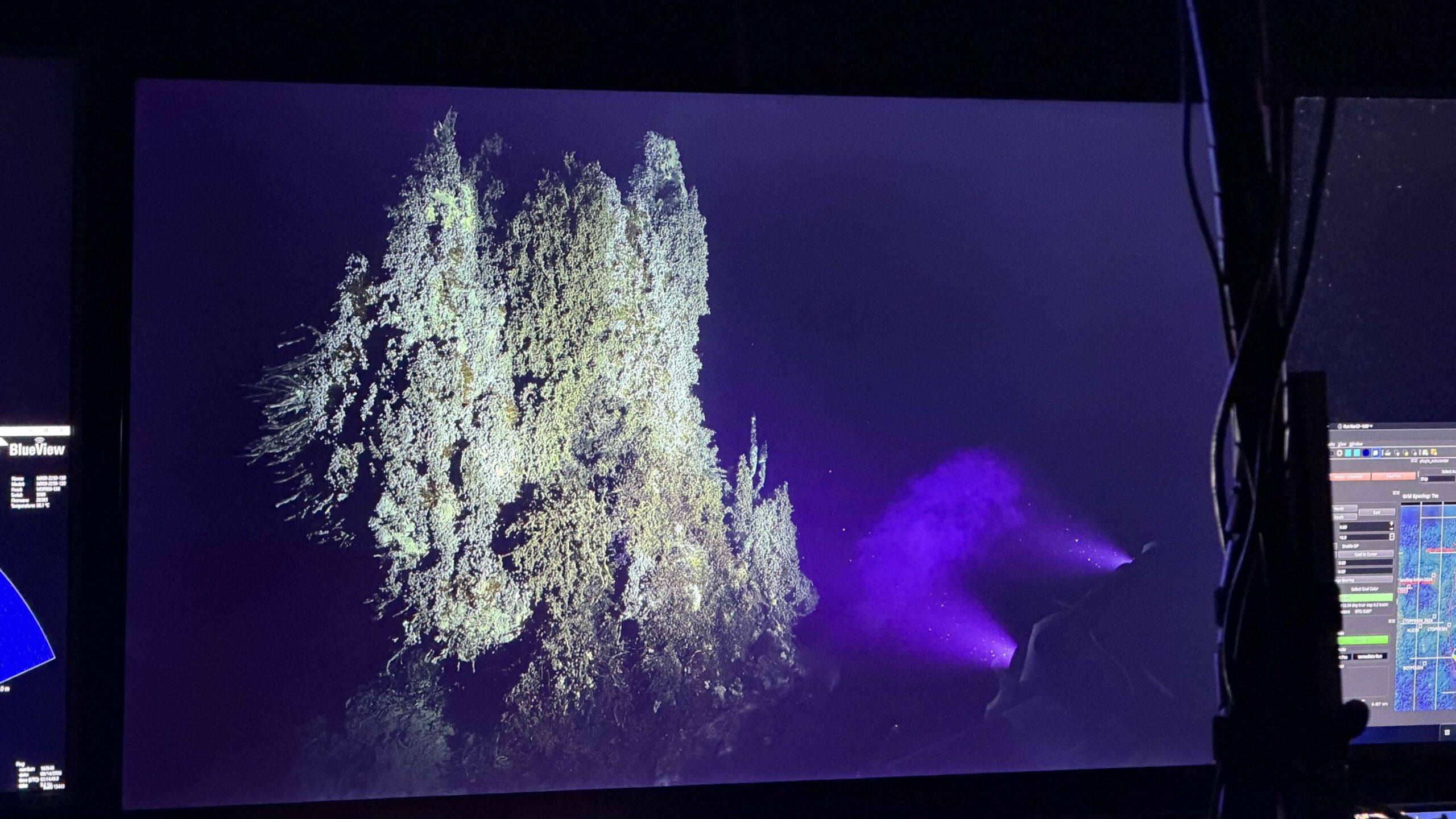
I headed up to the van around a half an hour before my shift began. We were at the ASHES hydrothermal field in Axial Caldera. The ROV (remotely operated vehicle) was just getting to the bottom. One of the ROV engineers is training to become a pilot, and the lead pilot was explaining how to land the undervator (a platform that can latch and unlatch to the bottom of Jason). The seafloor is covered in basalt rocks and is very uneven, and so the pilot has to be sure to land at a place where the undervator will not fall over. Then Jason drove over to the 2025 HD camera, and the engineer and pilot took pictures at where the camera was so that they could put the new camera in the exact same place. Then they brought the old camera back to the undervator and brought the new camera over. It then took what felt like forever to place the new camera in the exact same place. It was very difficult to control because the ROV had an arm that was grabbing a handle connected by bungee cords to the camera instrument. The scientists wanted the camera in the exact same position because they are looking at how the vent and the biology around it change over a long period of time. The camera takes one video for ~14 minutes every three hours covering the entire edifice, leading to impressive long time-lapse movies. After many attempts, it was finally in the right place.
Then we got to turn our focus to the vents themselves. There numerous vents in the field, but Jason focused on Mushroom where the HD camera was located, and Inferno around 10 meters away. We took lots of 4k video footage of the vents, as one of the members of the science team can construct 3D models of the vents using the recordings and computer vision. We then went to the side of Mushroom and turned off all the lights from the ROV when the small lights from the HD Camera were on during testing. It lit up the vent in a dark and eerie way. We also got lots of great shots of the tubeworms, palm worms, sulfide worms, and scale worms and millions of limpets. We then went over to Inferno, which was slightly taller and had a booming vent with strong, hot flow of fluids that formed an impressive plume into the water. Eventually we finished our survey, and as my shift was over, I headed out of the van as the ROV finished up securing the 2025 camera to the underwater and beginning its hour-plus accent.
I am hoping to get a good 6 hours of sleep for the first time in a few days, and it sounds like there will be an exciting dive at 4 am during my shift tomorrow. Due to the lack of a regular sleep schedule, I have lost any sense of time or what day it is. It is hard to believe we are already past halfway on this cruise, but at the same time it feels like I have been on this boat forever. Today’s dive was truly incredible. I texted my family to watch the livestream from home, and I’m glad they got to see it also. Sitting in that control van today and seeing those images on the monitors is something I won’t forget for a long time.
August 12, 2026
Today is mostly a transit day, meaning that we are sailing from the Slope Base site to Axial Base. It is supposed to take around 17 hours, so today is the day to catch up on sleep and do other small tasks. I went to my 4 am shift, and after helping clean water sample bottles and finishing yesterday’s blog, I headed back to sleep around 5:15. I woke up to my alarm at 7:50 and caught the end of breakfast.
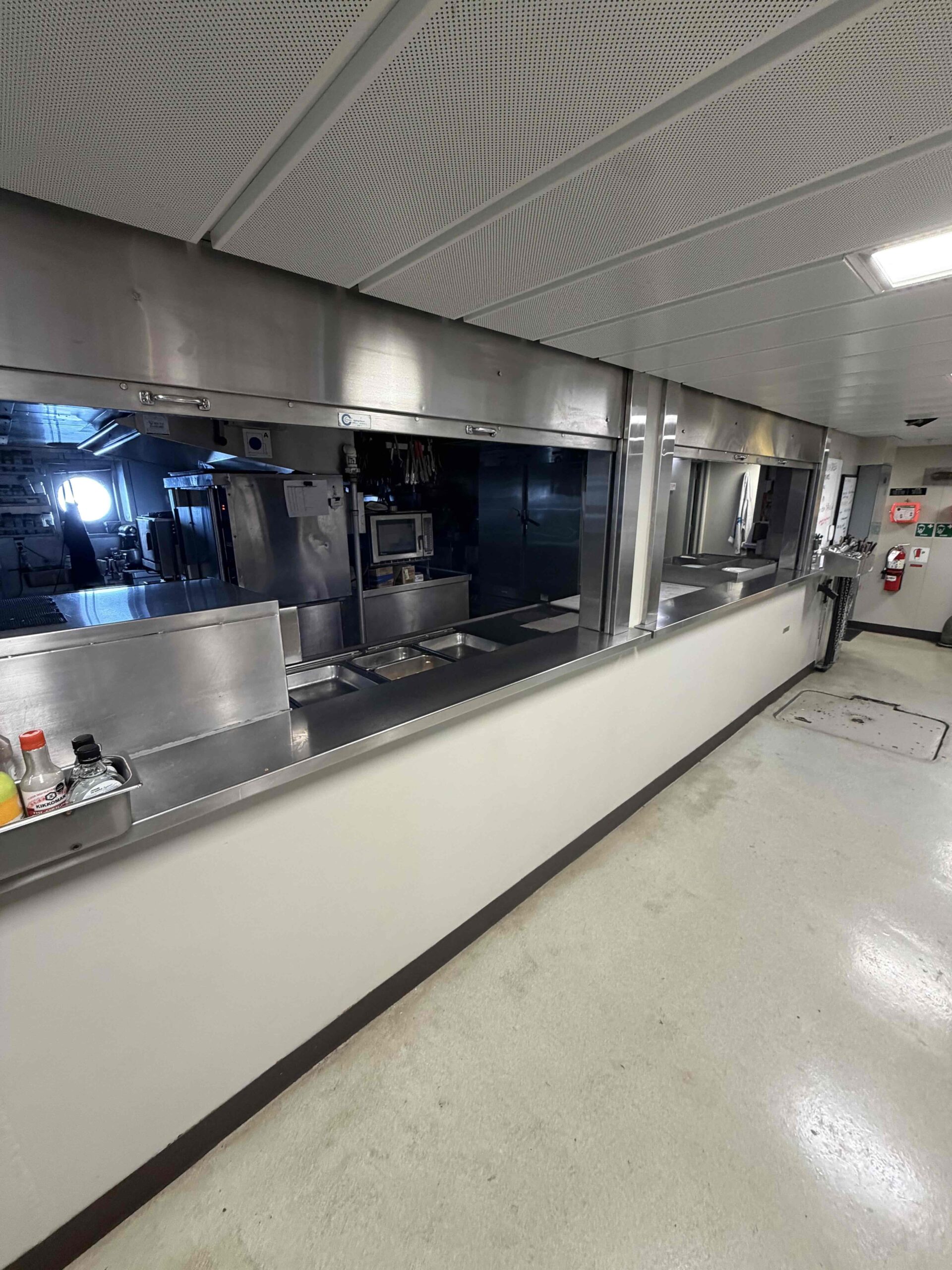
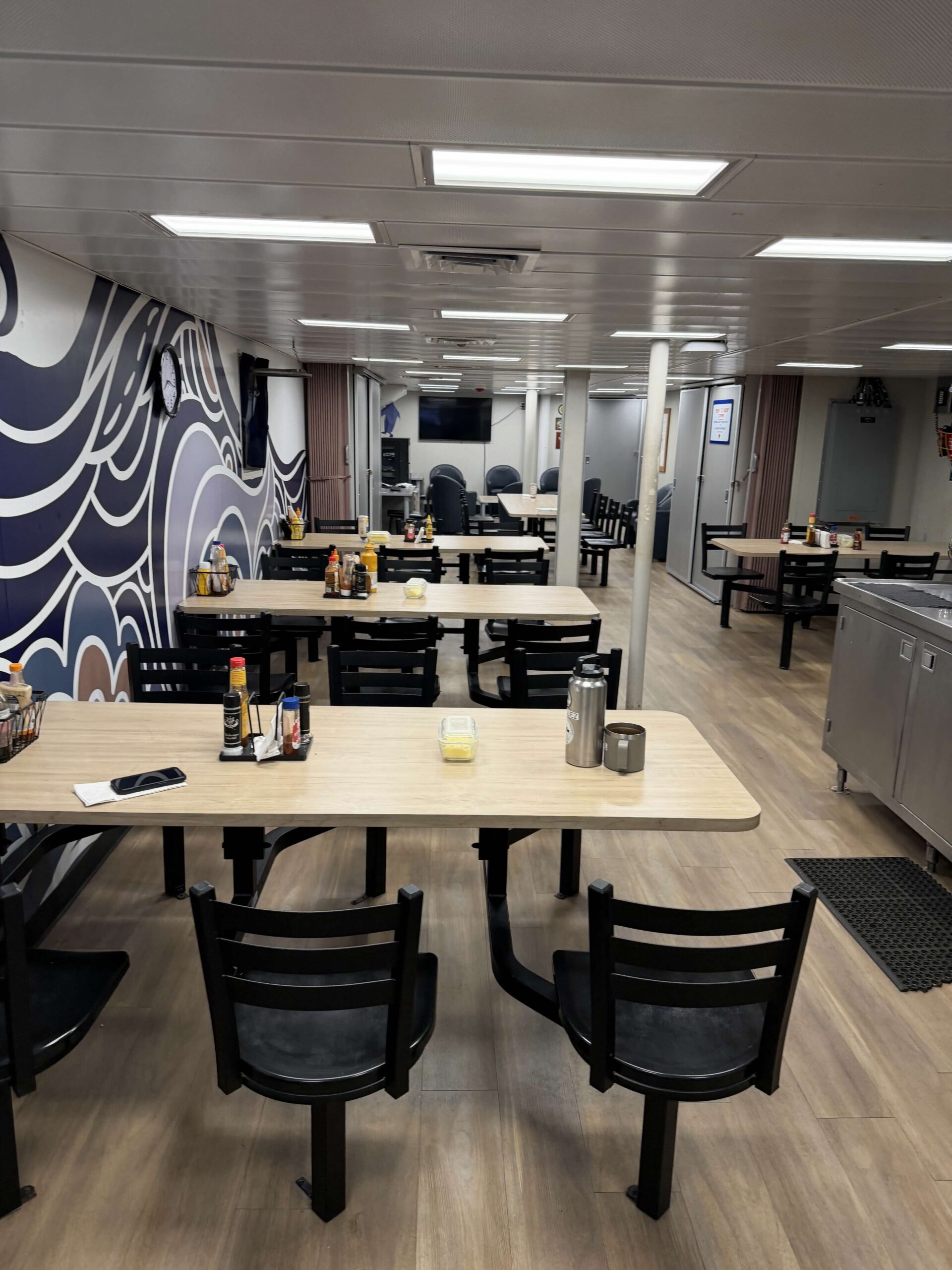
Meals are served three times a day on board. Breakfast is from 7:30-8:15, lunch is from 11:30-12:15, and dinner from 17:00-18:00 (5:00pm – 6:00 pm). The galley, made up of the kitchen and eating area, is one floor up from the Main Lab and main deck. There are two cooks that cook food and clean dishes for >50 people on board. Food is self-served buffet style. For breakfast, there is a small yogurt bar, with fruit, granola, shaved coconut, and cottage cheese. On the hot food side, there is bacon, sausage, potatoes, fried and scrambled eggs of some sort, and an alternating thing each day. Today was chilaquiles (and the scrambled eggs where in the form of chorizo omelets). There were also grits today. Yesterday was coconut French toast. For lunch and dinner, the first half turns into a salad bar with lots of choices. The second half changes daily. Lunch today was Philly Cheestakes, along with fries, broccolini, and a chicken and rice soup. Dinner was short ribs, mashed potatoes, fresh sourdough, roasted carrots, and broccolini. Dinner sometimes comes with a desert. The first night at sea it was an apple crisp, and yesterday was banana pudding. Both were incredible. You grab a plate, serve yourself, then go sit down at one of the 5 tables. Leftovers get put into a certain fridge, and anyone can go in and help themselves any time that they would like. There is also a snack corner, full of chips, candy, ice cream, and fresh fruit. Meals are fast paced as people need to get in and out to get back to shifts and to make sure everyone has a place to sit in the small eating area.
Waste needs to be disposed of carefully, even out in the open ocean. Once we are far enough from shore, food waste can be tossed into the ocean. The crew call that the chum bucket. Other waste is not allowed overboard and goes into separate bags. The ship has an incinerator on board.
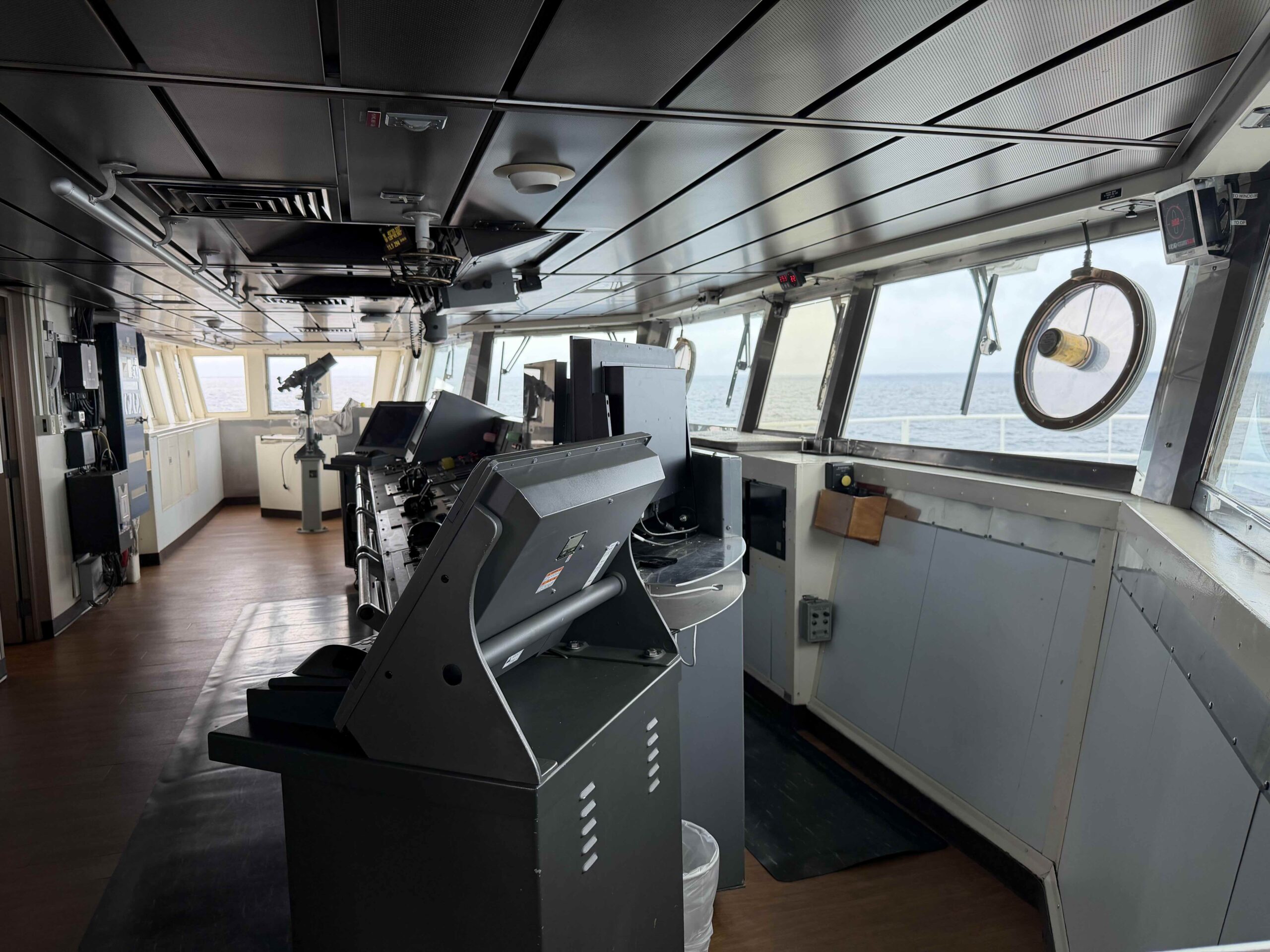
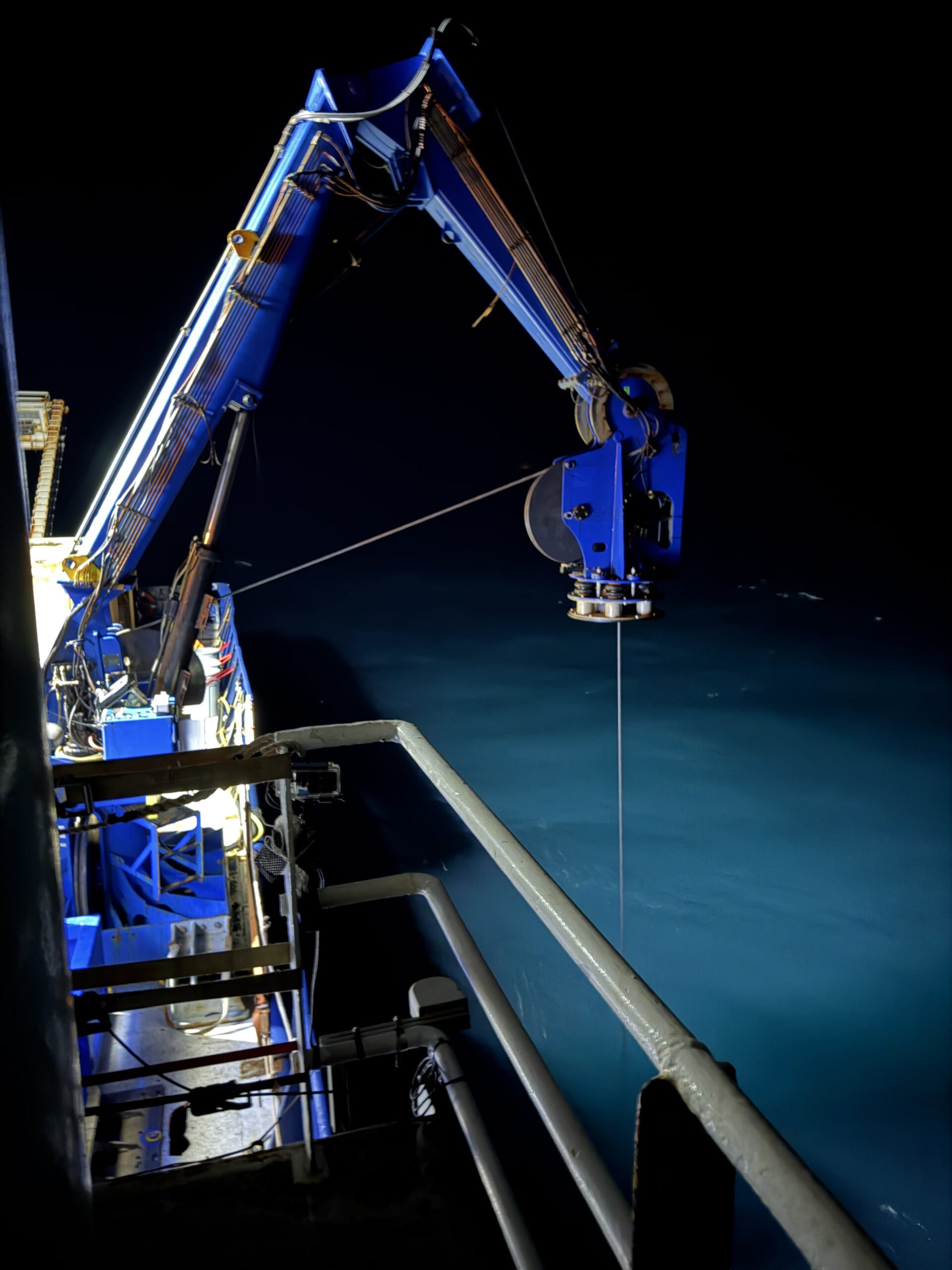
After lunch, I went up to the bridge with a couple of other students. The second mate was the officer on duty, and she showed us the different controls and equipment. We spent quite a bit of time up there talking and looking for whales or dolphins, but saw nothing. I also realized that the ship was leaning quite heavily to the left, or port side. This is because all of the Jason equipment (ROV, crane, control van, etc.) weighs tens of thousands of pounds all on the side of an otherwise mostly balanced ship.
My 4 pm shift was not very busy. We were doing a deepwater CTD, which took 2 hours going down and then up, and then an hour of preparing water samples. While in the computer lab watching the CTD profile, we got to talk to one of the Jason pilots. He was asking us about our career aspirations and seemed to have a quite passionate yet pessimistic view of the world, mixed with lots of swearing. He knew what my hat was and said he grew up only 20 minutes away from the location.
I have requested to be woken up an hour or two before my 4 am shift, as there will be another survey portion of the Jason dive. The site we are at currently is called Axial Base, which is the bottom of the underwater volcano known as Axial Seamount. It should be a fun dive, and I am looking forward to it, despite the short sleep.
August 11, 2026
Today was an early start. We were diving at Southern Hydrate ridge, and the dive started around 11:45 pm on August 10th. This is the site of several known methane plumes, about 780 meters deep. A methane plume forms from a stream of bubbles coming up out of the sediment. There are significant deposits of “solid methane” in the form of methane hydrate beneath the surface, and occasionally visible in cracks. The site is highly dynamic and prone to changes. I had gotten off watch at 8 pm, but didn’t want to miss the site survey of the area, which would occur after the switching of the digital still camera at Einstein’s Grotto had taken place.
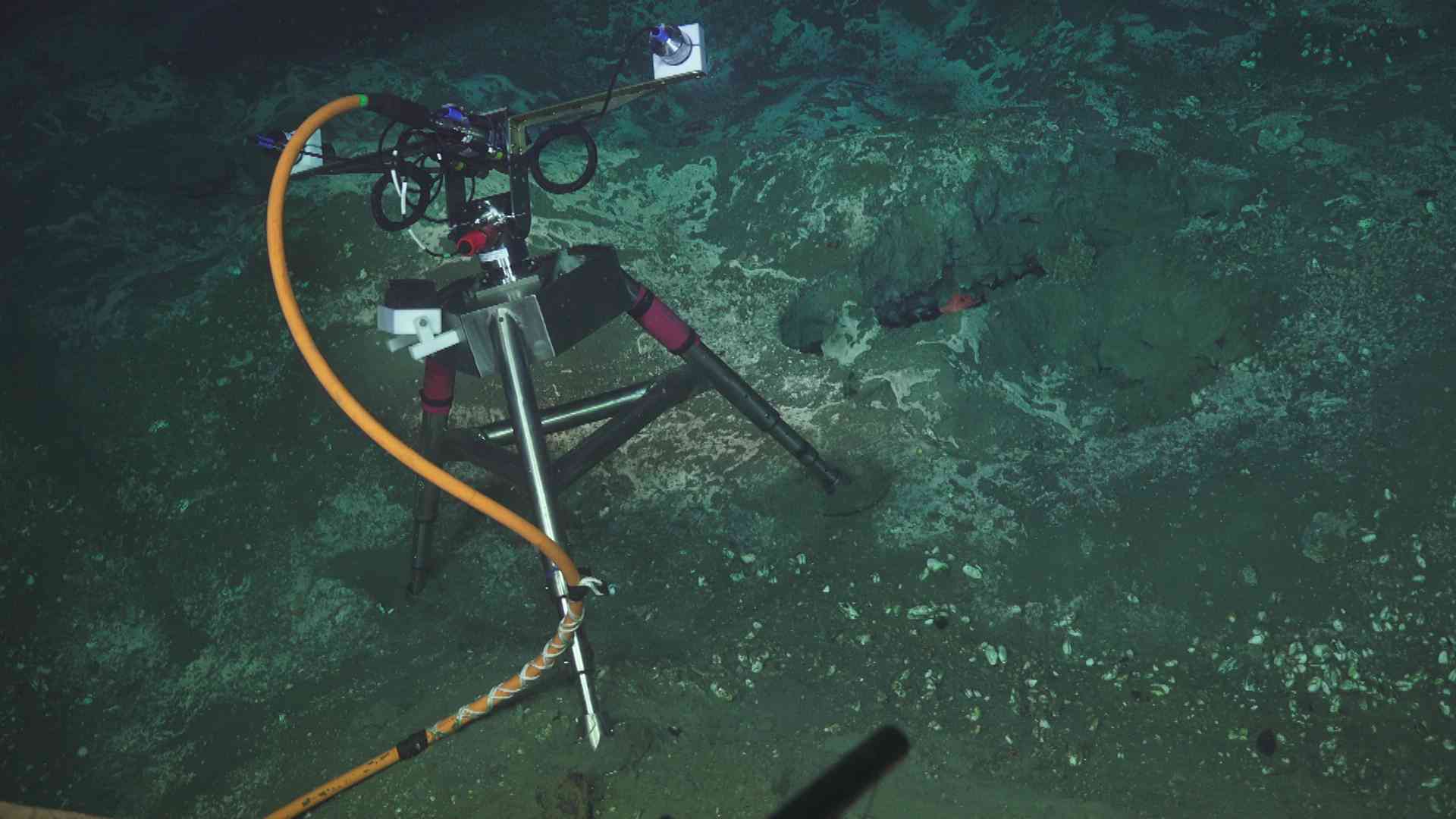
I asked Oliver, one of the RCA lab techs, to wake me up when switching of the 2025 camera with the 2026 refurbished camera was nearly complete. I went to bed around 8:45, and at 11:45, Oliver shook me awake, as he said I didn’t twitch when he tried gentler methods to wake me up. So, I got ready and headed up to the main deck, but then saw on the monitor that the Cam DS (camera) operations were still ongoing, so I hopped on my laptop and worked on some tasks that I had. I would look up occasionally, yet the ROV was still working on the camera. 1 am comes around, and then 2 am, and then 3 am. I got a lot of work done and grabbed some leftover lasagna and vanilla ice cream at 2:30 am and waited anxiously for the camera part of the operation to conclude. After my early morning snack, I would go in and out of the ROV Jason control van and listen in on the proceedings. The camera portion was taking longer than expected to complications, such as the sediment mound where the 2025 camera was had partly collapsed, and they were trying to put the new one in exactly the same place. There were also some troubles with the tilting functions of the new camera. However, right around 4 am, when I got behind the monitor to operate the video recording system, the science survey part of the dive commenced.
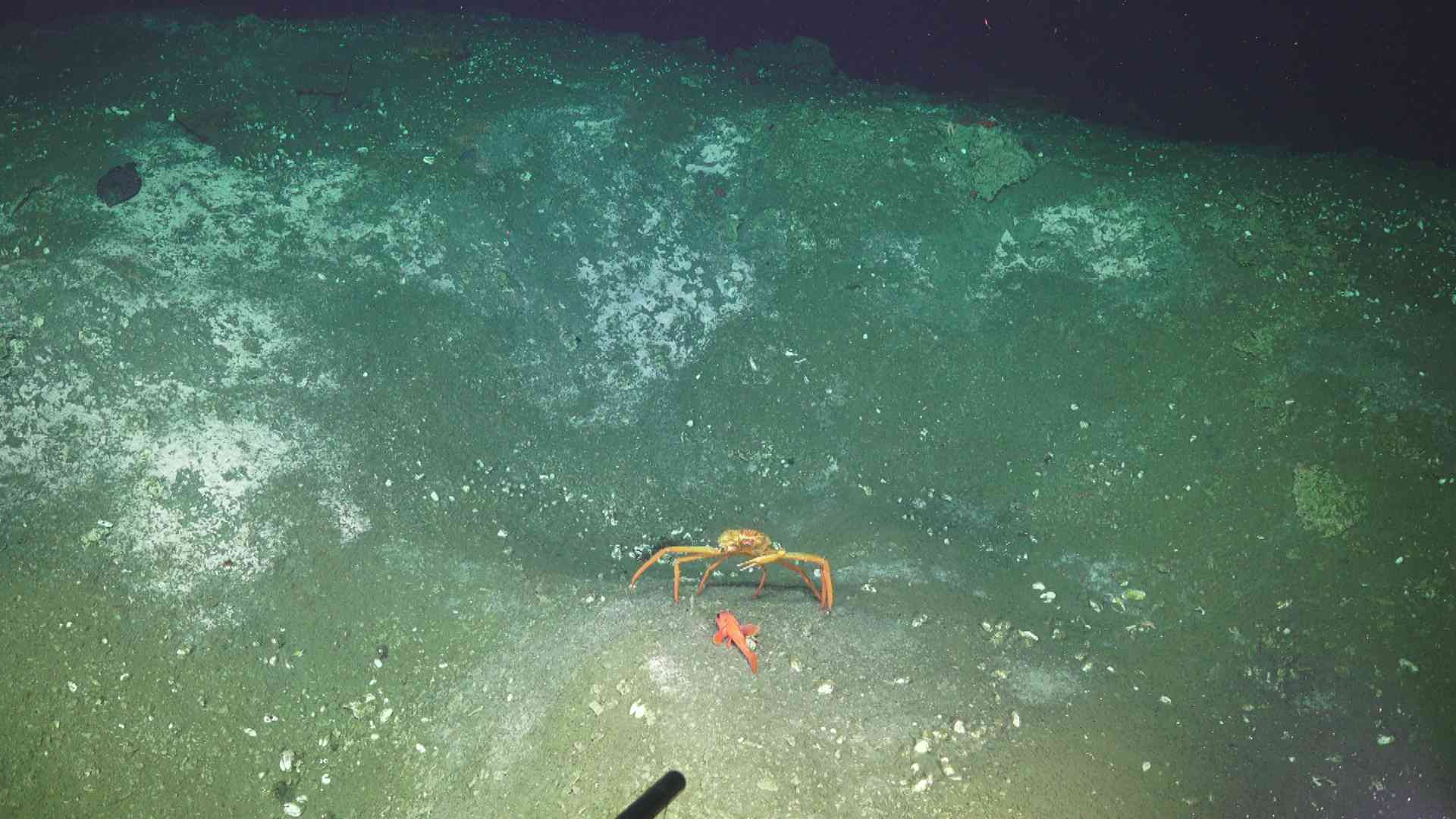
Deb Kelley, the Chief Scientist, came in the van, and one of the RCA staff members, Jolee, got into the hotseat and replaced the lead engineer. The science survey was different from most of the dives in that we were not switching out any equipment, but instead driving around surveying the ocean floor, and taking 4k video shots of things of interest. It was my job to switch the recording from the HD camera to the 4K camera and log the switch. I was also responsible for grabbing stills or taking screenshots of the 4k video feed.
We started by driving up close to the site that the camera was pointed towards, which was a hummocky stretch of seafloor that Dr. Kelley said that likely contained methane hydrate below the surface. We zoomed in on some cracks that showed the exposed hydrate and got some close-up video footage. Then we headed over to a known seep location called Smokey Caverns, a known site of methane plume emissions. On the way, I was shocked to see how much life was on the ocean floor, even at around 780 m. We saw rockfish, hagfish, anemone, snailfish, crabs, and lots of clams, although there were many more dead clams than alive ones.
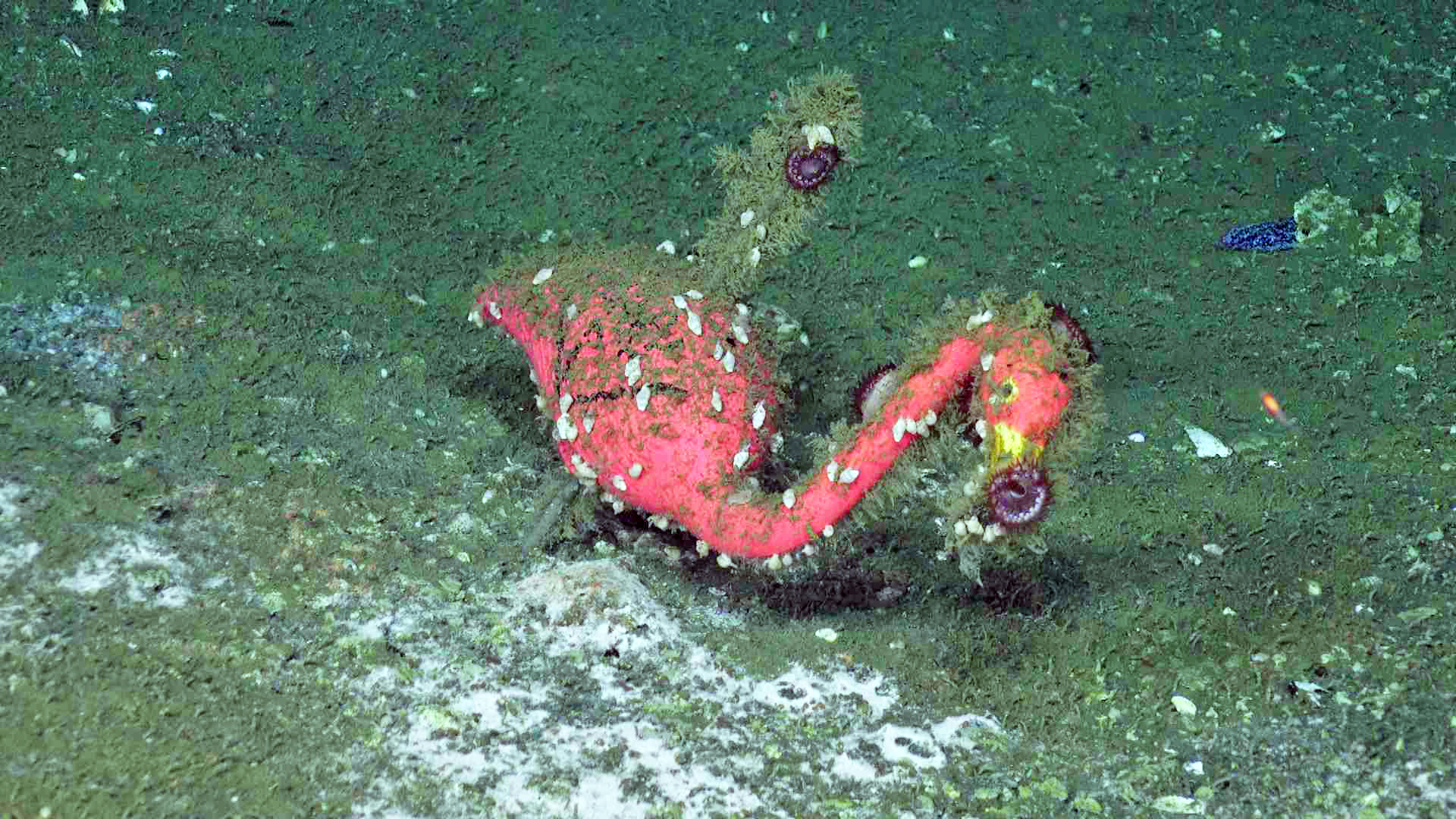
We made it out to Smokey Caverns, there was a pink flamingo left behind by previous researchers to mark out the spot. We found a few bubble plumes, before winding our way back to the starting location. When we got back to the camera, a pleasant surprise awaited us. The cracks in front of the camera at Einstein’s Grotto, which were dormant when we left, were now pouring out bubbles, only an hour or two later. We got lots of 4k video recordings there. After swapping out with another student participant, I got to talk with Dr. Kelley in the back, where we discussed the science happening before us, but also about how we had both been swimmers in high school and worked as lifeguards. Eventually we were relieved by the next shift as the ascent was beginning. Because Jason was so deep, it took over 45 minutes for the ROV to come back to the surface. This was easily the best dive and shift of the cruise so far, although as we will be sailing to Axial Seamount tomorrow, the best dive of the cruise overall is likely still to come as the hydrothermal vents await.
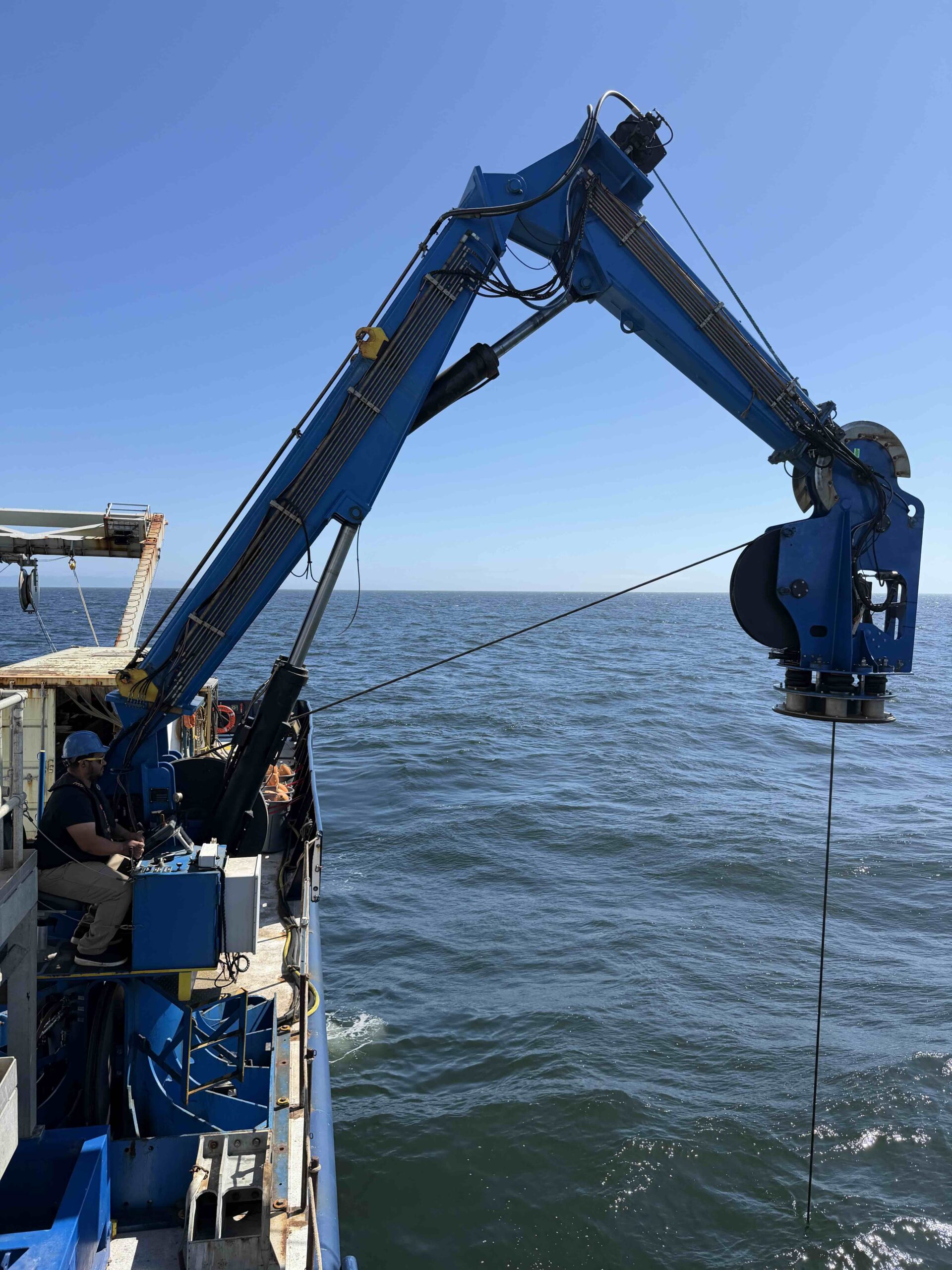
Another highlight from today came during the 4 pm shift, as Jason was ascending from the Slope Base. Slope Base is the deepest site of the trip, at around 2,900 meters such that it took Jason 1 hour and 45 minutes to reach the surface. Because of this, the pilot of Jason on shift let students in the control van control one of the manipulators (arms). The arm is controlled by a small metal joystick with hinges on it that mirror the hinges on the arm. You hold the end like a pencil, and there are two grooves that can be squeezed to open or close the claws. Then you move and bend the joystick, and the arm follows those movements. It was really cool, as we got to move the arm around out in front of the ROV, and then touch the claw to the basket, which is the metal grate beneath the arms that baskets can be attached for holding things.
August 10, 2026
Today began with an early start. My alarm went off at 3:30 am, and I stumbled around my room getting ready before heading up to the main deck. My shift began at 4:00 am in the wet lab, as the CTD had been down in the water and recovered on deck. Students from the previous shift were preparing water samples, so as my shift came on, we did the same.
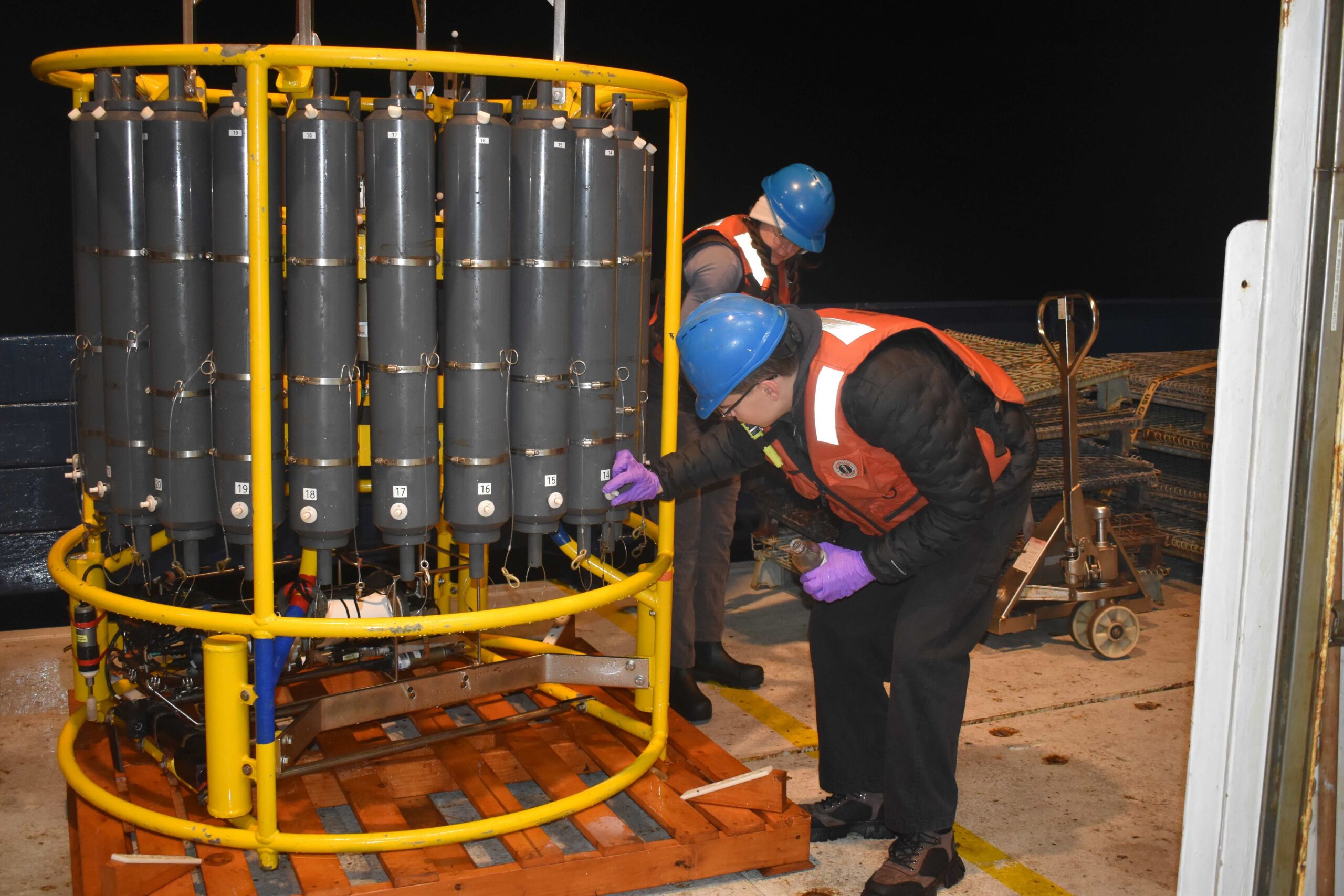
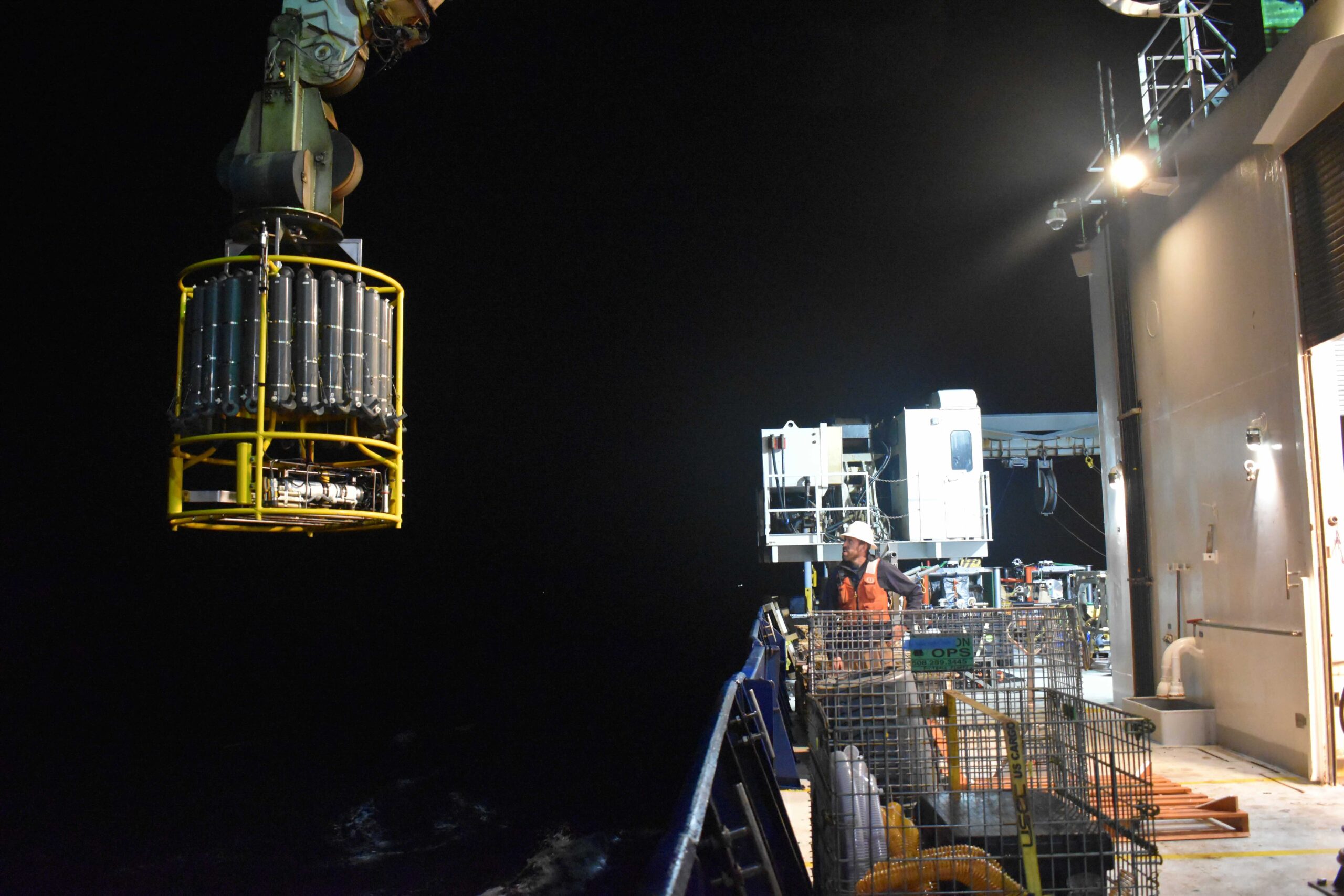
On the CTD there are 24 large PVC plastic tubes with lids, called Niskin bottles, that close when a computer triggers each one to do so. A scientist can pick which depths they want their water samples. We fill smaller sample bottles (either glass or plastic) from a spigot on the Niskins, so scientists can later analyze the samples on- and offshore. The CTD has numerous sensors on it. Hence, the water samples are also analyzed on deck to ensure that the sensors on the CTD are calibrated correctly. These data are also compared with data from the instruments on the seafloor and on the moorings, to ensure the instruments are also calibrated correctly. There are slightly different bottles used to store water samples, depending on the analyses. We retrieved samples for oxygen, salinity, chlorophyl a, and measured temperature directly from the Niskins.
We finished that task around 6:30 in the morning, and I grabbed a bowl of cereal around 6:30 am while the Jason crew were finishing their pre-dive checks and moving Jason into position for the launch. At 7:30 am, the ROV was in the water, carrying a BEP (Benthic Experimental Package) down at the Oregon Offshore site. This dive site was approximately 575 meters deep, so it took a while for Jason to reach the bottom. Along the way, the cameras imaged jellyfish, a school of small fish, and medium sized fish near the bottom.
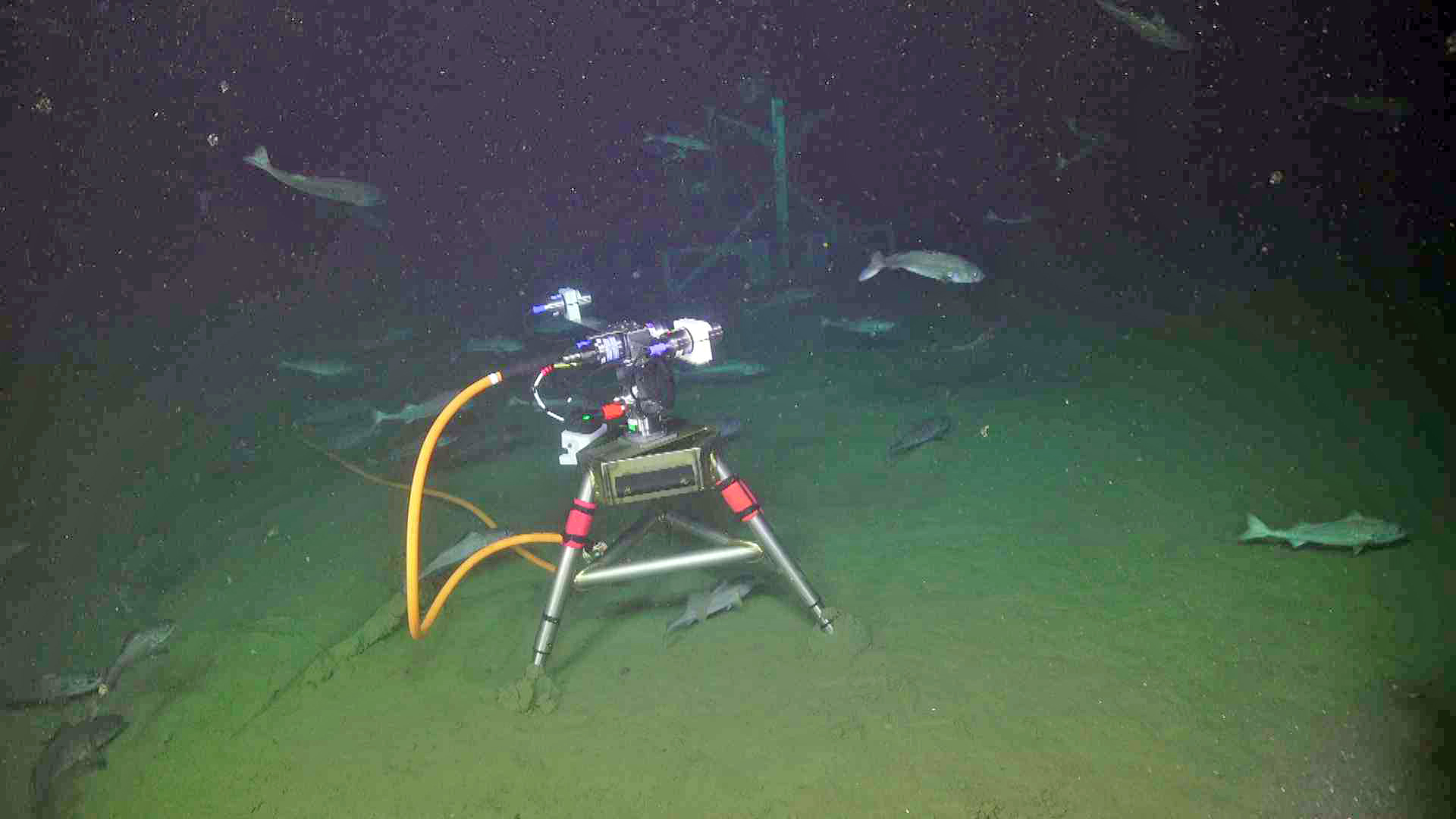
The water was much clearer than at the first shallow Shelf site (80 m), but it was still surprising to see how much particulate is in the water.
I was relieved from my shift before Jason got to the bottom and headed to the galley for breakfast. After breakfast, I spent some time in the back of the Jason control van and in the Main Lab, before eventually taking a nap. I nearly missed lunch as getting out of bed when my alarm went off was quite the challenge. However, I made it right before they began to clean up. After lunch, I headed to the Main Lab to do work on my laptop.
I headed to the control van at 3:30 pm, as I wanted to watch the ongoing Jason dive before my shift started. At 4 pm, I took over as the logger who recorded all of Jason’s actions. We were switching out a camera at the Endurance Offshore site, which was around 580 meters water depth. I was amazed at the number of sablefish present at the seafloor, below 500 meters. In contrast, there were hardly any fish within the top 200 meters of the water column. The dive was already far along, and Jason soon began its accent back to the surface. After dinner, I helped prepare water samples that would be used to analyze chlorophyll. We ran the water through a filter that removed all the chlorophyl, plankton, and sediments and vacuumed out the water. Then, we folded the filter paper, put it inside a tube with acetone, and then put the tube in the freezer for storage. When the samples get back to the lab, further analyses can be done to determine the concentrations and compare those data to the instrument data.
Being out at sea has been far more exciting than anything else, and I have gotten to see some fascinating things in the past two days. I have not been feeling sick at all, although as I was in the smaller analytical lab towards the front of the ship working with the chlorophyl, I started to notice the ship moving up and down, and side to side a lot more. My stomach was then starting to feel a bit woozy. I took some time outside just behind the analytical lab to get some fresh air and look out at the ocean. I think I saw a whale jumping out of the water in the distance, although I only caught the end with the head in the water and the tail in the air. I am going to try to get a nap in around 8:30, as I will likely wake up far before my next 4 am shift to watch the dive at the methane seep site, also known as Einstein’s Grotto.
August 9, 2026
Today is our first day out at sea! This morning, I woke up on the RV Revelle after arriving in Newport, Oregon yesterday and getting settled on board. I got breakfast in the galley and got to meet a couple of people who worked on the ROV Jason (remotely operated vehicle). We later had our orientation for the Jason control van, where the data people showed us the different roles inside the van. The pilot, navigator, and the engineer all sit in front of a wall of monitors showing the different cameras form the deck and on Jason. The hot seat sits behind the pilot and navigator and is where the scientist or engineer tells the Jason crew what they want them to do. Two students, working at the same time, are behind three monitors in the middle of the control van. There is one student who is monitoring the video recording and taking still shots of the video feed that look interesting. The other person is in charge of doing the Sea Logs. Using a software, they record all the actions during the dive, including if the ship moves, where the ROV is, and what it’s manipulators (arms) are doing. The recorded action is paired with pictures taken at the time that the action is recorded.
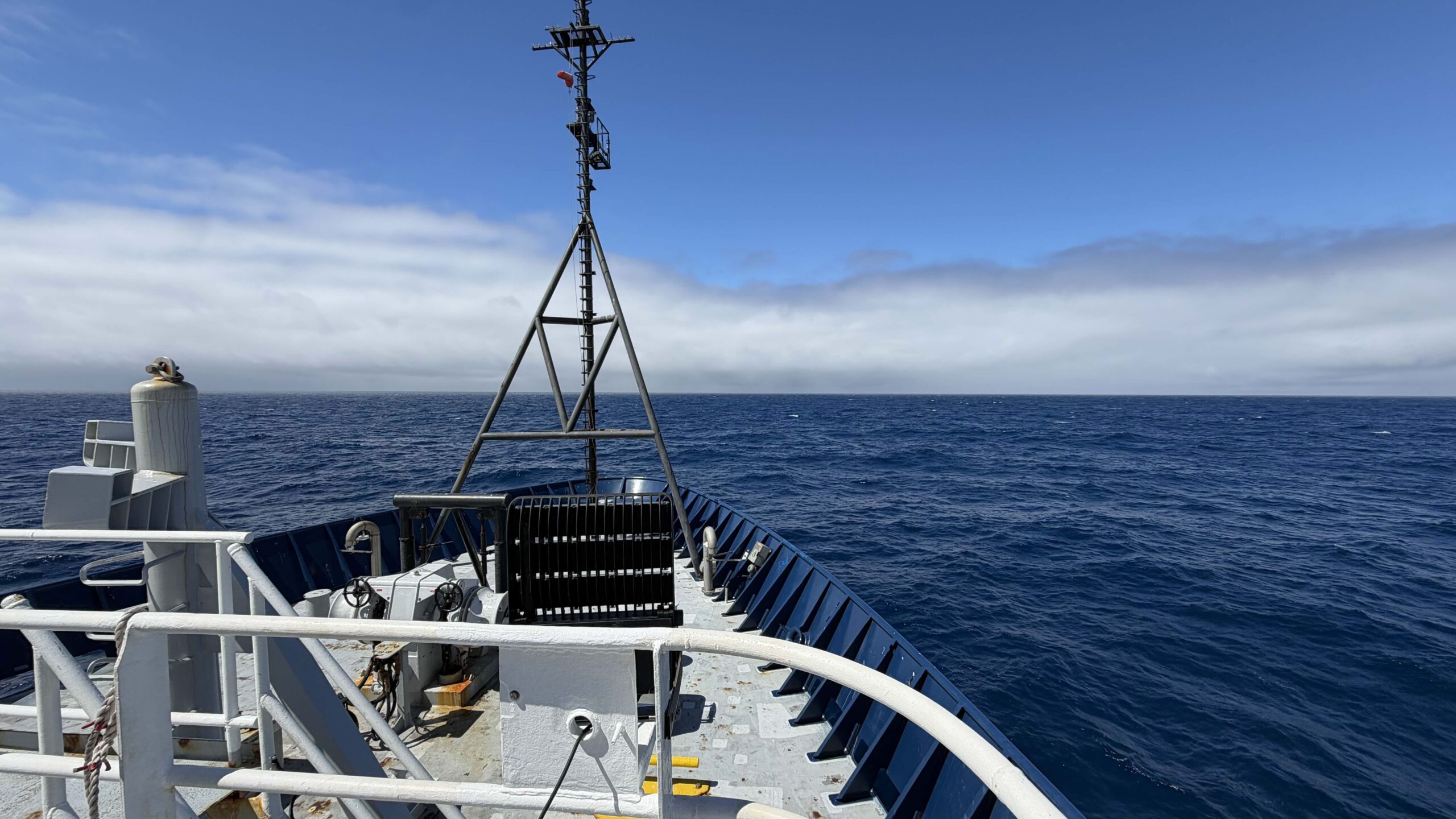
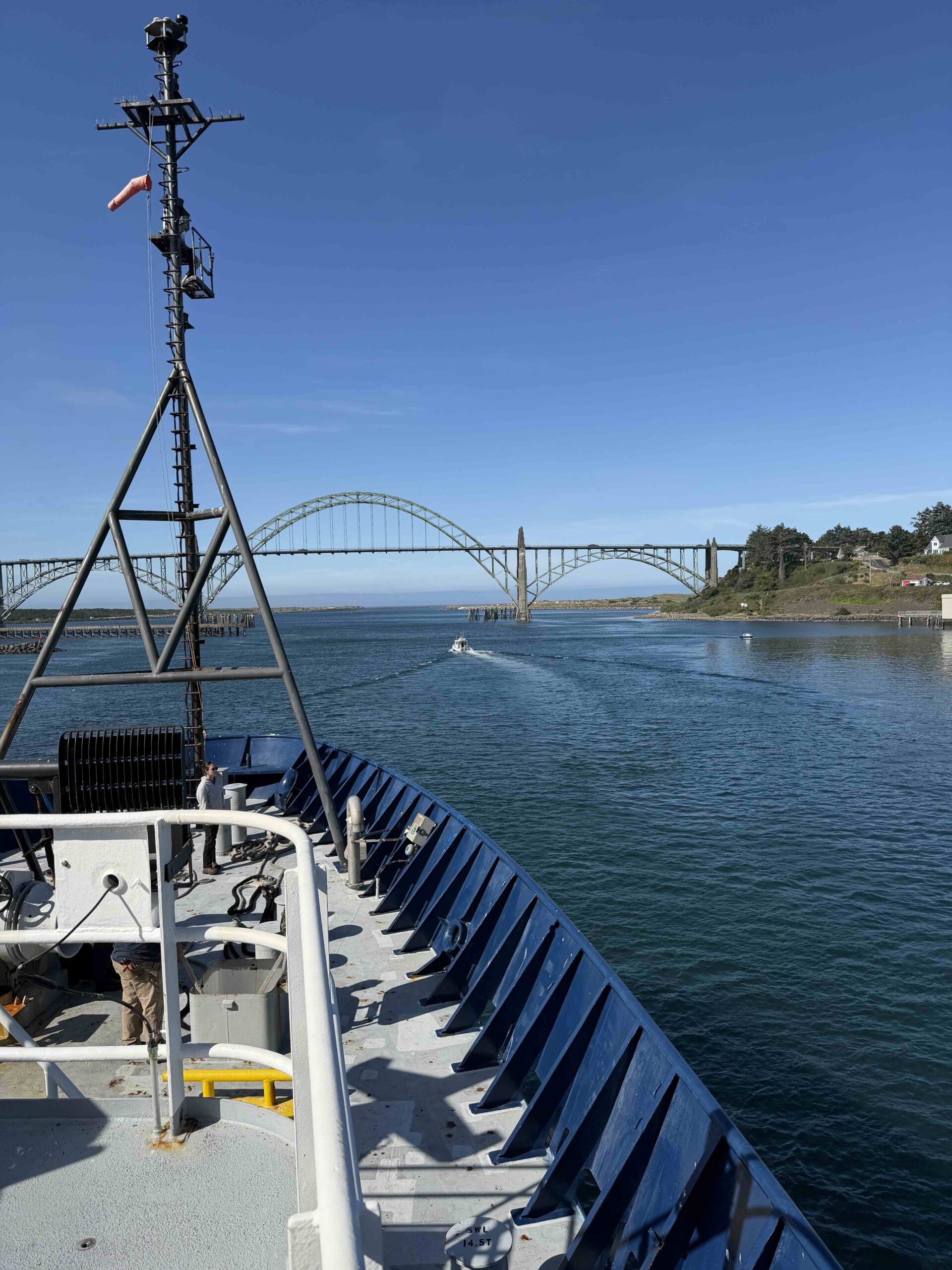
After our introduction to the control van, we got introduced to the CTD. Some of us, including me, had worked with one before, but for others it was their first time. The CTD measures many ocean water parameters, including oxygen, salinity, temperature, chlorophyl a, turbidity, and pH. It also has 24 “Niskin” bottles that collect water samples, which can be closed to capture water at a chosen depth. While we were doing this, the ship took departed, and we hurried to the bow of the ship as we headed out of the Yaquina harbor, under the bridge, and out to sea. It was quite calm and sunny, and very windy. We arrived at our first diving site, the Oregon Shelf, around 11.
After lunch, we had an abandon ship drill. The alarm went off with six short bursts and one longer bursts, followed by an announcement over the PA system saying it was an abandon ship drill, and all science and crew members were to muster (gather) on the O2 deck (second deck above the main deck) with our immersion suits, life vests, and the other emergency things we were told about in the prior day’s safety meeting. After roll call on the deck, we split up between the science party and the crew. With the science party, I watched as we were told what the procedure is used for release of lifeboats during an emergency. Then, we went to the Main Lab and all put on our immersion suits. They are bright orangish red and feel like a thick wetsuit.
Once the drill was over, I hurried into the control van and sat on the bench in the back to watch. The first site is about 25 km off the coast, and the shore was still visible from deck. We are still on the continental shelf, so the sea floor is about 80 meters below the surface. The ROV was already on the seafloor when I entered the van. The BEP has a bright yellow shell, and is about 8 feet by 6 feet, and around 4 feet tall. As I took my seat, the Jason crew were pulling the fiber optic cable, which powers the BEP, from the 2025 one and plugging it into the new unit. The old one was covered in barnacles, pale white anemone, and a handful of bright pink starfish. After watching the operations for a few hours, it was then my shift. At 4 pm, I got in the seat to operate the Sea Logger. I did that for an hour and a half, until I was released to go eat dinner. During the dive that I was working, the goal was to add a new camera and take up the one installed in 2025, which had fallen over within the previous year. After dinner, I came back and operated the video logs, until the third person in my shift took over. At 8 pm, the shift was up.
My next shift will be from 4 am to 8am. I am hoping to fall asleep before 9 and get some sleep before waking up sometime around 3:30.
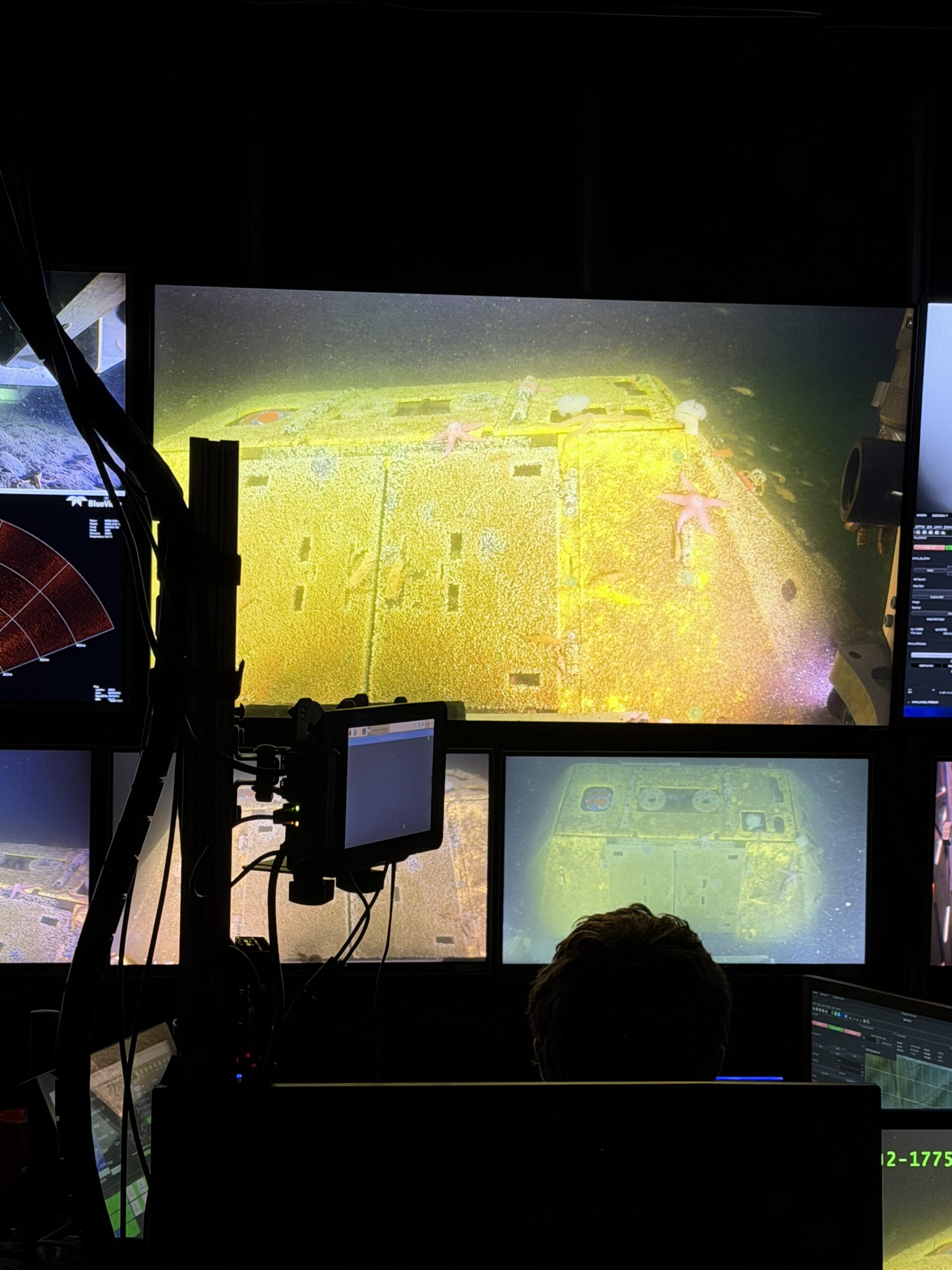
It is hard to leave the control van, as it is fascinating to watch the ROV as it begins its third dive of the cruise. It is also interesting to hear the pilot, engineer, and scientists communicate as they operate Jason. Because the site is (relatively) shallow and in a very productive zone, it is very hard to see anything. The water is filled with debris (sediment and biologically-produced material). We must rely on sonar until the vehicle is within a few meters of the instruments or platforms. Natural sunlight barely reaches this part of the water column, so we use the bright lights attached to Jason to see. I am going to watch the sunset, grab some of the apple crisp that is still out, and then try to get to sleep as soon as I can.