
August 18, 2026
Today was our final full day on the ship, and it started at 0700, or at least it was supposed to. Likely due to my consistent routine, I slept through my alarm that was meant for me to catch breakfast and instead woke up around 1100, just like I would have for any other day. During the time that I slept, the ship had completed the final transit to a designated buoy not too far from shore. It was here that we stayed for a few hours while we had to wait for a ship pilot to be boated out to assist with transiting into Yaquina Bay and the OSU dock, as per regulations.
Prior to today, all the students were tasked with making a rudimentary project proposal presentation, nothing more than showcasing a couple power point slides detailing some of our ideas and how we would examine them. I presented the idea of observing the ecological colonization around the RCA instruments, using the footage and data from multiple years to track variations.
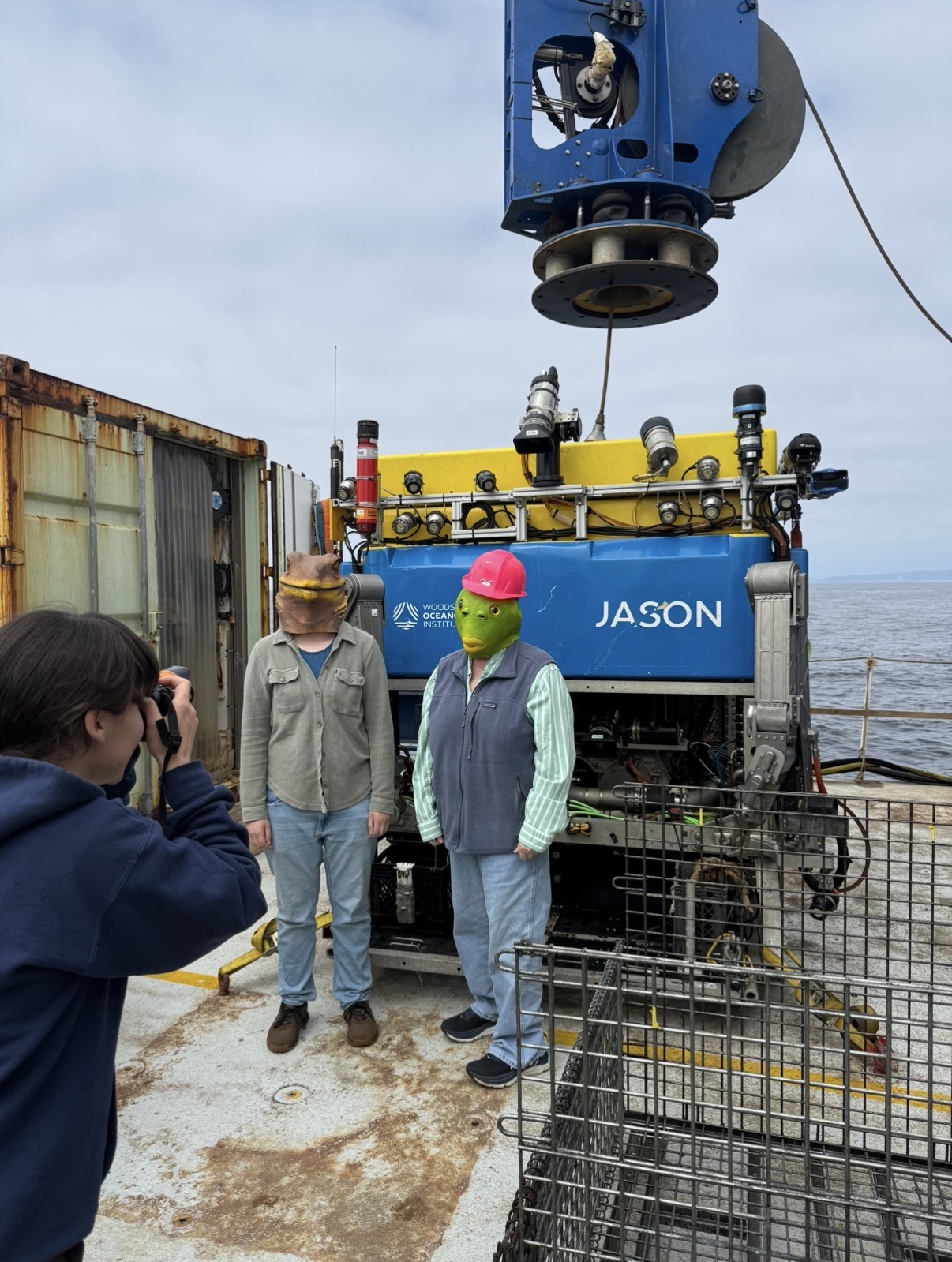
Following the presentations, we all gathered around Jason to take some memorable photos. I spent the next couple hours tidying up my belongings and packing my bags, as well as spending some time playing ping pong. Our leisurely activities continued until around 1600, when the pilot had arrived and we began transitinginto Newport, and into the OSU Hatfield Marine Center dock.
By 1730, we had fully docked and secured the boat, with everyone anxious to get off and onto dry land, particularly the science crew who all were eager to find the nearest bar. Since we were not at the NOAA dock this time, we had free reign to leave the ship and explore the town of Newport. Unfortunately, there was complications with the depth of the tide and attaching the gangway bridge to the ship to let us off, and we had to wait an additional hour and a half until we finally were able to touch down on land. Jolee offered to drive us all to our requested destinations. Justin, Tejas, Mike, and I all went to a local Thai restaurant while some of the students went their separate ways. Avery and Izzie explored for sweet treats, and Maddy and Alex, both over 21, decided to continue to ride with Jolee to the bar where almost everyone else from the ship was. At the Thai restaurant, I had a pad see ew which was quite good, however the highlight was watching Tejas and Mike order their dishes on the highest scale of spice that the restaurant offered, stunning the waiter who upon later inspection, had put question marks next to both their orders on the receipt.
Tejas seemed quite comfortable with his shrimp fried rice, noting that it was definitely spicy, but enjoyable for his standards. Mike was another story, as he bravely went through the first third of his noodle dish comfortably before the spice caught up to him. Three glasses of water later, and a third of the dish remaining, Mike called it quits. It was certainly an impressive effort nonetheless, with mainly the vegetables having been left behind. The waiter complemented their bravery when we paid, noting she would never be able to handle that level of spice.
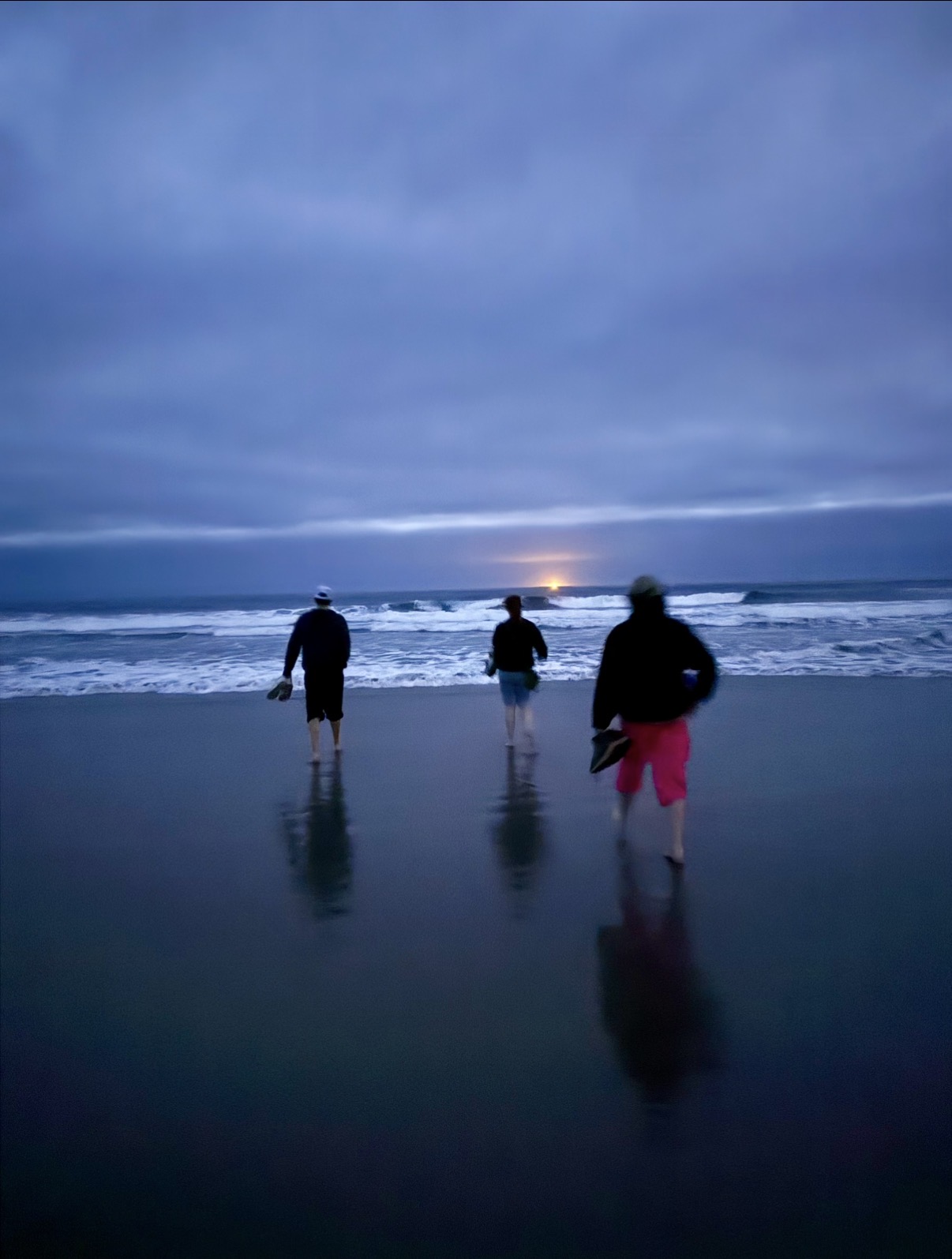
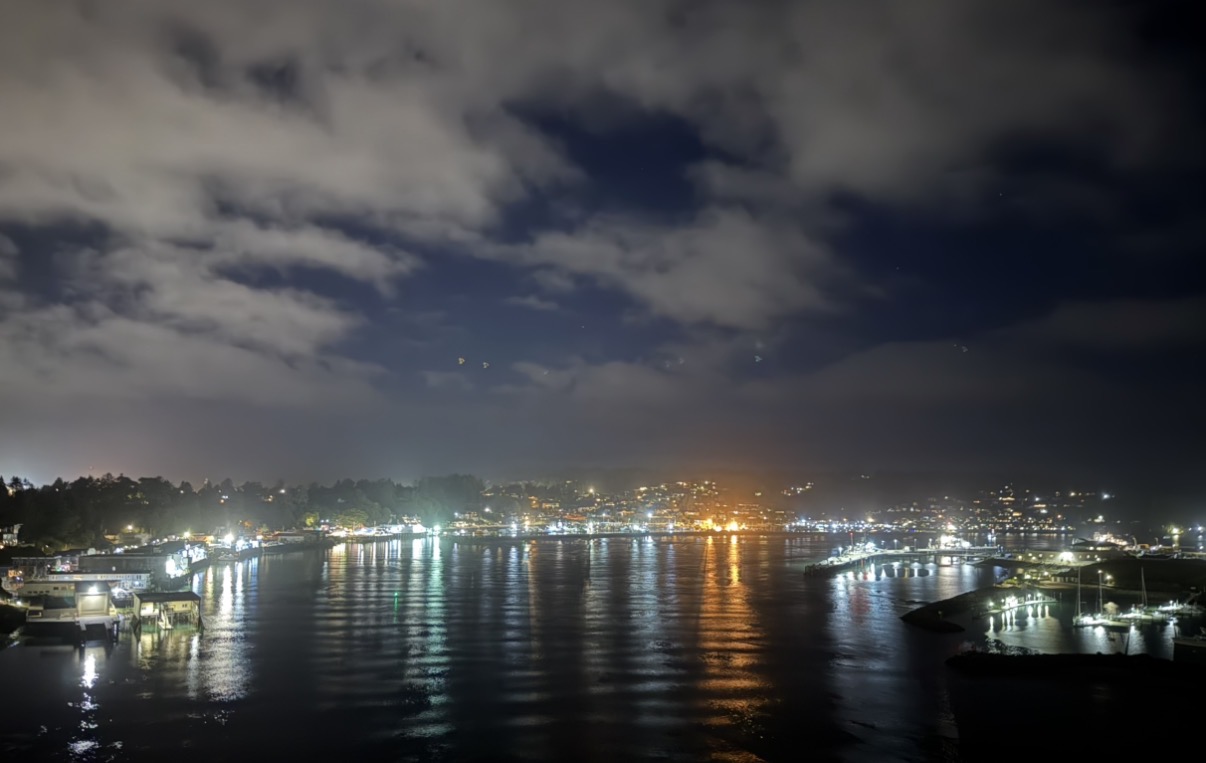
Afterwords, we all walked about 15 minutes to meet up with Izzie and Avery at the local beach, which was a spectacle. With the sun having already set, the ambiance was extremely calming and almost ethereal, and we ended up going barefoot on the sand which was some of the finest ground sand I had ever felt, making the sensation wonderfully soothing. We went out to dip our feet in the water, before promptly turning back, not wanting to continue embracing the extremely cold waves. By this time, it had started rapidly getting dark, so we all headed back from the beach to the accompanying trail, where we decided to take the scenic route and let Jolee take her time at the bar by walking 40 minutes back to the boat over the Yaquina Bay Bridge. The bridge overlooks the marina and town on one side, and the ocean on another, creating an incredible contrasting view from both sides. Dr. Kelley had requested that we all returned to the boat by 2200 to ensure our safety and our whereabouts known. Returning to the boat was somewhat comforting, and it feels bittersweet for the expedition to end. We will promptly leave the boat and return to Seattle as soon as we can tomorrow, so all the time to soak in the experience happens tonight.
I am extremely grateful for the opportunity Dr. Kelley and Bigham gave me, and I hope I made the most of it by gaining invaluable experience and knowledge and creating lifetime memories.
August 17,2026
The usual 0000 shift started off with an operation to retrieve the Slope Base shallow profiler. This instrument was unlike a lot of instruments we had looked at previously. Many of the instruments along the Regional Cabled Array are benthic, meaning they sit on the seafloor, however this shallow profiler (one of three on the RCA) is latched into an anchored floating platform at 200 meters deep. It was pretty eerie to have Jason fly through the empty void of the ocean and slowly witness a large floating object come into view.
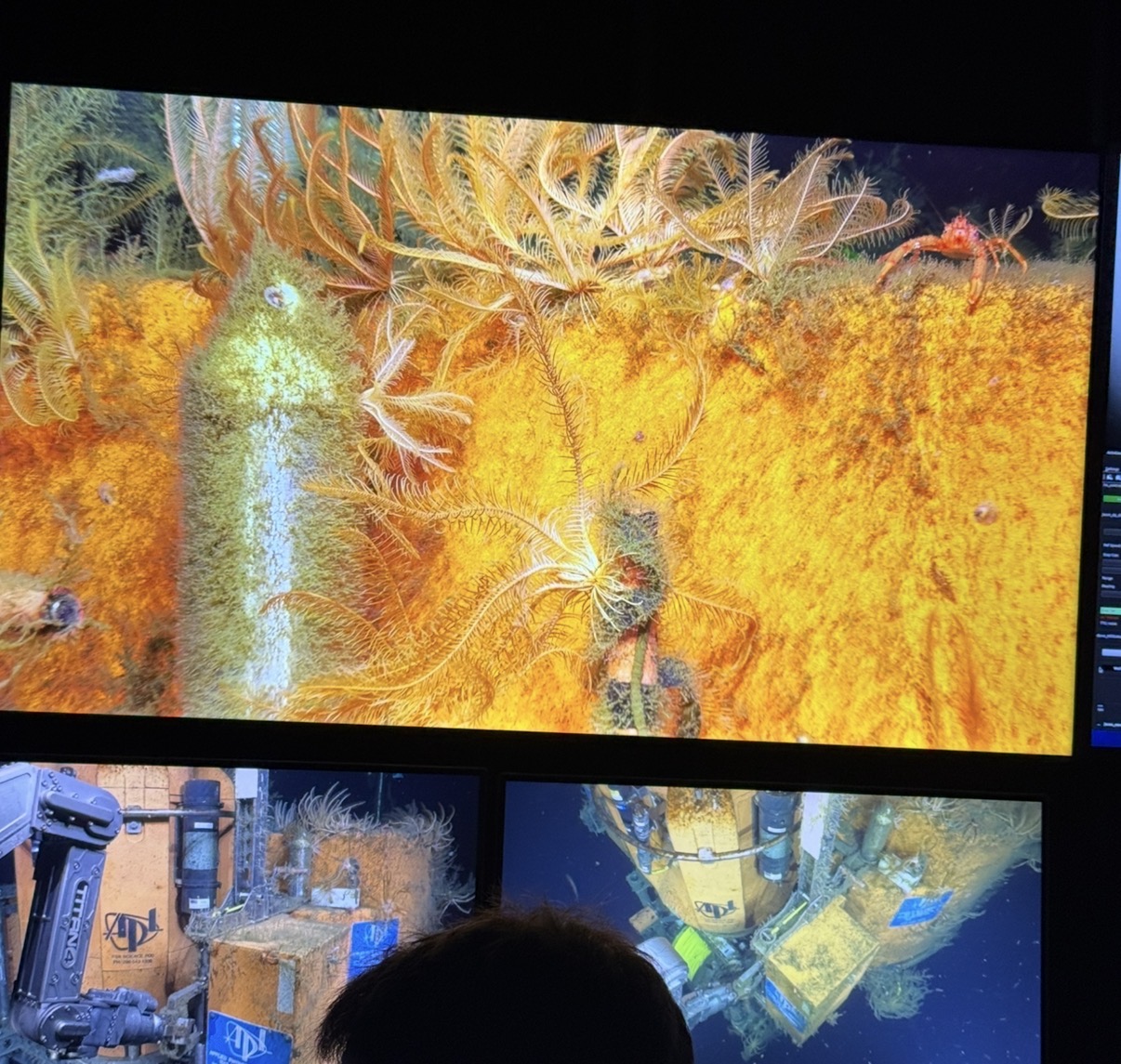
A wide variety of organisms inhabited this platform, with two particularly dominant specimens. The first were long feather like organisms called crinoids, which are relatives of starfish and urchins, anchored themselves to the shallow profiler using their claw like appendages on the bottom of their body. The other dominant species were squat lobsters, a familiar face at this point, which get their name from how they curl their tail under their body, giving them a compact appearance. While observing, Alex posed a great question: how did they get there? This is essentially an island with nothing around for miles. These communities start from organisms somewhere else in the ocean who lay eggs or birth larvae which then get swept away by the current, endlessly floating until they happen to run into a floating object like the shallow profiler. The shallow profiler then becomes the home for these larval organisms, who spend the rest of their entire life cycle there, ultimately reproducing with other specimens who will inhabit the same home, or be swept away to somewhere else. Planktonic larvae migration leads to countless new ecosystems all around the world, and it is one of the primary ways life seems to just appear in seemingly random places. Despite tubeworms being completely rooted into hydrothermal vents, we see them colonize newly formed hydrothermal vents all the time. This is because their larvae are planktonic creatures that can live for weeks, giving them ample time to be swept along the currents of faults and ridges to find a new hydrothermal home.
Since the operation only required diving approximately 200 meters, taking video of the profiler, and then retrieving it, the entire dive only took about an hour and a half. With more than half the shift to spare, our watch group partook in a snack break which was practically a tradition at that point. One of the highlights of the snack break were a bag of banana flavored corn puff snacks which were surprisingly very good. The puffs were light and airy and the banana flavor wasn’t very artificial, nor did it coat the mouth with a strange aftertaste like many banana flavored food items. We likened them to pirates booty, though I thought the banana puffs were far airier. I then polished off the last of the loaf of sliced bread from the fridge by toasting the two ends and sandwiching melted Hershey’s chocolate and salted kettle potato chips in between. I’ve always found combining something sweet with salty potato chips can work well, and this crude sandwich wasn’t bad, but it would have ideally been high quality milk bread instead of random bread ends, thin potato chips instead of kettle cooked, and I would have preferred a different spread like Nutella or cookie butter rather than melted chocolate.
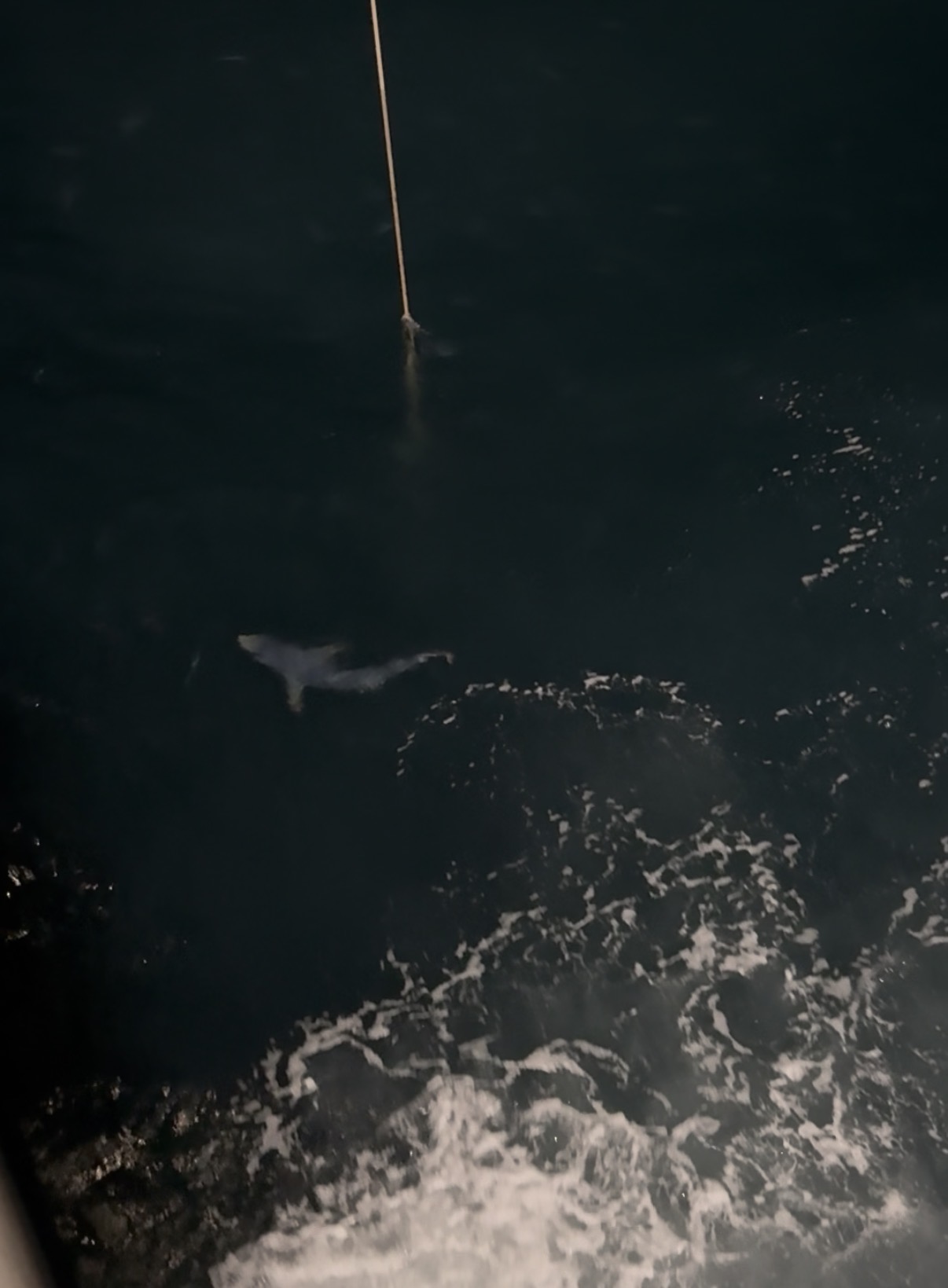
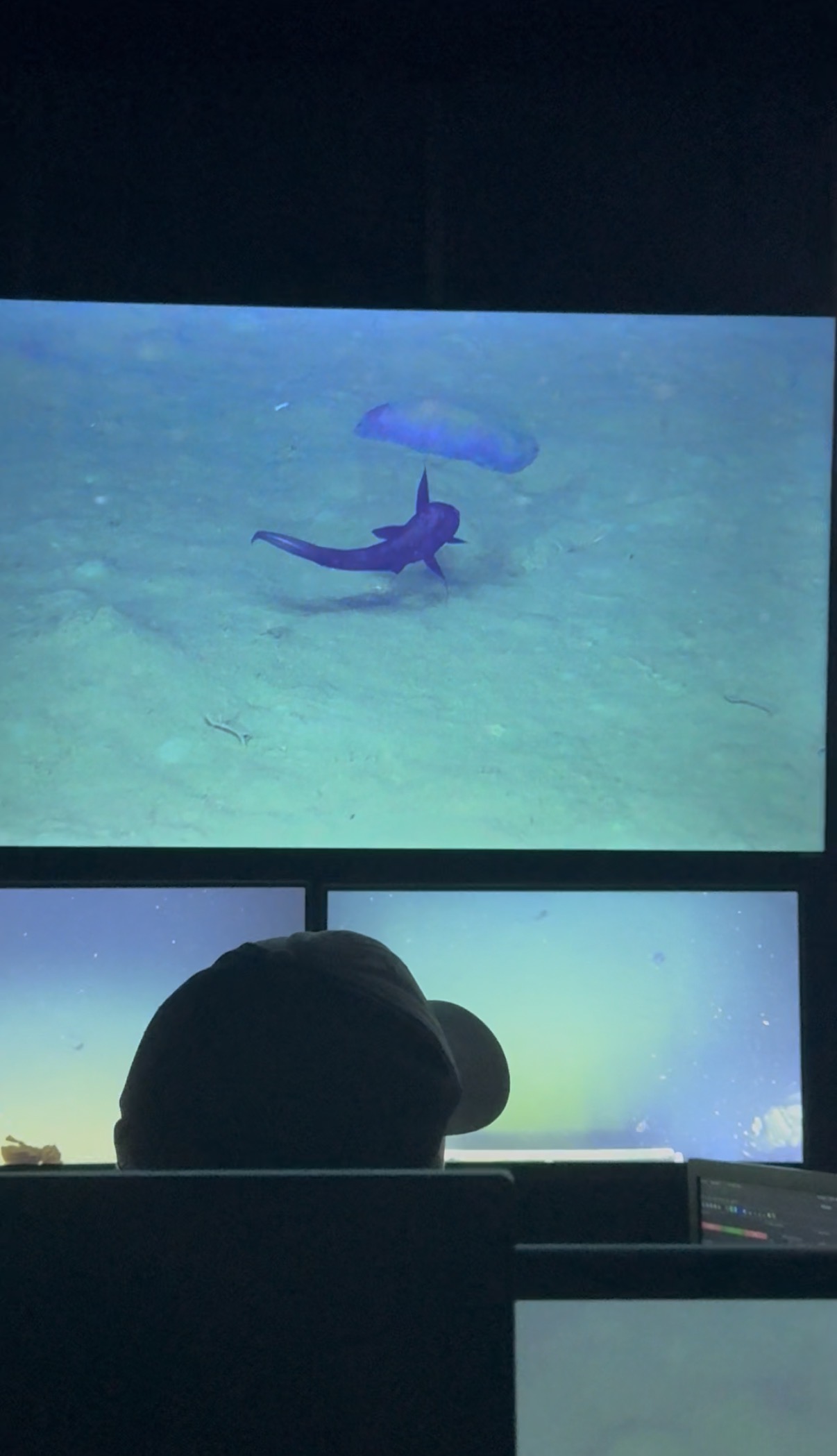
At around 0345, we were called back to the van to initiate the next dive, and while we had to log less than five actions before being relieved, the lights from Jason entering the water must have attracted a large school of mackerel which began swarming our boat. Following the mackerel were multiple large blue sharks which swam in our eyesight from the side of the boat, constantly chasing the mackerel and fading in and out of the limited topwater visibility. After approximately 20 minutes, the mackerel seemed to relocate, taking the sharks away from the boat and signaling the end to another shift.
When I woke up again at around 1100, I was particularly excited for an event that was highly anticipated by many since the start of the cruise. The R/V Roger Revelle crew announced on the first day that they had just gotten a shipment of new merchandise and they would be for sale later in the cruise. Today was that day, and everyone onboard waited for when the clock hit 1215. I bought a crewneck designed with the ship surrounded by various sea life as well as a coffee mug with a simple design of the ship and its namesake. Dozens of crew, students, and scientists lined up to secure a comfortable piece of memorabilia. I then headed to the van to start my shift for a dive to survey a set of instruments at around 600 meters deep, to survey an offshore mooring’s anchors, and the shallow profiler housed on the mooring.
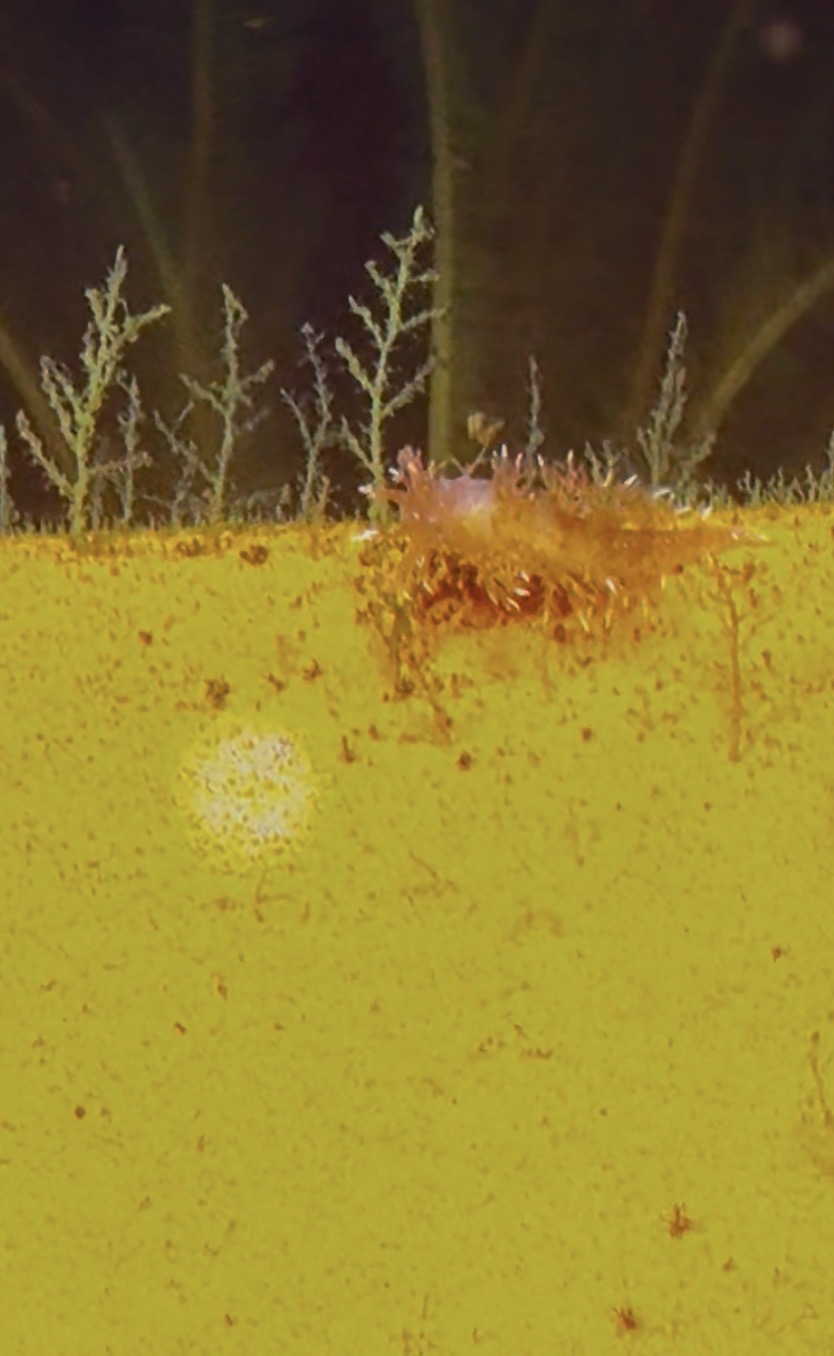
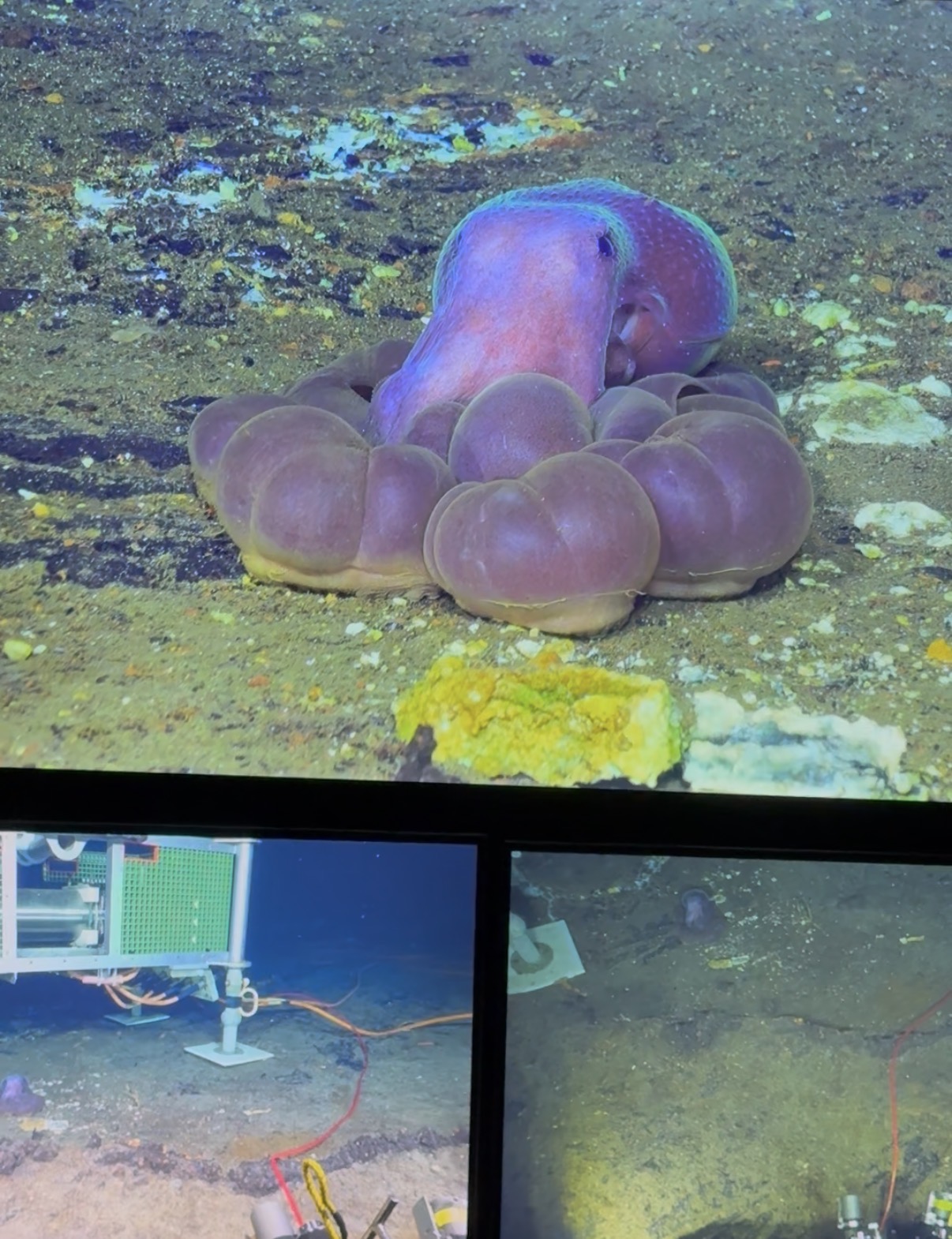
At the beginning of the descent, we observed even more blue sharks following Jason’s descent. Soon after we arrived at the seafloor, Alex and I were called for a student meeting, so we missed much of the first half of the dive and returned to the van for observing the shallow profiler. Here, we saw one of the most ecologically dense areas yet, as the entire instrument was covered in crinoids, squat lobsters, sea sponges, anemones, and many nudibranchs. We hadn’t seen many nudibranchs on our cruise, so it was nice to see so many in one place together, with there even being multiple different species with distinct colorations and body shapes. Observing all the fauna on the profiler bled into the end of my shift time, so as I headed to the galley to grab some snacks, the team descended to observe the anchors of the moorings and observed a giant Pacific octopus latched onto the cable near the bottom. It was displaying a behavior where it curled its tentacles around its head to form a large ball, which we assumed was a defensive behavior to either protect itself or try to intimidate Jason. The octopus marked another species that I was not at all expecting to see before I came onto this cruise, which really reinforces that every cruise is going to be different, regardless of if they follow similar or the same procedures every year like this one. There is no telling what can happen, or what can show up.
August 16, 2026
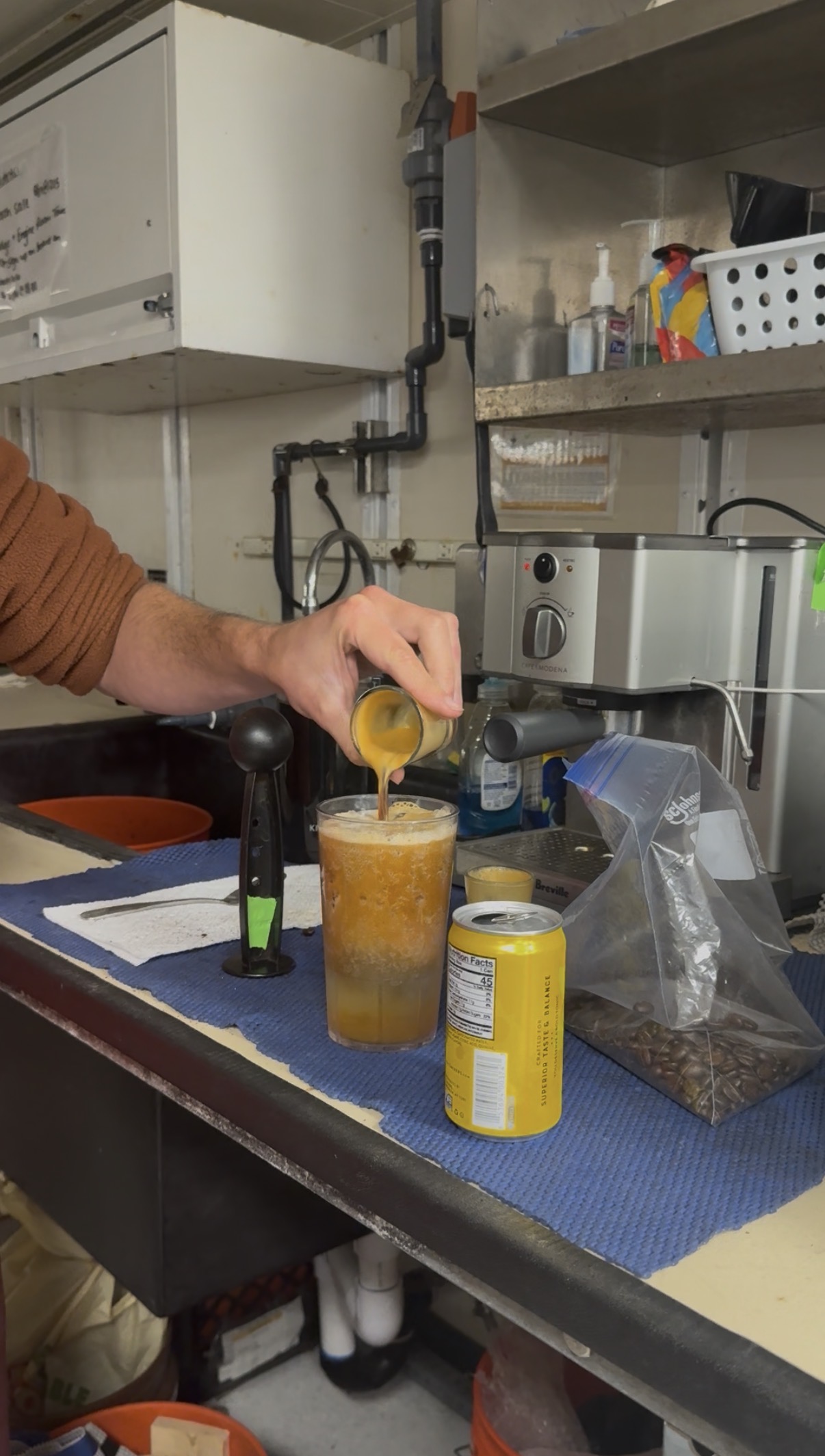
The 0000 shift for today had a slow start. I found my usual watch leaders Joe and Ada at around 2330, as we were in the middle of transiting to the Axial Base site. We were scheduled to begin a dive to recover and instrument from the seafloor called the HPIES at around 0100, so there plenty of time to pass. Joe and Ada have often been drinking a concoction during our early morning shifts that they like to call a “Sproton” to keep them energized. A Sproton is a mixture of two espresso shots mixed with tonic water, two drinks I am very unfamiliar with. Both Joe and Ada performed an almost ritual-like regimen to create this concoction, deeply narrating every step of the process to me, with a lot of playful emphasis on Joe’s Italian heritage making him naturally gifted when pulling an espresso shot. Despite Joe’s seemingly innate professionalism, Ada’s following turn apparently outperformed Joe’s, with a noticeably thicker layer of golden brown foam which I’m told are desirable. It appeared that I was on watch with two coffee geniuses. These shots were dumped into a glass of iced tonic water, instantly dividing into two distinct layers of coffee and water, just like the mixed layer in the water column as Ada noted. I tried a small sip from both of their Sprotons to settle a friendly competition as well as experience what they’re always promoting. Ada’s seemed to be a more complex flavor profile that stayed in my mouth longer than Joe’s, probably due to her tamping down the espresso with her full body weight. Regardless, one thing was made clear to me: I don’t like coffee and I certainly didn’t like the Sproton. It was an initially sharp and bitter flavor that left a thick acrid aftertaste in my mouth for multiple minutes. I may need a few years of tastebud maturation before I ever consider trying this again.
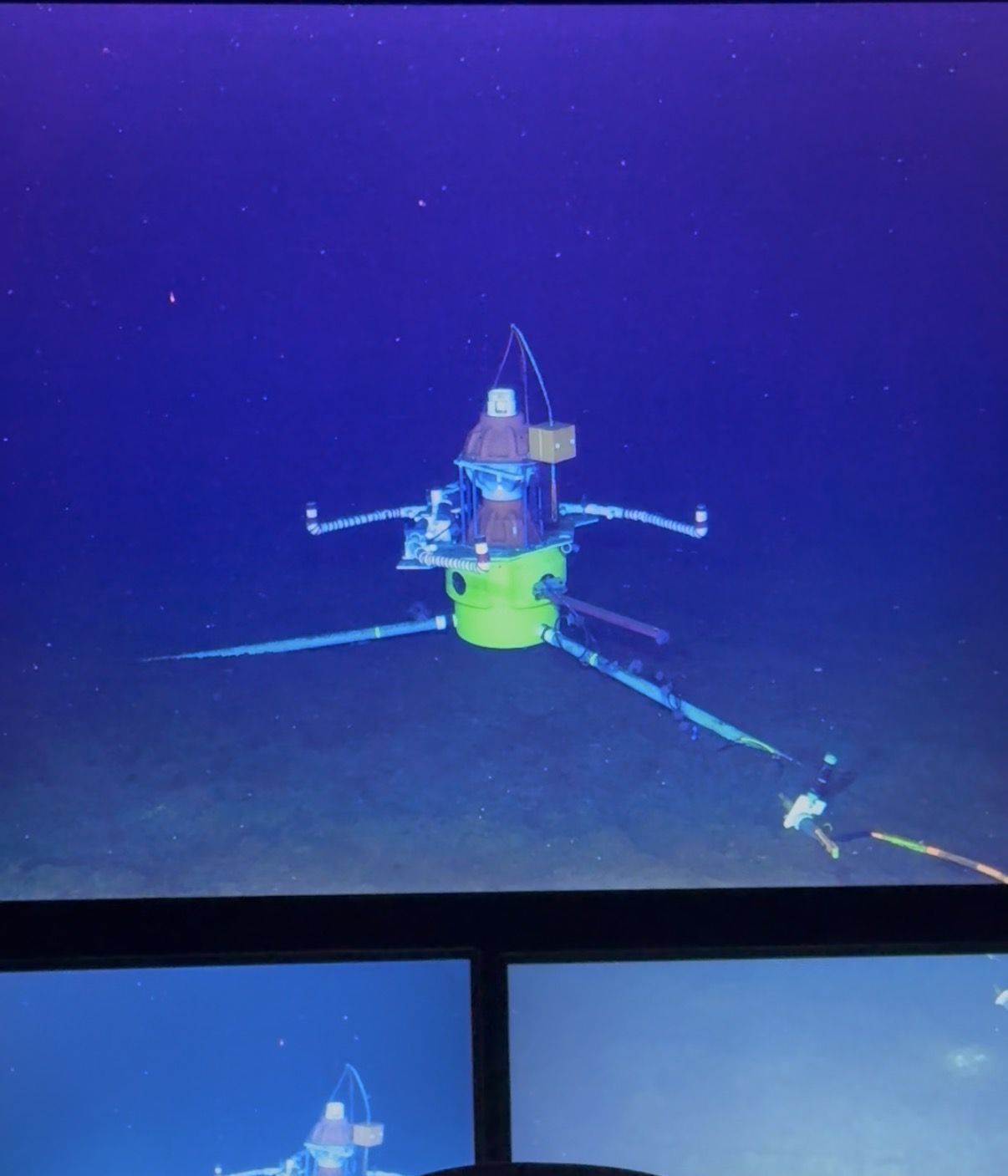
At around 0115, we were all in the Jason control van for the dive to recover the HPIES (Horizontal Electrical Field, Pressure and Inverted Echo Sounder). The HPIES is a system of instruments that sits on the seafloor and measures various benthic properties such as the surrounding water pressure, the vertical acoustic travel time from seafloor to surface, and electric fields. Our task was simply to descend to the bottom of the seafloor and video the surrounding area before attaching the instrument to the bottom of Jason and recover it to the surface. The operation was extremely smooth and fast, having been completed with an hour to spare in the allotted timeframe. The only hiccup came when disconnecting HPIES from its power and data transmitting oil-filled cable, as one of the handles at the connection point of HPIES and the oily cable came off, meaning Jason had to delicately grab onto the actual connection housing of the HPIES plug to disconnect it. With such a smooth dive, it was the first time during my shift that I had completed a dive beginning to end with over two hours of time to spare. The remainder of the shift had us all playing table tennis in the main lab in a round robin format. With the rocking of the boat, especially during transit, there can be some unprecedented ball movement.
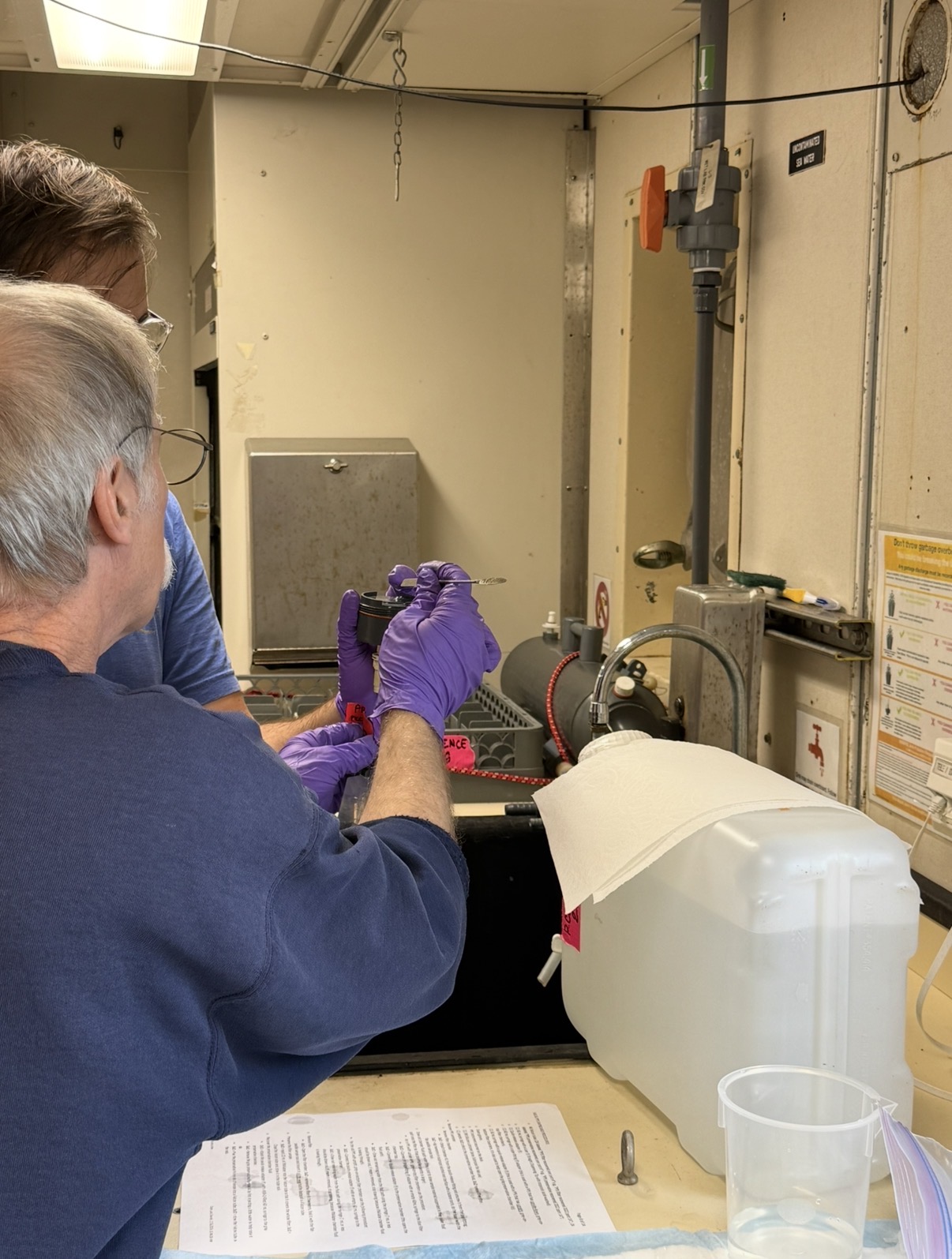
While I slept following my watch, the ship began its long 18 hour transit to Slope Base at around 0700. I woke up around 1100 to freshen up and eat lunch before my shift. 1200 rolled around, and there was nothing hands on for Alex and I to do, so we made our way to the bow and basked in the fresh air and looked onto the endless sea around us. At around 1400, one of the scientists and onboard photography expert Mitch had us assist in processing the RAS/PPS samples. This was a simple but delicate process that required us to disassemble the sampling containers, remove the filters containing phytoplankton and other microbial life, and preserve them in RNA later (a solution that preserves RNA which would otherwise breakdown). We also made sure to sterilize our tools in between every sample. By our third sample processing, Mitch, Alex, and I had a smooth line of actions between us, and we ended up breezing through all twenty-four samples before 1600. At that point, we were observing a gathering of people which we investigated. This turned out to be one of the ship crew, Zack grilling tri-tip steaks on deck in preparation for dinner. This segued into one of the standout dinners for this expedition: grilled tri-tip steak with chimichurri, roasted potatoes, roasted brussel sprouts, fresh garlic bread, and crabcake hollandaise. The classic combo of steak, potatoes, and cruciferous stem vegetables is hard to improve upon.
There is a lot of downtime for everyone on the ship during transit, so the crew had the pleasure of welcoming us students into the inner workings of the ship. At 1800, we split into two groups with one going to the bridge of the ship, and one going to the engine room. I was part of the group visiting the bridge first, and despite already having been there, it was still incredibly interesting. Chief mate Pam was very descriptive when describing how the ship is controlled. During our time on the bridge, a pod of short-beaked dolphins approached the boat and began to swim and jump in the wake of the boat. There had been a few dolphin sightings by various groups people throughout the trip, but I had never been awake or around during those times, so it was great to finally see them. We then swapped places with the other student group, heading down to the engine room while they came up to the bridge. One of the engineers Gabriel was our designated tour guide for the engine room. The engine room is incredibly loud, requiring double ear protection of earplugs and earmuffs, so Gabriel communicated through hand signs and writing down on a whiteboard. One of the things that I found really interesting was that the main ship engines are cooled by seawater, and the seawater that captures the expelled heat is funneled into a water distillation chamber which only requires very little energy to turn the already extremely hot sea water into steam and into potable water. Apparently when the ship had been doing an operation in Antarctica, the freezing cold seawater cooled the engines so much that they didn’t have sufficient excess heat to run the water distillers. It’s interesting how many things on the ship serve multiple purposes for the sake of efficiency. Knowing how the ship operates now gives me a better appreciation for all the crew that works diligently around the clock to literally keep us all afloat.
August 15, 2026
0000 marked the beginning of my day and my shift once again. This dive was focused on replacing the digital still camera, collecting hydrothermal vent fluid, and collecting temperature and electrical resistivity on vent fluids. I started the shift by taking over during the middle of collecting hydrothermal vent fluid samples using an instrument called an IGT sampler (Isobaric Gas-Tight). This instrument allows measurement of the temperature of fluids expelled by hydrothermal vents during sampling, which sometimes rise beyond 300°C, and collection of a sample that will be kept at is original pressure to study the gasses dissolved in the fluid, including those issuing from the underlying magma chamber (e.g. CO2).
Following the collection of those samples, the Jason team pivoted to installing the TRHPH probe, which had just been replaced by the earlier shift. This is an instrument that measures temperature, electrical resistivity, and redox potential of hydrothermal vent fluids. There is the main body which sits by the vents near a vent orifice and then a specialized probe that can withstand high temperatures, which is inserted into the vent opening to transmit the data. The probe is left inside the vent, which sends data in real-time back to shore during the year. This provides information about changes in the vent fluid properties, such as boiling or impacts from fracturing in the seafloor and entrainment of seawater. Through my own research and experiences prior to the expedition, I knew about quite a few of the instruments we would use and their purposes, but these two were entirely new to me, and it was incredibly fascinating to watch them in action and learn about them.
Our highly technological and successful dive so far was pleasantly paused for a Graneledone octopus that made its way to one of the junction boxes in the area. These octopi have many unique qualities, with one species holding the record for longest egg brooding period of any animal on Earth. This octopus took part in a interesting display where it inflated its tentacles, something I had never seen before. Jenna theorized that it was threatened by the ROV and tried an intimidation tactic. We ended up recording almost ten minutes of 4K video of this one octopus. Our shift ended as the Jason team swapped the old digital still camera out for a new one, and securing and retrieving the old one. Following this, I headed to bed as usual.
I have always considered myself very resilient and adaptive to a lot of conditions, and I was very proud that I’ve never been seasick, let alone ever felt abnormal at sea. This all changed when I woke up at around 1030, an hour and a half before my shift. I opened my eyes, and my vision didn’t come for another few minutes. I felt pain in every inch of my head, from the corners of my mouth to the molars of my teeth, to the entire circumference of my head. I had swollen and open sored areas in my lips and cheeks, swelling and pain in my back molars, and a few mysterious cuts and scrapes on my hands and arms. I felt like I had just gone ten rounds in the ring with Anthony Joshua. For the next 45 minutes, I laid in bed watching the Jason livestream during its survey of international district area two as my body regained control of itself.
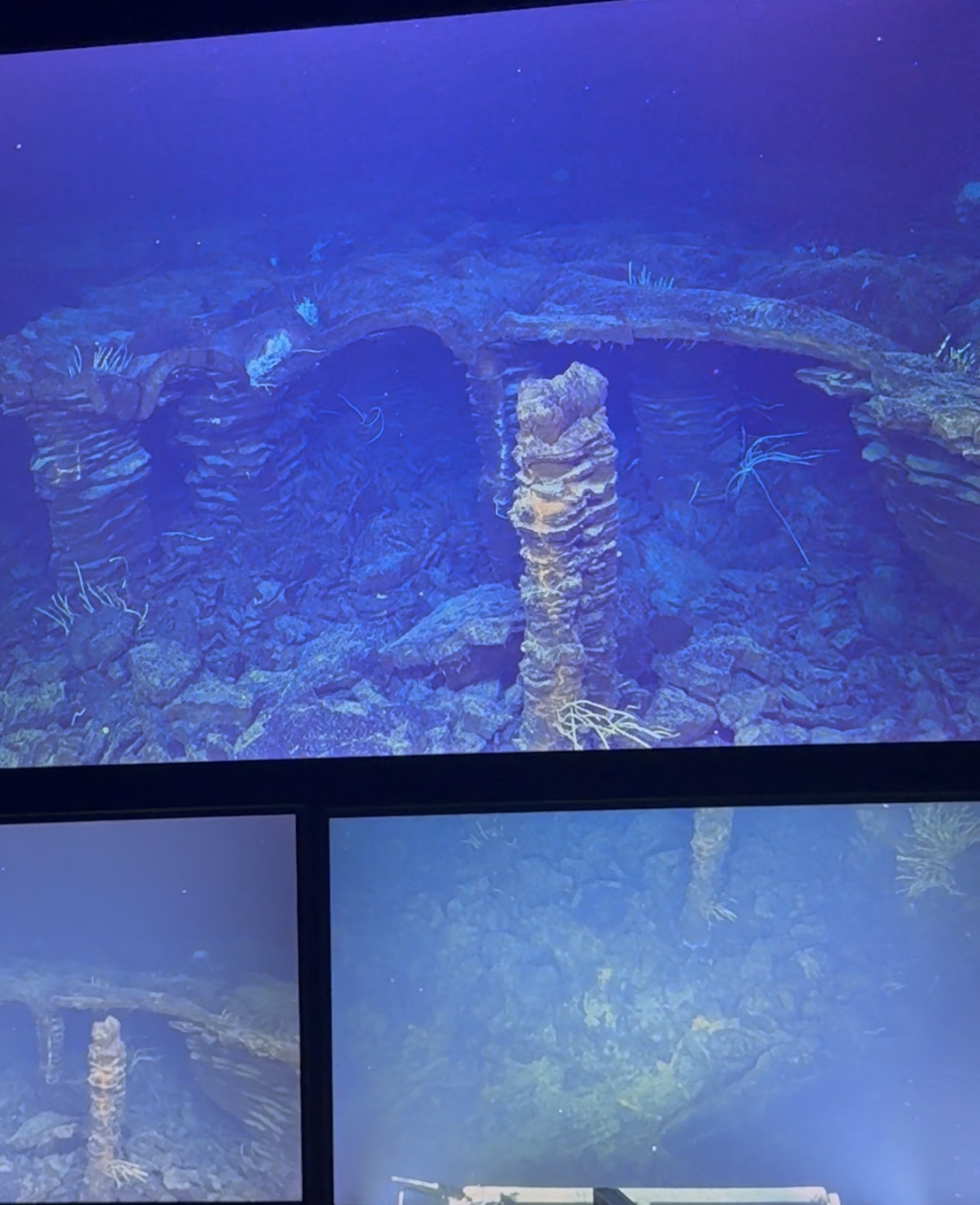
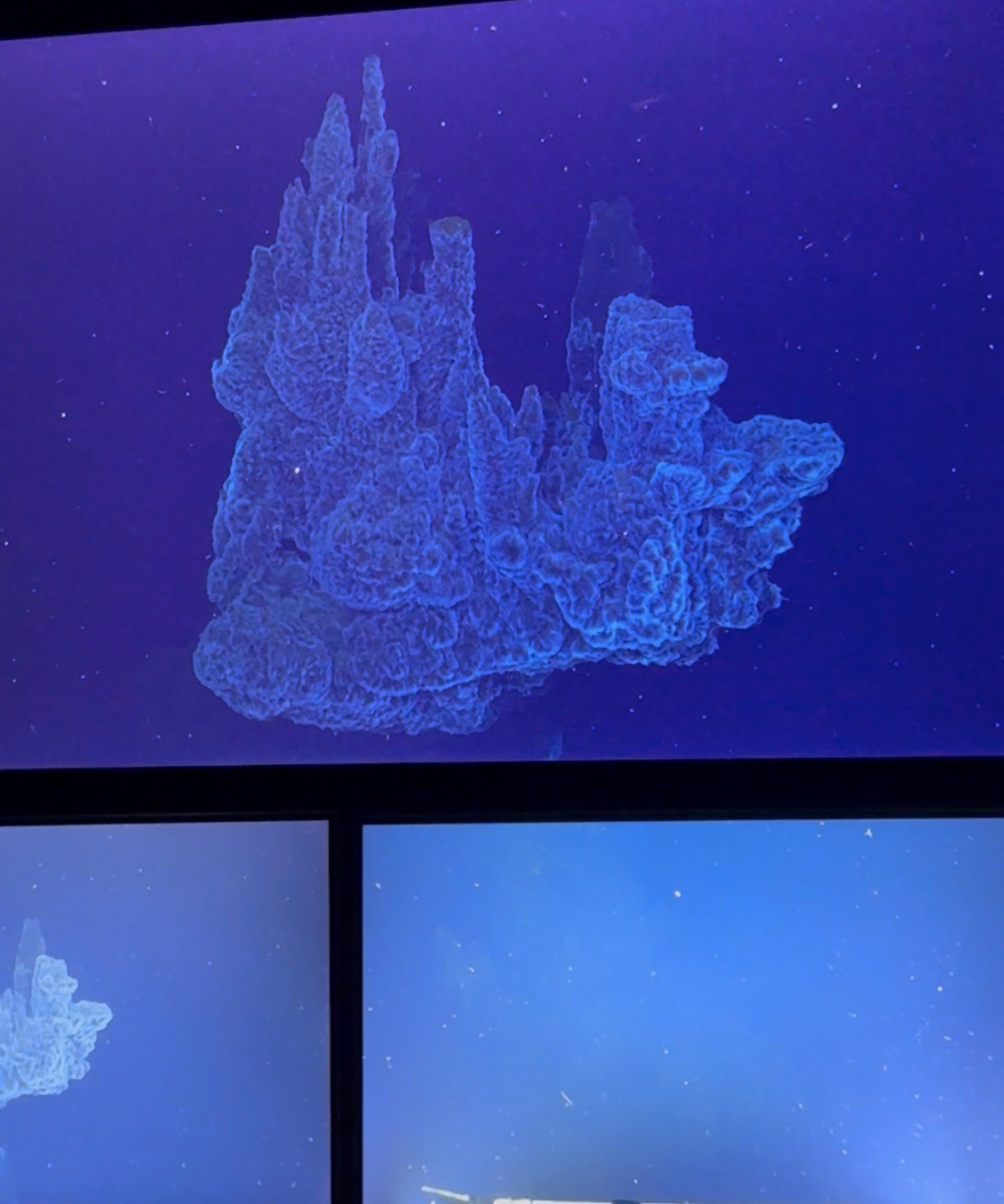
At around 1130, I had gotten out of bed, and all the pain had localized itself to my head. I grabbed various fruit as my pre-shift meal and headed to the van. We spent a lot of time visiting various sites of interest, including the 18 meter tall hydrothermal vent “El Guapo”, the filamentous bacteria coated “Castle”, and the distinct formations of the “Collapse lava lakes.” These were incredible to see, all with their own distinct features, which would have been even more incredible if my head didn’t feel like it was also pressurized at 1500 meters deep. I ended up taking a short break for a few minutes with Oliver filling into my position. I took a few ibuprofen and a glass of ice cubes to chew on which gave me just adequate enough relief to perform during the shift until we headed down at 1400 for a student meeting. At around 1530, all the pain had mostly subsided and I only had a dull light-headed feeling which soon went away in the hour as well. Interestingly, I didn’t get any nausea and all I felt was mostly pain. During this time, many of us students helped oceanographer Mitch in processing RAS water samples. This processing continued until we all headed to dinner at 1700, which consisted of roasted cauliflower, couscous, baked fish, and pan seared scallops.
I was particularly impressed by how great the scallops were. There is a pretty small margin of error when cooking scallops that decides whether your scallops are raw and undercooked or rubbery and overcooked. This is especially prevalent when cooking many at a time, like the galley was, so careful attention is quite important. I would argue that the galley is the heart of this ship and expedition, and probably every ship and expedition, for their consistent quality bringing everyone together for meals. I am extremely curious to know the galley crew and learn their career path and how they ended up with this job.
August 14, 2026
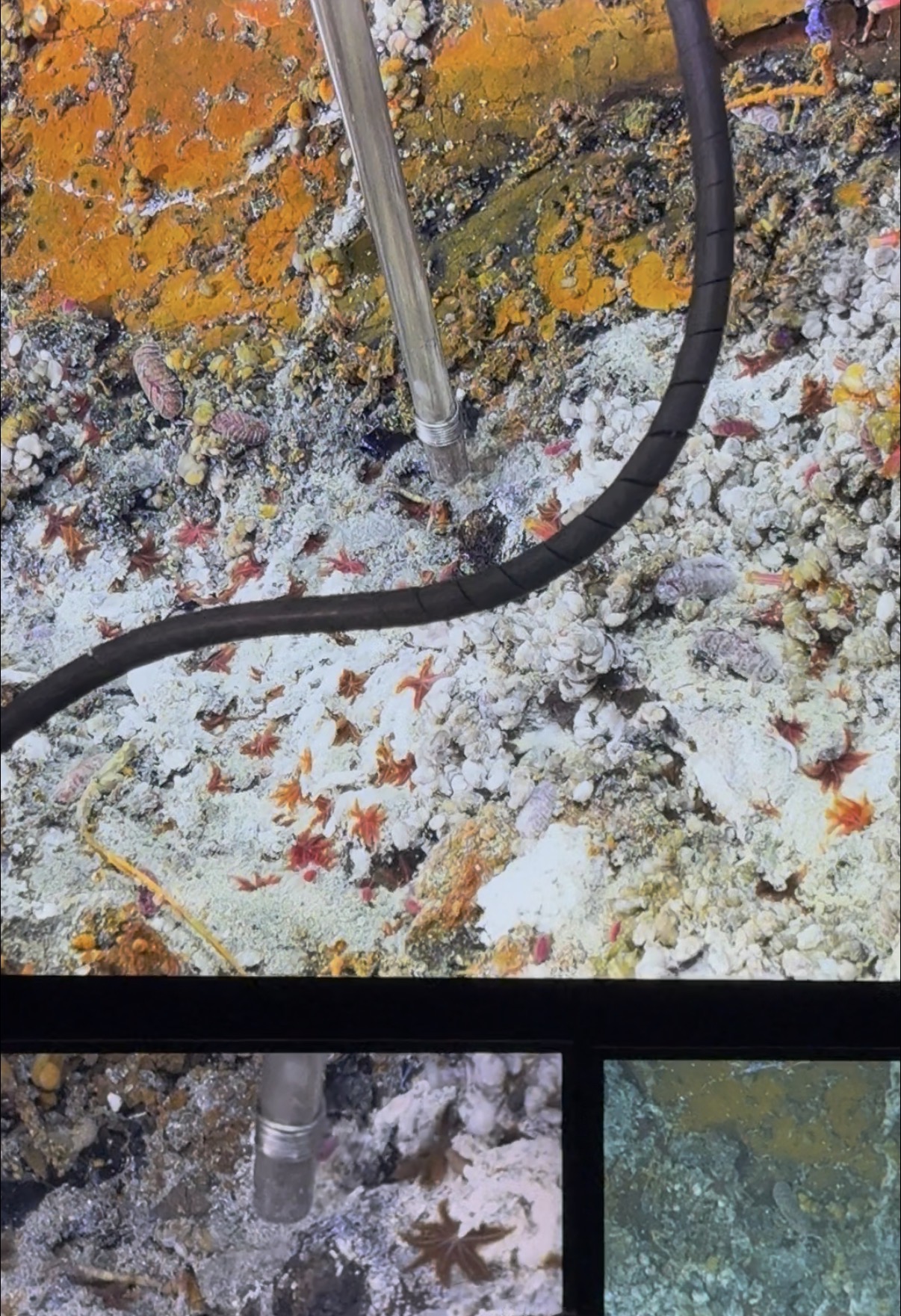
Our 0000 shift mainly involved the replacement of junction box MJ03F and reinstalling all its instruments. We continued to see many organisms, which all had now become familiar faces at this point. While observing the various fauna, I noticed an interesting detail about rattail fish coloration. Throughout our dives, we were seeing a range of bright silver to a dark brown and gray coloration on them, and I realized that it was relative to their life cycle. There were often rattails around the junction boxes, so I used that as a figure for scale and caught that the largest rattails were always the darkest in color and the smallest ones were always the lightest. I later confirmed this by looking it up online and the coloration of rattail fish is directly linked to how mature they are. It’s interesting to note that in general the darker colored individuals are the ones that mostly inhabit the deep ocean, while the lighter ones appear to be in relatively shallower waters. When I think about deep sea organismal physiological adaptations, it feels easy to be caught up in the strangest of them all. My first thoughts go to chemosynthetic bacteria in hydrothermal vent tubeworms or exaggerated body proportions like in gulper eels and fangtooth fish, but sometimes the adaptations to the deep sea’s harsh conditions come as simple as the rattail’s darker coloration for camouflage.
The central parts of my second shift revolved around taking readings and data from various diffuse flow sites and replacing the RAS and PPS at the Tiny Towers site in the International District Hydrothermal Field. The RAS and PPS are two types of samplers which allow for collection of water and phytoplankton and organic matter particulates. The most interesting part of this dive was certainly observing the diffuse flow sites, which are slower and lower temperature outlets of hydrothermal vent fluid. We took the temperature of a few sites which ranged from near 20°C to over 70°C, all being a stark contrast to the surrounding water temperature which was generally 2-3°C. One of the equipment we used during this operation was a Vent Cap, which collects this cooler hydrothermal fluid for microbial and chemical analysis. We had to break apart some of the sulfide chimney around a suitable diffuse flow site with a tool in Jason manipulator to make room for the Vent Cap.
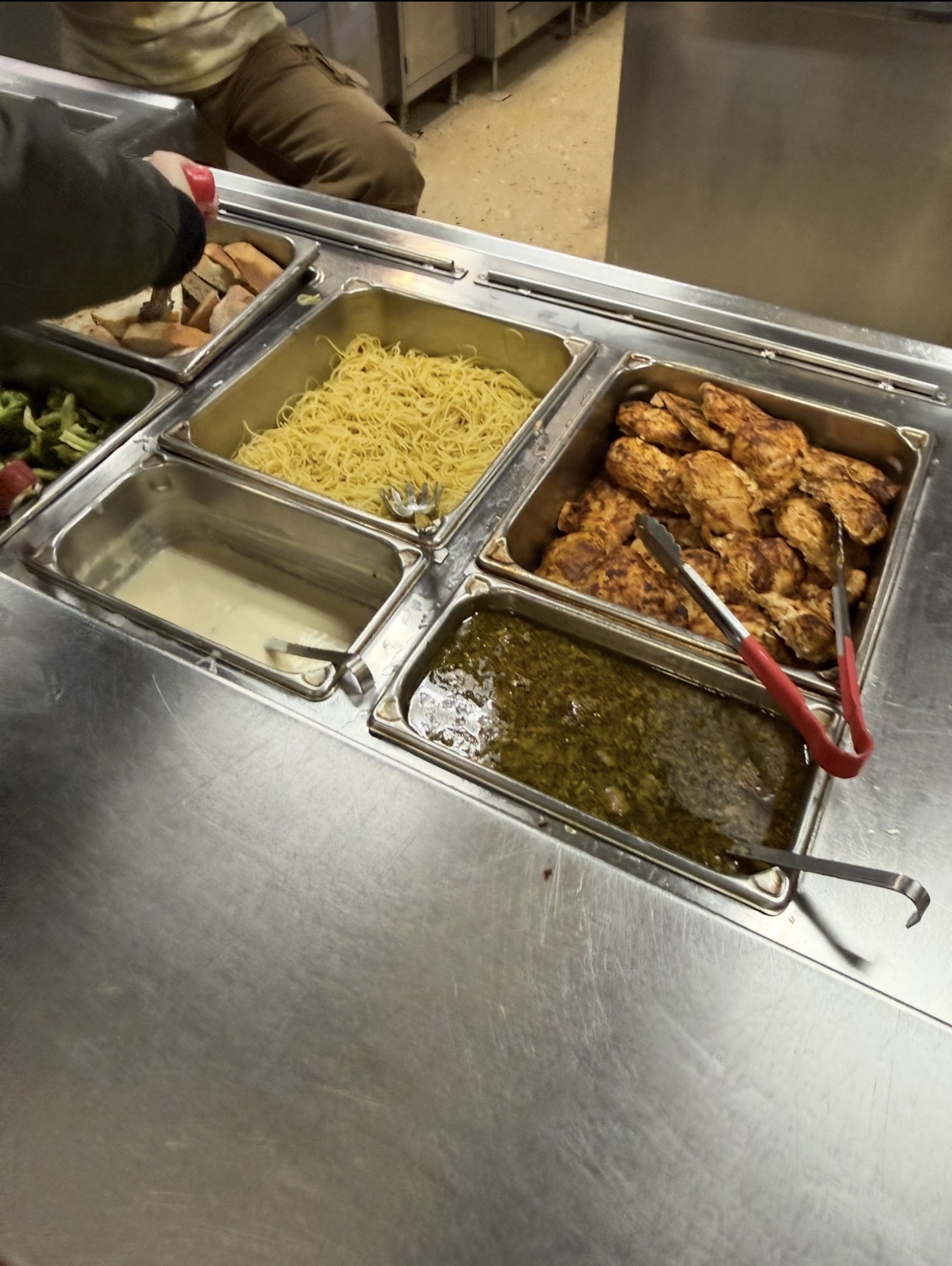
Dinner was as always great, with the blackened chicken being the star protein of the meal along with a supporting cast of alfredo pasta, roasted broccoli and fresh bread. The chicken was wonderfully juicy and well-seasoned. I even took a piece from the leftovers fridge and put it in between two pieces of toast for a late-night meal. While the chicken was my favorite, it had a competing rival which won most of my peers over. The galley always makes dessert during dinner time, and the classic brownie was the choice of the day. I watched other students scoop ice cream over their slices, and within less than two hours the entire large tray was almost completely gone. I followed dinner with spending more time researching for my project and working out in the confined gym. I was able to fall asleep easily to get some rest in before my next shift.
August 13, 2026
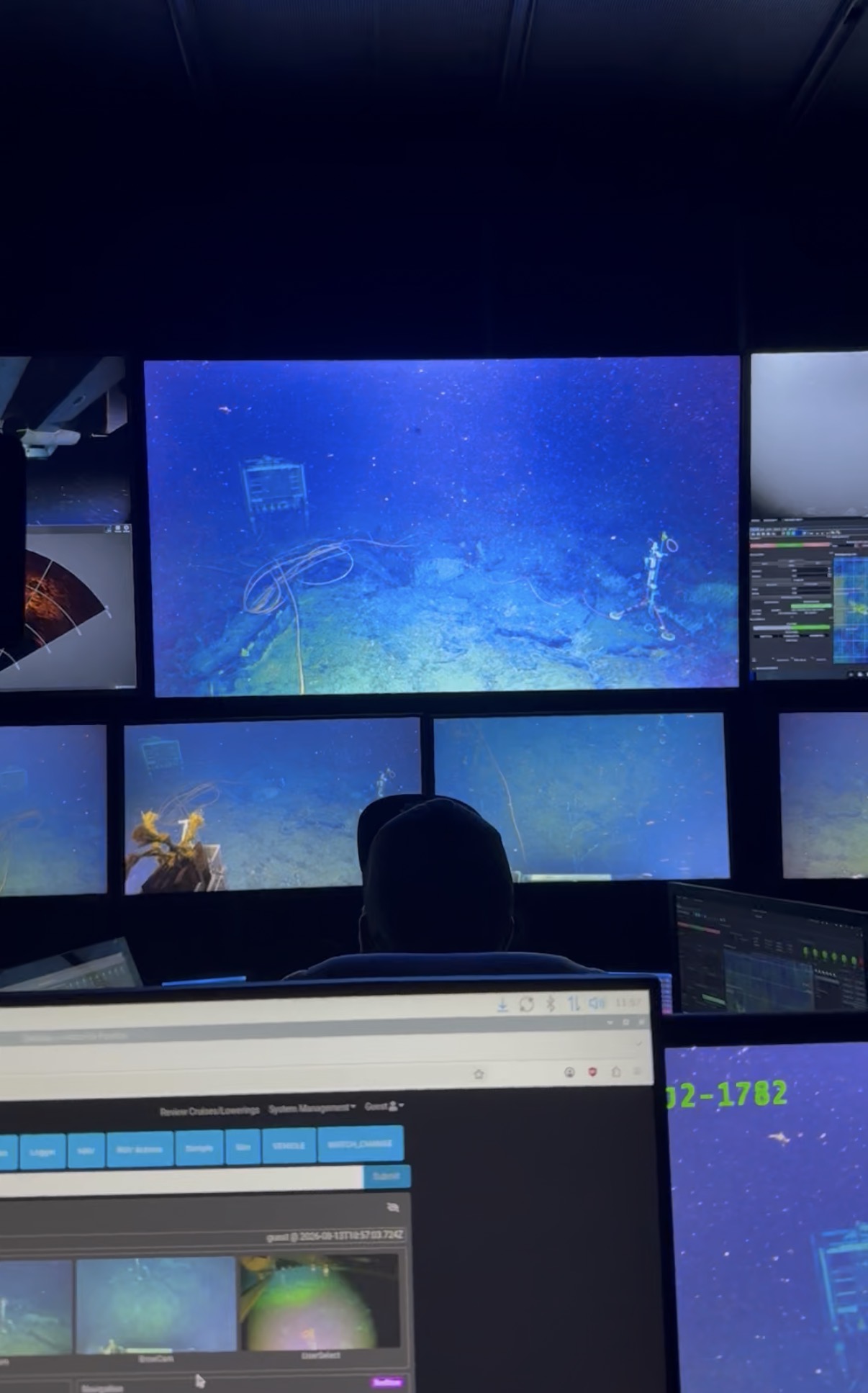
Once again the day starts at 0000 for Alex and I. We went into the van expecting Jason in the water as we had gotten word that we were ahead of schedule and the dive that was scheduled to start at 0100 had gotten the go-ahead to begin at 2200. We entered the van to be greeted to a multi-camera view of the ships deck. Unfortunately, when Jason entered the water at around 2200, a swell came by that upset the HD camera in the undervator to be deployed at ASHES. As a result, the dive was postponed until conditions improved for a heavy lift dive and the camera tested on deck. For over an hour, Alex and I stayed on standby, waiting for when the dive would be reinstated. At around 0130, we finally begun Dive J2-1782, which involved swapping a junction box, benthic CTD, and completing video surveys around the area. After about another hour, we had reached the seafloor and began our duties. Replacing the junction box required us to detach every cable from the old junction box and reattach them to the new one, for which there were six cables. About halfway through reconnecting the cables to the new junction box, some one of them was a bit too far away from the junction box. As a result, all the work put into plugging in the cables had to be undone, and the process started all over again. Even a thing like cable management must be very thorough, as any problems that happen now and left untouched will just be worse over time and be a problem for the next year’s RCA crew. By 0400, we were still plugging and unplugging cables, so I gave the rundown to the next shift and promptly headed to bed. I had a strong headache by the end of that time, so I can only imagine what the Jason operators were feeling. I’m hopeful they got good sleep after that.
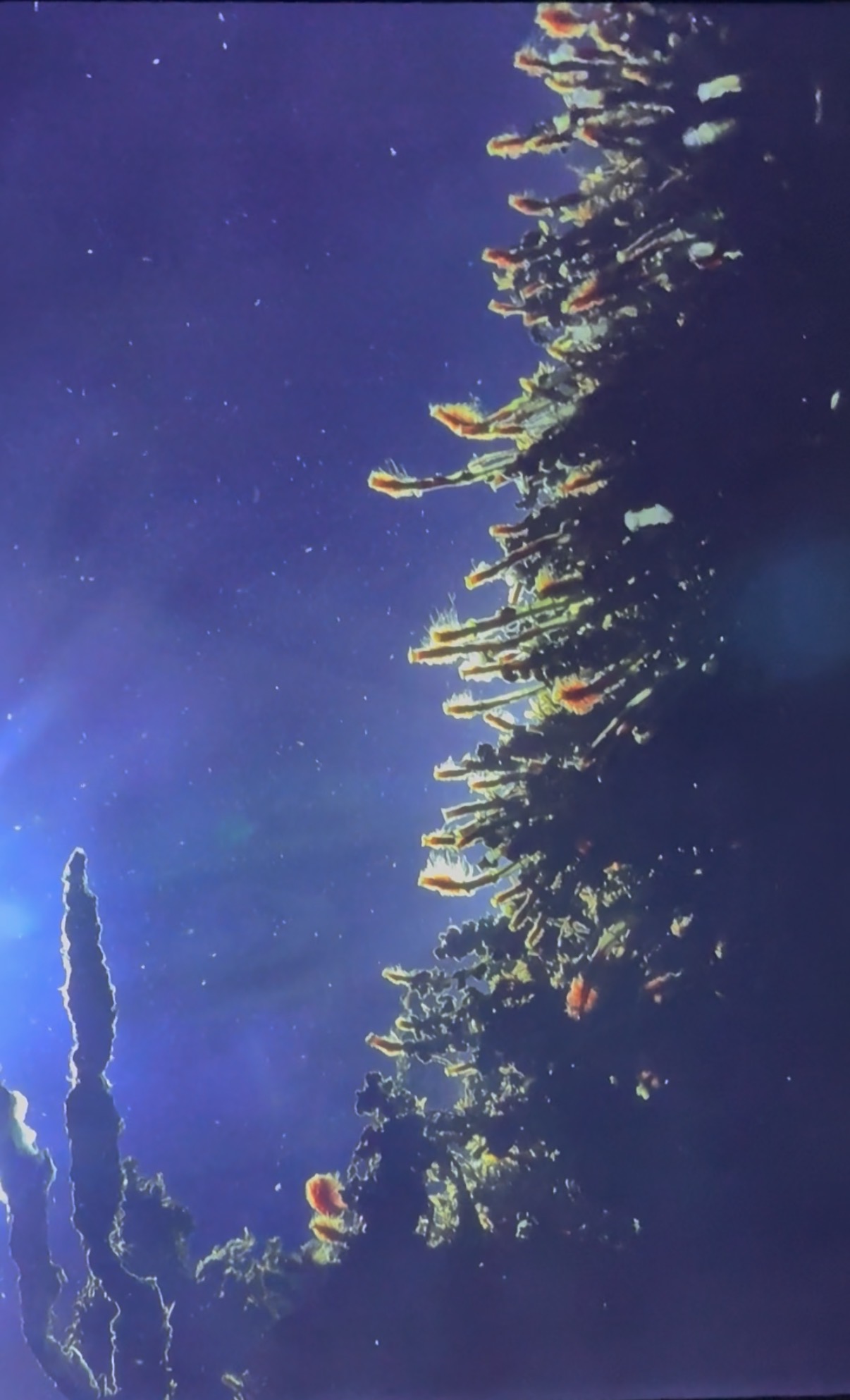
For our next shift at 1200, we were in the middle of transit to a new spot on the Axial Seamount to the ASHES Site. Alex and I weren’t needed in the control van until around 1300, where we began dive J2-1784 to swap the HD camera pointed at the Mushroom hydrothermal vent. This was by far the most fun and interesting dive yet. After arriving at the seafloor and flying over to the vent, we were greeted by a 3.5-meter-tall hydrothermal vent called Mushroom teeming with invertebrates. The bizarre life that surrounds hydrothermal vents were the catalyst for my interest in these environments and ultimately the opportunity to be on this expedition. Ridgeia tubeworms covered all the faces of the hydrothermal vent, some noticeably healthier than others. The healthiest of them have bright white casings that make up most of their body and vibrant red plumes at the end. The unhealthier ones are much duller in color as well as being smaller and appearing flimsier. These organisms are some of the most unique on the planet, from their extremely rapid growth to their reliance on chemosynthetic microbes for food, there is nothing like them on the planet.
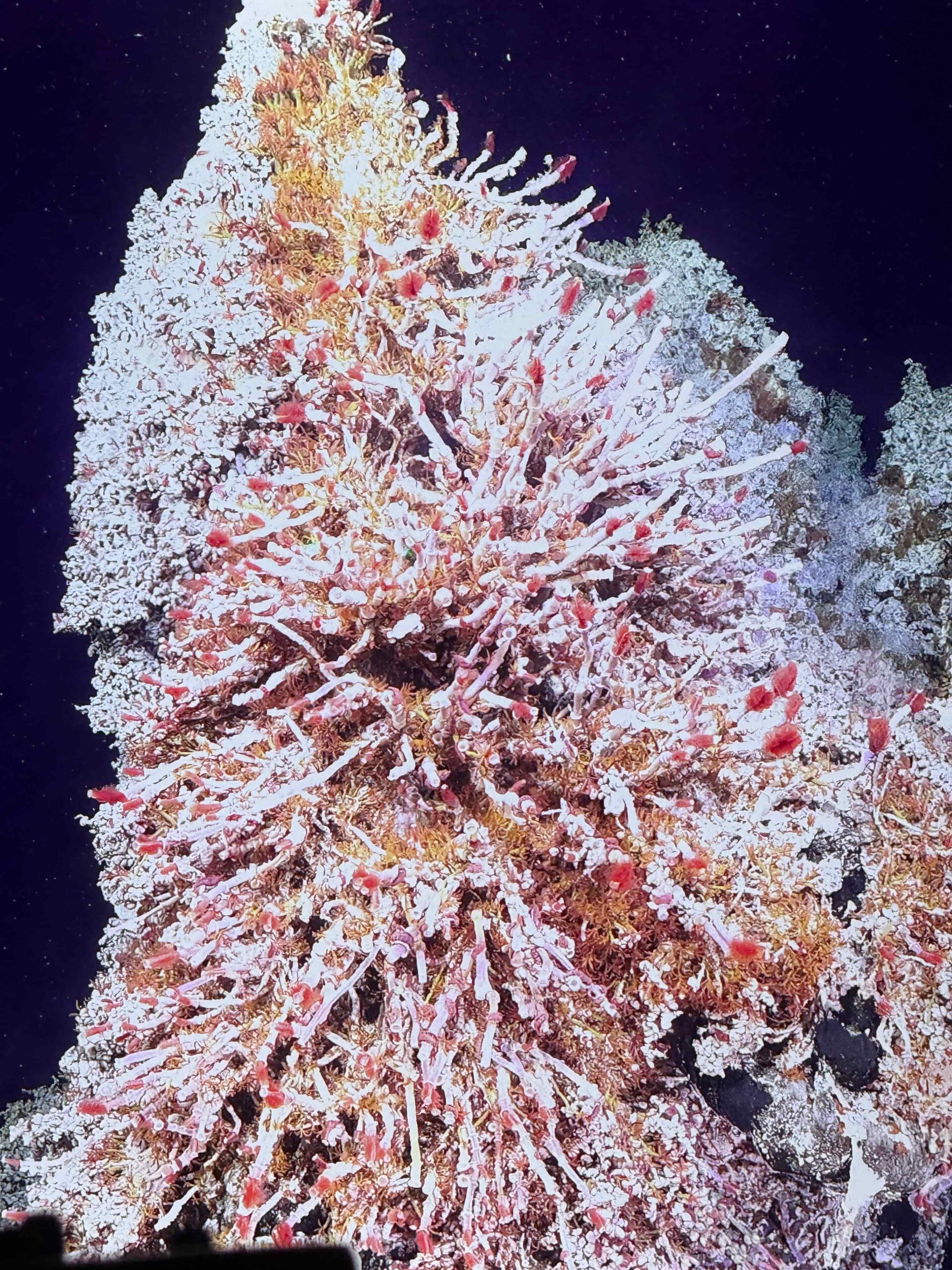
After my shift ended and the large audience in the van dispersed for dinner, we were all back in the van eagerly observing. After multiple hours in this area, we had finally set up the new HD Camera pointed directly at the hydrothermal vent. Dr. Kelley was very adamant to ensure the new camera would be able to exactly capture the angle of the old camera. There are projects with this specific vent that follow years and years of timelapse footage, so keeping the angles consistent is extremely beneficial. The pilots then began to drive Jason around the vent, capturing detailed 4K video. We had also gotten word that the new HD camera was now operational, and we witnessed it come to life. Jason used its robotic arms to pose for a picture in front of the camera, which was then sent to us later. The HD camera has its own lights, so for added ambiance to our footage, Jason cut off all its lights and captured many scenic silhouetted shots of Mushroom illuminated by the HD camera’s lights. We had probably spent four hours flying around and capturing footage of the vent, but it only felt like several minutes. After a little while longer for the Jason team to regroup, they began to ascend back to the boat carrying the old HD camera, marking an end to an unforgettable experience.
August 12, 2026
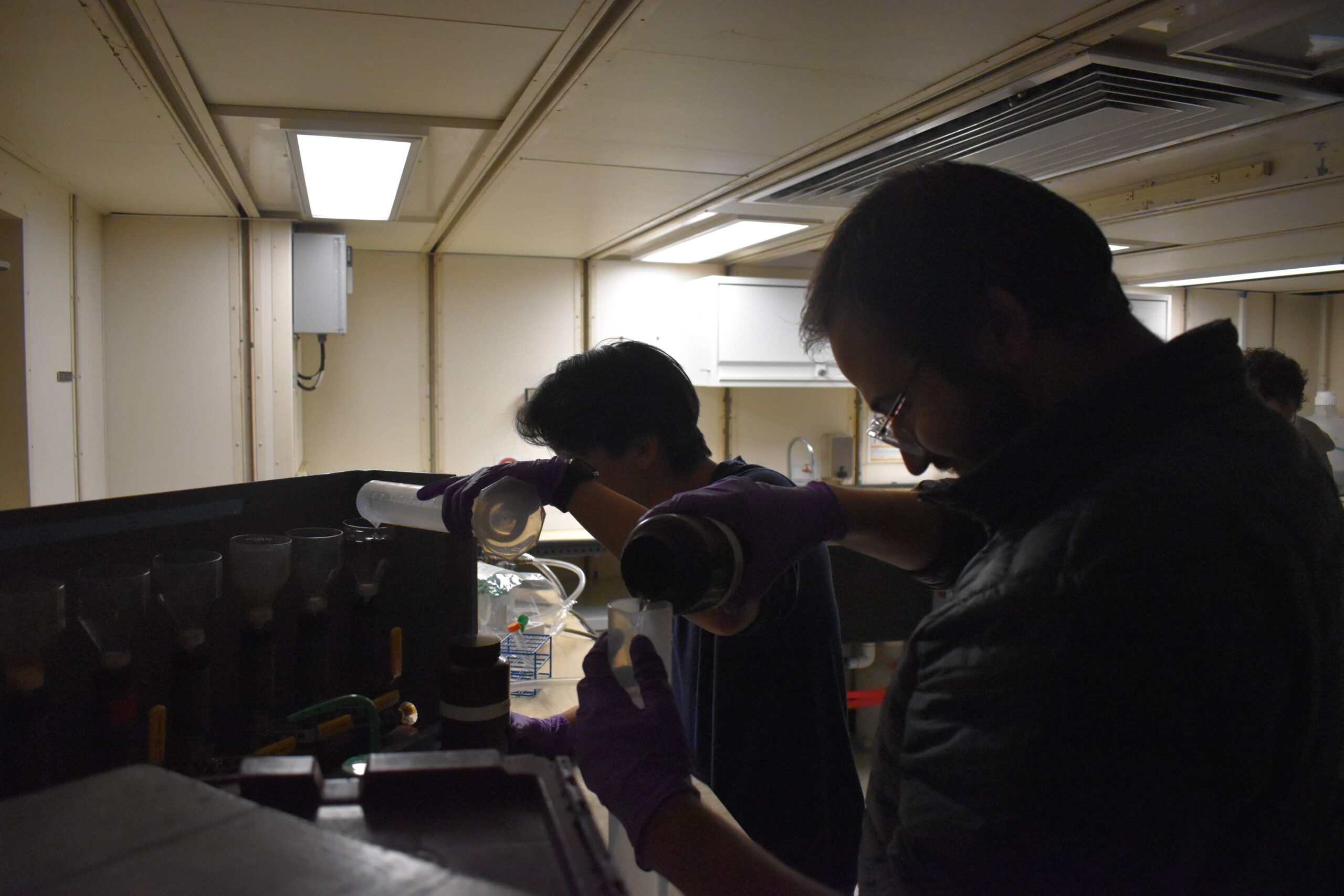
Today started at the usual hour of 0000. The ship had just begun its approximately 18-hour transit from the Slope Base to Axial Base site. Since we were in transit and would still be by the time of our next shift, this meant that there would be no Jason dives for the day, which was a change to the routine. The shift before us had just pulled up the 2900 meter CTD, which meant it was up to Alex and I, along with our watch leaders and supervisors Joe and Ada to process the water samples. We collected water from each of the Niskin bottles, which housed water from different depths, and collected them into multiple flasks and bottles for chlorophyll-a and salinity analyses. One thing to note is that the water samples that are collected to test chlorophyll-a concentrations must be decanted into opaque bottles to not let light through. These samples contain phytoplankton, extremely small photosynthesizing organisms, so any extraneous light that it meets can initiate unwanted photosynthesis in the bottles, ultimately increasing the chlorophyll-a concentration and providing an inaccurate representation of the actual photosynthetic activity at the sampled depth. Once we had collected all the required bottles of water for chlorophyll-a analysis, we stored them in the fridge and took an imperative midnight snack break.
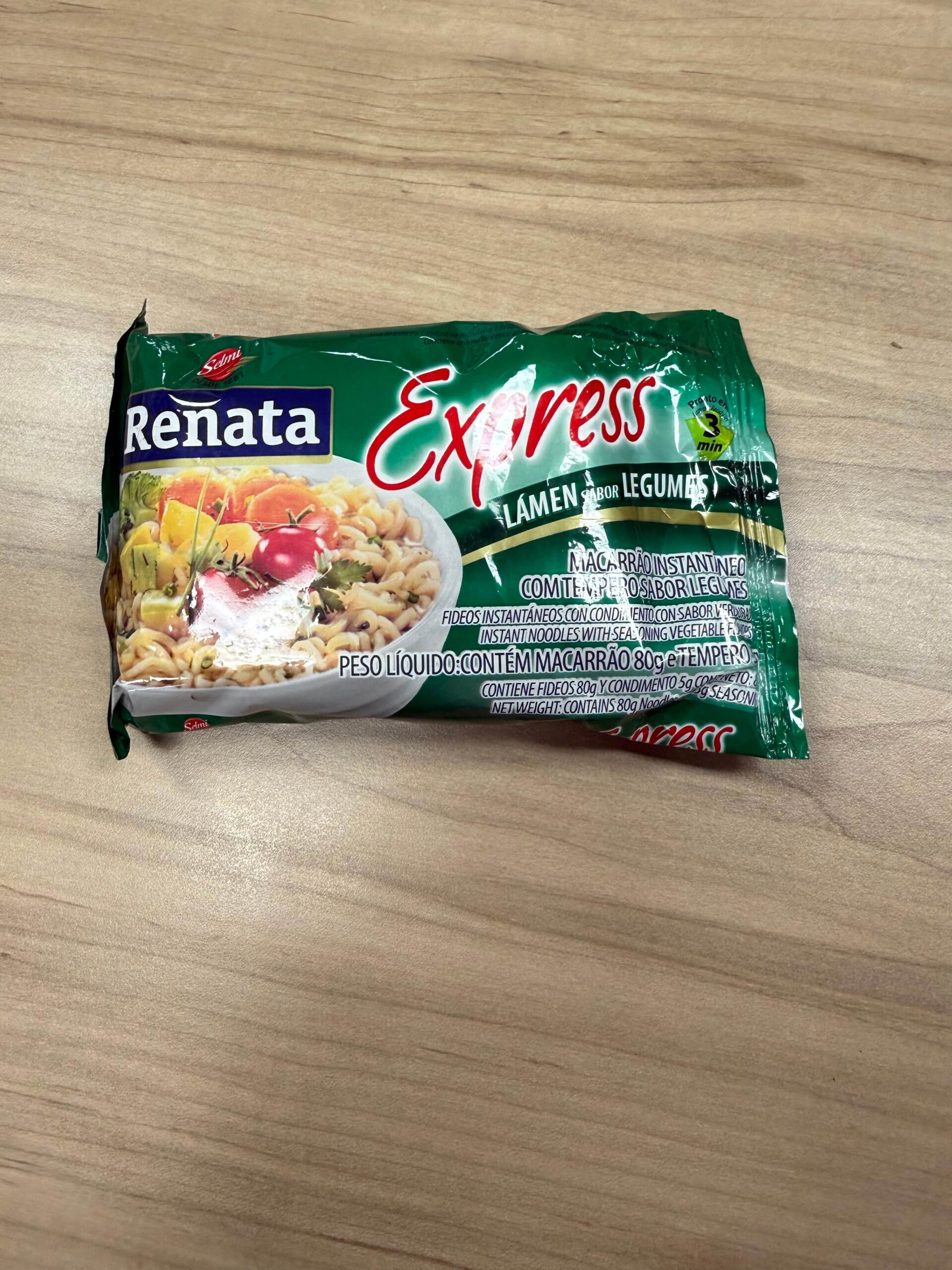
Our midnight meal was nothing short of an experiment. Joe and Ada opted for bagels as their food of choice. We soon found out that the bagels were potato based after a confusing two rounds in the toaster yielding almost no browning. They then lathered their bagels with a classic spread of cream cheese and a not so classic spread of sriracha and barbeque chips. Alex arrived from the leftovers fridge holding a plate which contained bok choy, something I was certain we hadn’t had during our time on the ship. Ada and Joe confirmed that the bok choy was a part of a meal from 8/6, a full two days before Alex and I stepped foot onto the ship. Alex seemed to enjoy it, a testament to the galley’s exceptional cooking and preservation. My route went the path of instant ramen. The ship cupboards yielded the classic cup ramen and a few packets of an unknown brand to me. Upon further inspection, the writing on the package was not in English, but rather Portuguese, with a small label on the top right reading “produto do Brasil.” Brazilian ramen was not one of the things I expected to be consuming on this trip. Hopes were not high about its flavor among the crew, but it still intrigued me. Hot water and a few minutes later, my doubts were absolutely proven correct. Alex perfectly remarked that it was like “somewhat tasty cardboard.” Adding sriracha to the soup proved no help in enhancing the flavor, to which Joe remarked that there was no hope left for these noodles.
Our food journey over, we headed back to the lab to process the chlorophyll-a water samples. We essentially do the first few steps of the entire chlorophyll-a analysis and preserve the samples, and once we return to land the process continues with instruments far more sophisticated than needed on a ship. From each water sample, we measure out 500 milliliters and pass that through a microfiber glass filter. This system is attached to a vacuum to ensure all the water passes through the filter, trapping all the phytoplankton in the sample on the filter. The filter is then folded to fit inside a plastic centrifuge tube before adding 10 milliliters of acetone to preserve the sample. These tubes are stored in the freezer until the ship returns to land. This is all done in a dimly lit area so to not skew the results. Almost two dozen samples later, it was just about 0400 and time to head to bed.
When I woke up at around 1100, the ship was still in transit to Axial Base and would continue to be for the next few hours, which meant that there was no scientific work to be completed during my shift. With plenty of time to spare, Justin, Alex, and I asked for permission to enter the bridge, where the ship is piloted. The crew let us into the bridge and gave us a quick tour. For transit, the ship is usually put onto autopilot, whether it be specifically following a set route or straight lining at a specific heading, which means there isn’t much activity in the bridge. The second mate showed us a few more of the controls, such as the throttles for the three engines, port, starboard, and forward, that can turn the ship when set to differing thrusts.
We finally arrived at Axial Base at around 0430, with the current shifts set to perform more CTD deployments, with one to be sent to the bottom and one to be done near the surface. Axial Base is at a depth of around 2600 meters which meant there is a lot of downtime in between deploying and retrieving. With not much action happening on the ship, it’s the best time to think about projects and deliverables to accompany this expedition. I am hoping to take the experience and results of this incredible trip and apply it to projects that expand beyond our corresponding fall class, and maybe even beyond my time at UW.
August 11, 2026
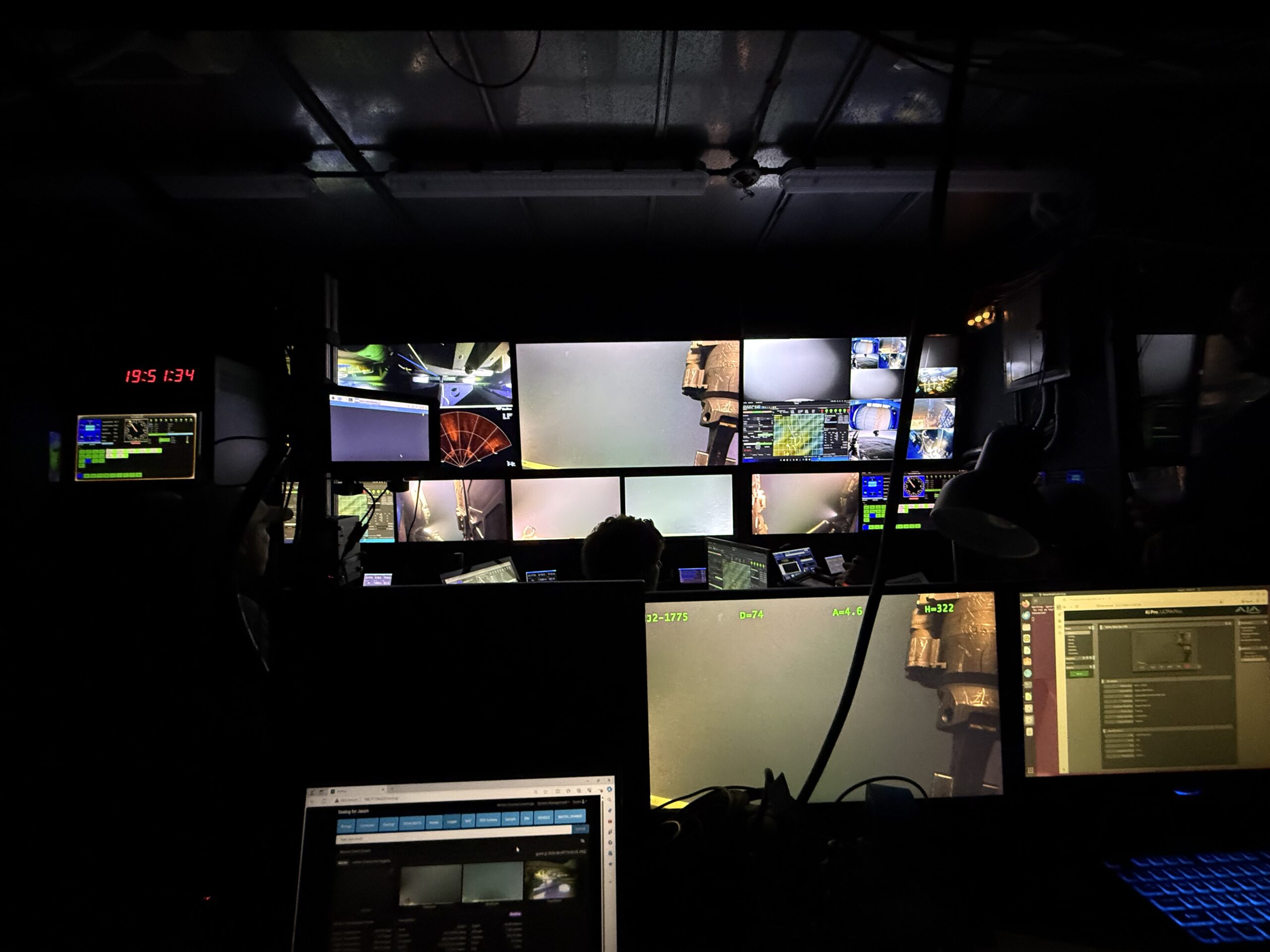
My days started at its normal hour at 0000, with Jason having just reached the seafloor at Southern Hydrate Ridge for Dive J2-1780. This operation was very similar to the previous dives to swap out last year’s digital still camera. Unlike the past dives, we encountered a slight problem with the 2025 Digital Still Camera. The seafloor at this site is constantly subject to slight deformations and changes, and there was a depression in the sediment under one of the 2025 Digital Still Camera’s legs. This meant that it was crucial to be extremely careful when removing the 2025 camera and cautious of the depression when installing the 2026 camera. The Jason team spent a lot of time to place the 2026 camera away from the depression while maintaining approximately the same camera angle as the previous years. This endeavor took up my entire shift until 0400, when we had just about successfully confirmed the final position of the new camera.
The next portion of the dive, which was to be handled by the following shift was a survey of the surrounding area that is notable for its unique methane seeps. The methane seeps are area in the sedimented seafloor that release methane gas into the water column. The methane is formed, in part, as a result of the subduction of the Juan de Fuca tectonic plate under the North American plate, during which sediments containing organic material is “scarped” off onto the margin. There was quite a lot to see during the survey, including various organisms, geological structures, and a pink flamingo marker left by MBARI, or so I heard. I was extremely tired following the end of our shift, so I decided that my personal rest was more important than witnessing the survey in real-time and headed to bed.
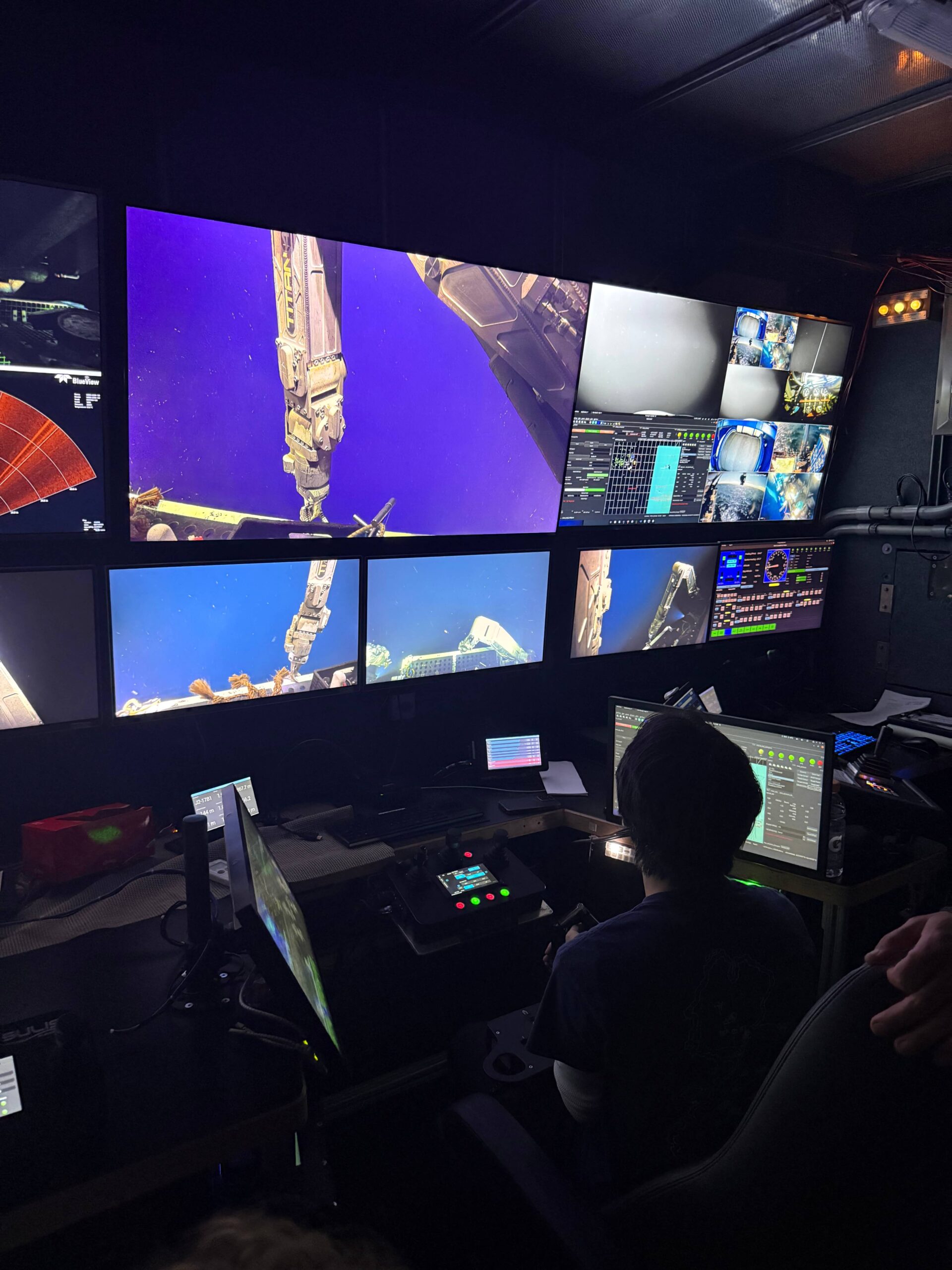
I slept essentially all the way until right before my shift at 1130. While I was asleep, the methane seep survey concluded, and the ship had transited from the Southern Hydrate Ridge an hour to the Slope Base site. Alex and I took our positions in the control van and continued where the previous shift had left of in Dive J2-1781. The dive involved replacing and retrieving a system of instruments that measure dissolved oxygen, spectral absorption, pressure, and conductivity. This operation was at a depth deeper than we’d been before, at approximately 2900 meters. At this depth, the organisms we encountered included grenadier fish, various sea anemones, snailfish, crabs, and even a relatively large octopus. At this depth, these animals’ physiological differences from those in shallower waters are extremely prevalent. Organisms either have extremely large or small eyes that compensate for the lack of sunlight and form ecologically niche body types, such as snailfish and grenadiers with anguilliform bodies to maximize energy efficiency while swimming in a food-scarce environment.
After more careful manipulation by Jason to perform the duties to swap equipment at around 0300, it was time for a multi-hour ascent from 2900 meters all the way back to the surface. In ascent, Jason is pulled by the ship’s onboard winch. During this time, there is essentially nothing to do but wait and occasionally observe organisms pass by the cameras. With so much time to kill, the Jason operators graciously pulled us from our logging and video duties and instead sat us down in the frontmost seat in the van, the pilot chair. Each student took turns manipulating Jason’s arms under the careful guidance of the star ROV pilot.
One of the things I had never really noticed before was that the arms of Jason are practically identical to a human arm. Jason arms have a shoulder joint that connects to the main body, an elbow joint, and a wrist joint. This freedom of movement is one of the primary reasons Jason is so precise. The controller for the arms is essentially a replica of the Jason arm, with its own mimicking joints, which means that any movement on the controller can be identically translated to Jason. It is almost like if you moved your own arm and someone else’s mirrored yours. We had the opportunity to move the arm back and forth through the open water in front of Jason, as well as fiddle with more of the controls such as the 360-degree rotation of the wrist joint and the opening and closing of the claw. That incredible experience marked the end of my shift.
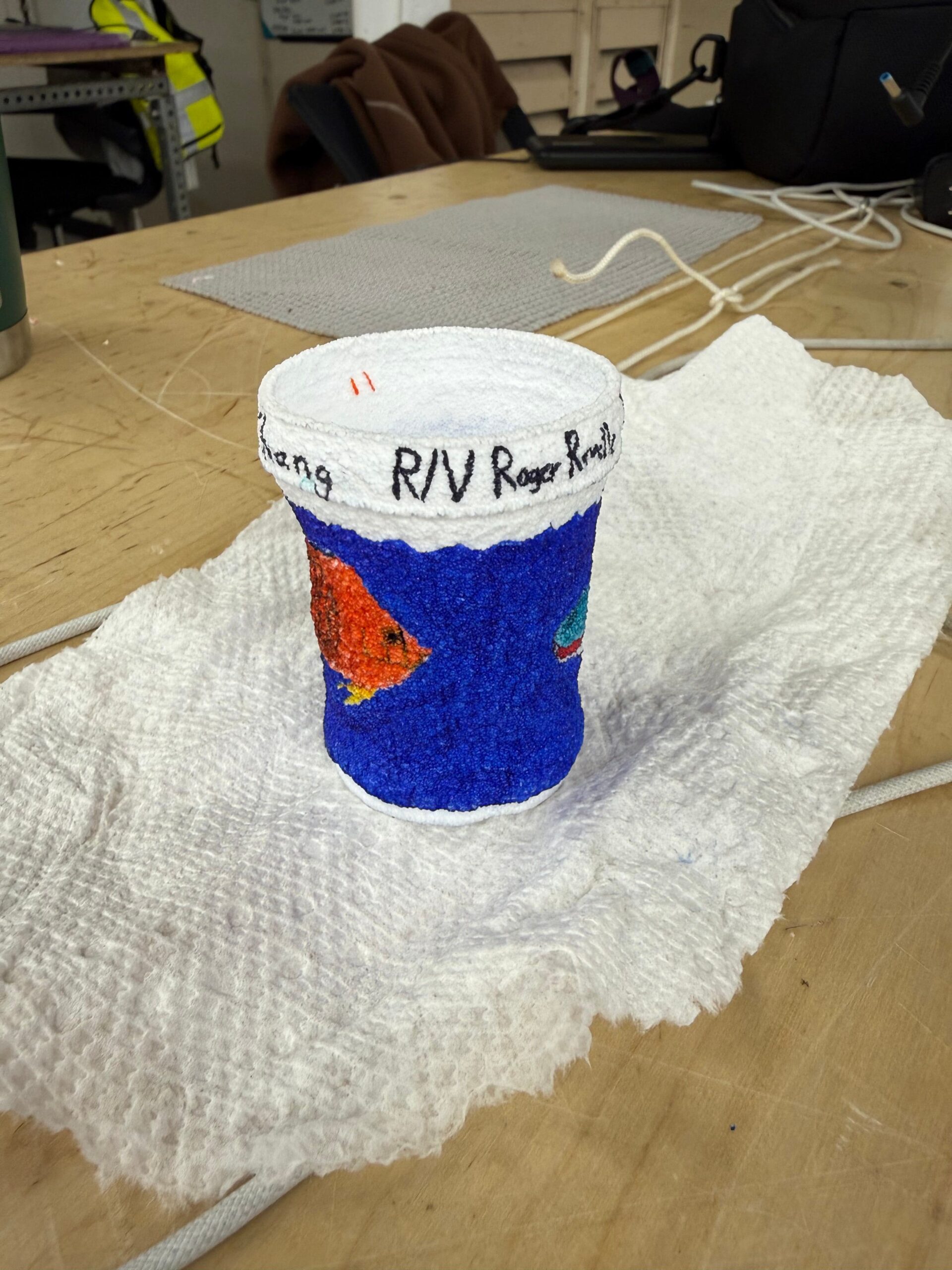
For the rest of the day, there were a few CTD deployments that went to different depths, but one was on everyone’s mind. Prior to today, many of us had decorated Styrofoam cups and balls, signing them with our names and adding our own personal touches. This was because we would be deploying a CTD down to the bottom of the site, at around 2900 meters, and at that depth the water pressure is so intense, it heavily compresses anything with air inside it. It is a long-standing deep-sea activity to send Styrofoam objects down and observe how much they shrink and compress from the intense pressure. At around 2330, thirty minutes before my shift was going to start, the CTD had come up with everyone’s decorated cups. These will remain as one of the coolest souvenirs we can obtain from this trip.
August 10, 2026
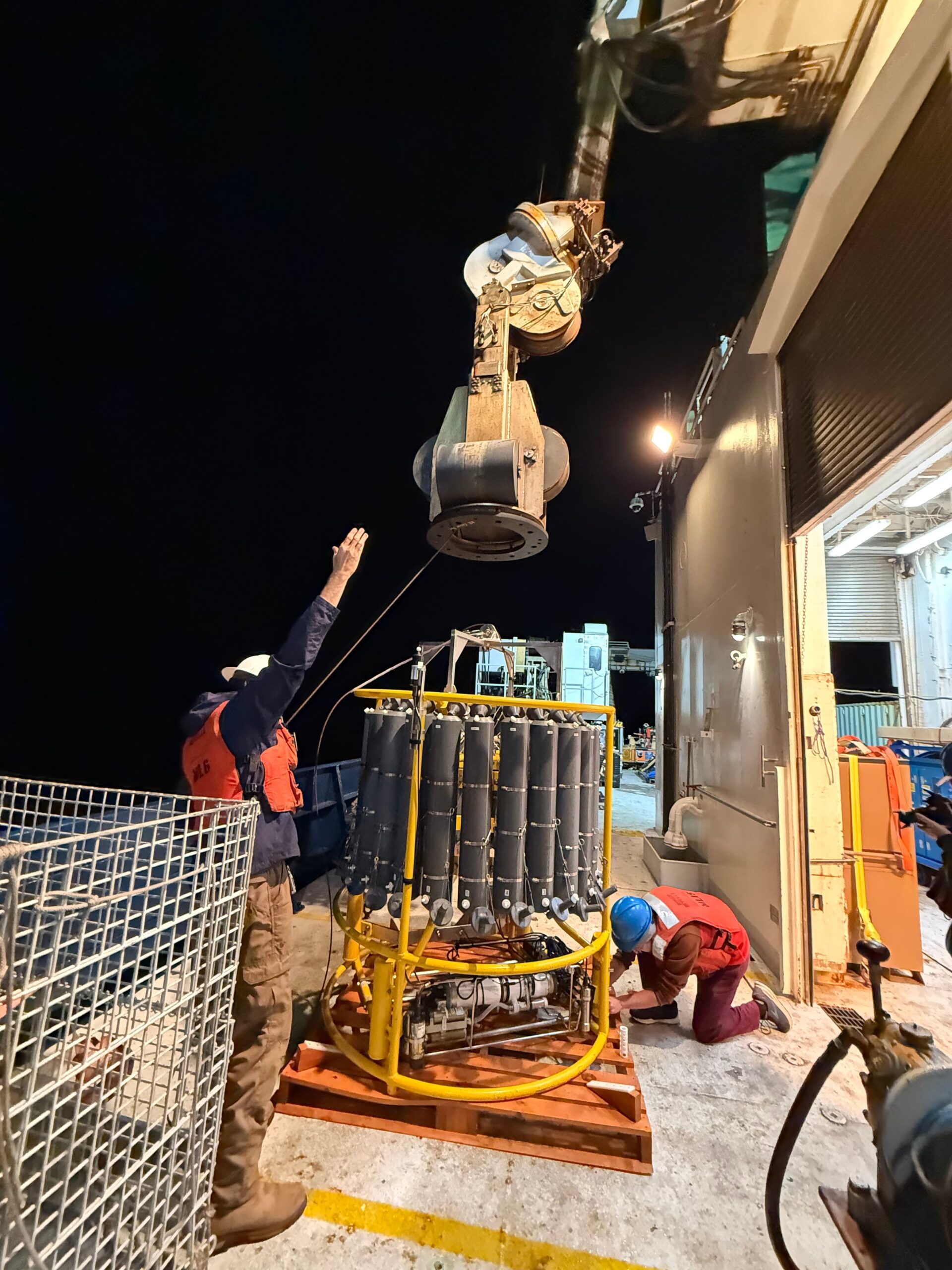
Today my shift started at a very comfortable 0000 (12 am) as the ship was transiting to the Oregon Offshore site. Alex and I spent the first hour standing by and awaiting any directions as the ship was still a few hours from reaching the site. We spent this time brainstorming for our eventual projects and keeping ourselves energized for our early shift. At around 0100 we began preparations to lower a CTD into the water so that we would be ready to launch as soon as we got to site. CTD stands for conductivity, temperature, and depth, and it is a system of instruments that measures just that, as well as many other things such as pH, salinity, and chlorophyll-a. CTD instruments are commonlyn attached to a round metal frame that houses multiple plastic tubes called Niskin bottles, which are containers that are open as they enter the water column and fill with ocean water. They can be closed remotely at will from the lab on the ship, allowing for water samples to be taken at various depths. It is extremely common to have a myriad of instruments together in one system to make each cast and operation as efficient as possible. The more data we can get with less work, the better.
The preparation work we had to do was priming the Niskin bottles by latching them open so that the spring-loaded mechanism can activate at the push of a scientist’s button, closing the bottle and securing the water sample inside. Once the ship arrived on site, with the help of the winch operator, the CTD was lowered into the water to a depth of 220 meters. With 24 primed Niskin bottles, the scientist on watch, Joe, proceeded to take two water samples every 20 meters. After a lengthy spell of water sample collecting, the CTD was hauled back aboard the ship, and the water was ready to be collected into various flasks for nutrient, dissolved inorganic carbon, and dissolved oxygen analysis. This involved going back and forth between our log books and the Niskin bottles to note which flasks were filled with water from certain depths. When we were relieved by the next shift at 0400, I headed immediately to bed.
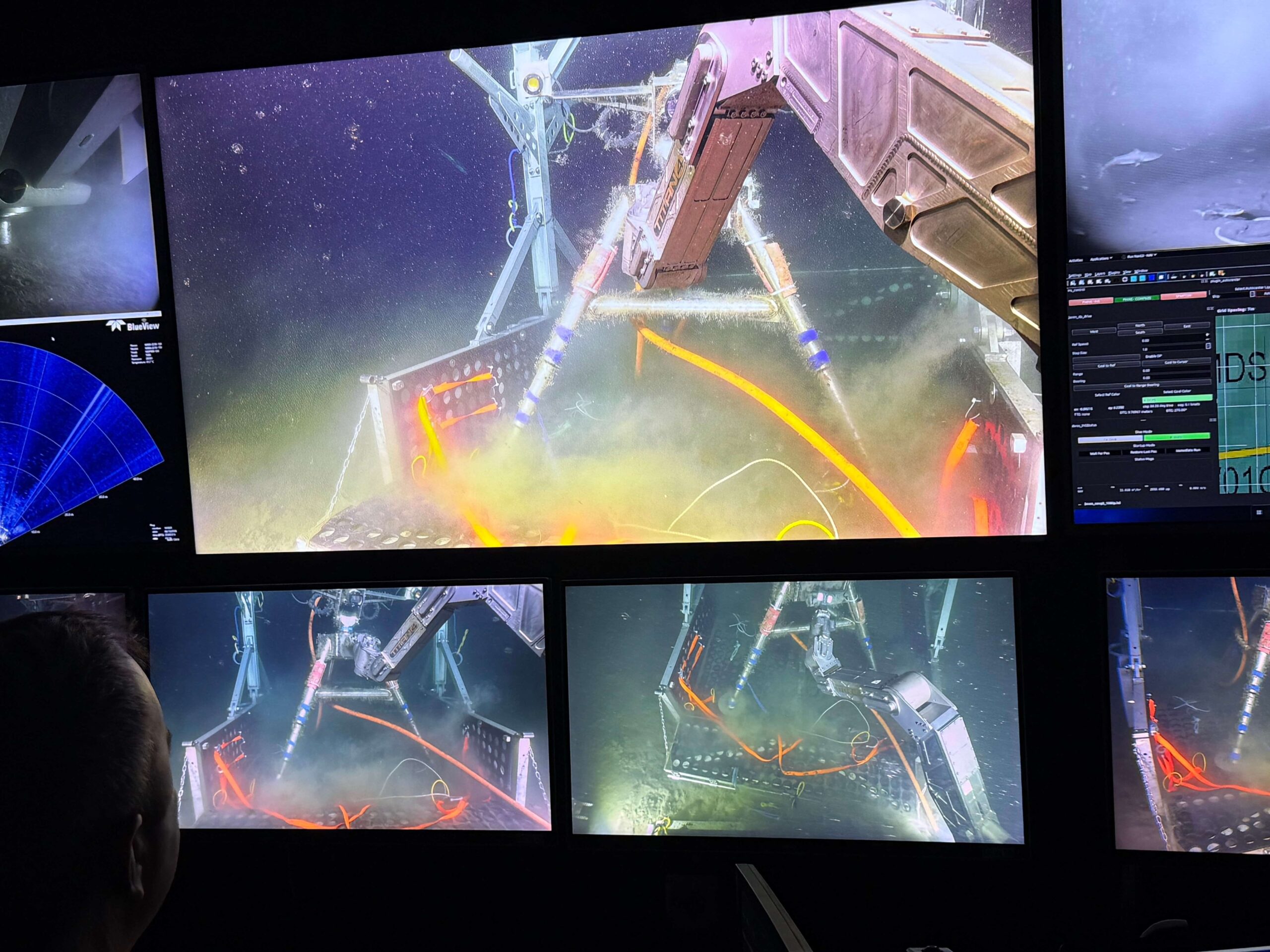
I slept until 1100, just in time to witness Jason come up from having just swapped the Oregon Offshore’s Benthic Experiment Package. At 1200, it was time for my turn in the Jason control van which involved an operation to replace the Digital Still Camera. This operation relied heavily on very precise and calculated movements with Jason as the Digital Still Camera and its cables are more fragile than most of the other instruments. The Digital Still Camera is also mounted on a tripod, so it was more prone to being unstable, as opposed to the two box-like instruments I had previously helped log in the control van.
Once again, I was in awe of the engineering of Jason, as well as the precise coordination between the Jason operation team. The communication between the navigator, the pilot, the engineer, and the hot seat (RCA dive lead), was fluid and efficient. This operation was at a depth of about 580 meters, deeper than our previous dives which meant the lifeforms present were much different. There were plenty of black cod surrounding the entire instrumentation area, and occasionally the ones who were too curious ended up being sucked into the Jason turbines and end up mutilated. It was morbidly humorous to be focused on our operation and then see a section of black cod gill float into focus. My shift ended at 1600, where the next set of my peers took over and the operation hit its final stride by taking some 4k highlight videos.
Following the end of that operation, we began our transit to the Southern Hydrate Ridge. All of us students were taken to the main deck by Mariela to witness deployment of an XBT (Expendable BathyThermograph), which is a disposable probe that is dropped into the water and is attached to an extremely thin strand of copper wire. This probe falls a certain depth into the water column sending real time data back to the ship before the wire eventually is snapped either by the scientists or on its own and sinks to the seafloor, hence its expendability. Since the housing of the XBT looks almost identical to a t-shirt cannon, we were all led under the false premise by Mariela that we needed PPE; hard hats, safety goggles and life vests, when in fact the probe is anticlimactically just dropped into the water, not launched. Being a student means you’re subject to be tricked occasionally.
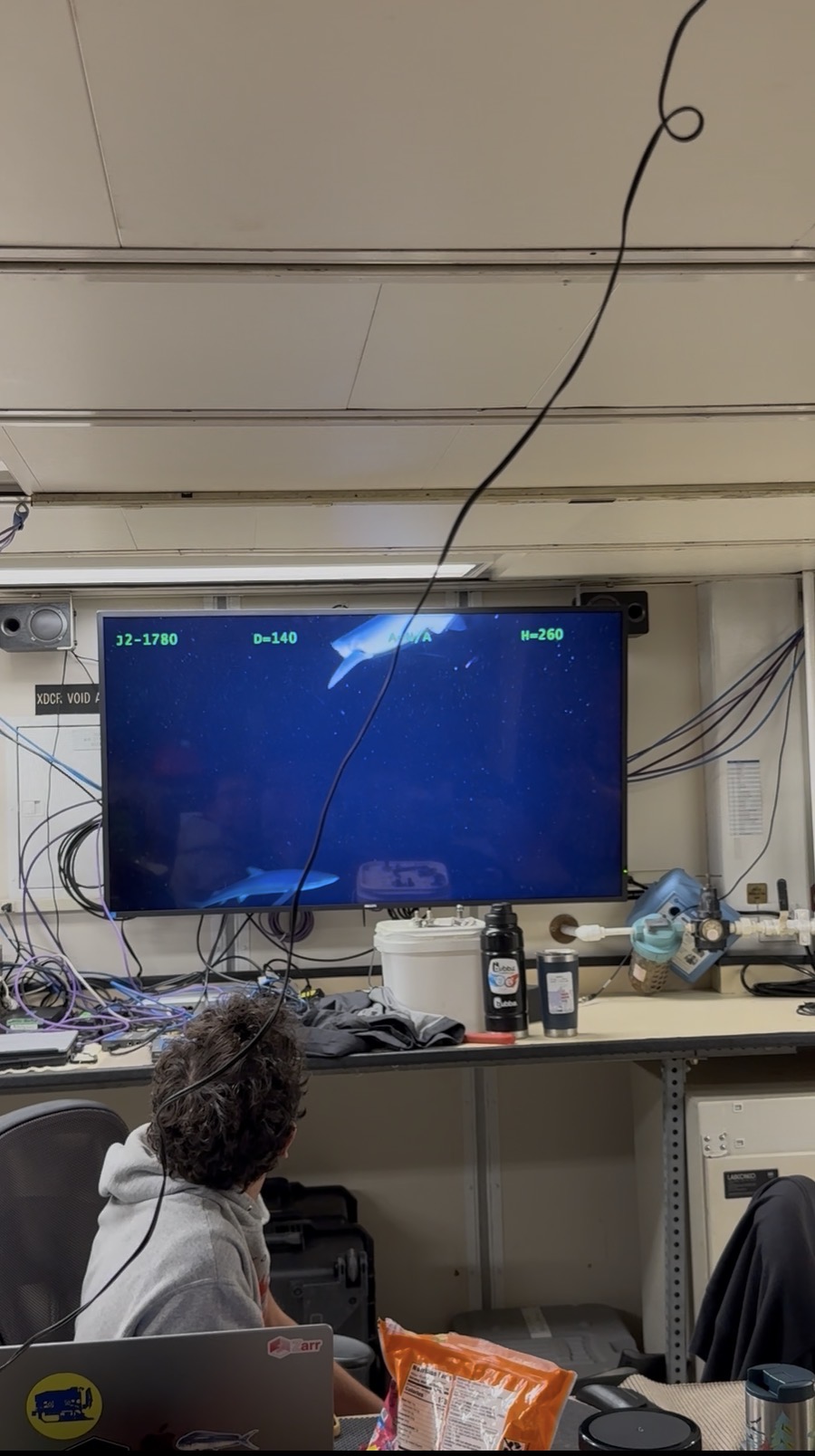
Dinner was a hearty selection of chicken thighs and salmon with sundried tomato sauce as well as rice and focaccia. After a few hours napping to rest up for my next shift, I awoke at around 2230 and caught the beginnings of the descent for Dive J2-1780 to swap the Southern Hydrate Ridge Digital Still Camera. What greeted me as I was still waking up was a pair of curious blue sharks following Jason’s descent, streamed down to the Main Lab monitors. I made my way to the control van and witnessed even more lifeforms as the ROV descended, jellyfish, zooplankton, and lanternfish. By the time we had reached the bottom of the Southern Hydrate Ridge, it was almost 0000 again and time for my shift.
August 9, 2026
Today is our first full day aboard the ship R/V Roger Revelle. We started bright and early with breakfast at 0730 to fuel up for our first scientific operations of the trip. Fruit, eggs, sausage, bacon, and chocolate chip pancakes were my foods of choice. At 0830 all students were taken to the ROV Jason control room to get a feel of where we were going to spend most of our time. Among other things, we are entrusted with the task of logging the actions of the dives and capturing important footage during the dives. It is important that we track every movement the ROV makes to have an accurate recount of the operation. At 0930 we were taken to see the ship’s CTD and become familiar with priming the Niskin bottles for water sampling. We made sure to have a good idea of everything we were working with before we head off to the first site.
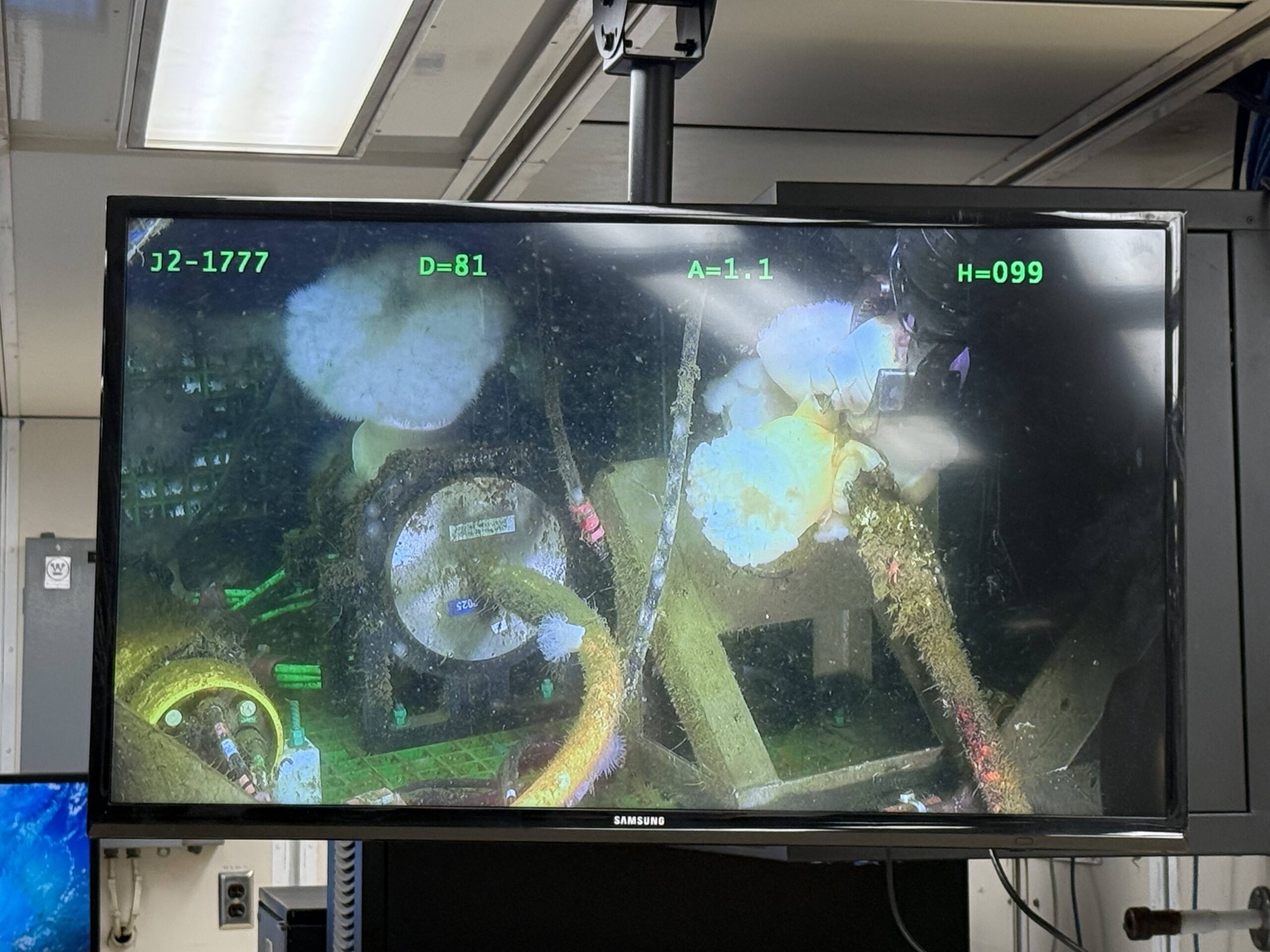
After about a one-hour transit starting at 1000, we arrived at the Oregon Shelf site for our first three Jason dives. After a quick lunch of a turkey-duck wrap with sweet potato fries and a final safety orientation, Alex and I were the first students thrown into the seats of the control van to help operate Jason. The goal of the dives was to recover and replace the Benthic Experiment Package; a large system of various instruments housed in one chassis. When we came upon the old BEP deployed in 2025, the Jason operators skillfully navigated using Jason’s two robotic arms to open the doors of the old BEP frame and disconnect the main cable. The 2025 BEP frame was home to a plethora of organisms including various anemones, sea stars, various fish of differing sizes, and most abundantly a large population of sole. The organisms had grown so much that they covered the cable connector with two large white anemones making their home on the connection point. The Jason operators were able to successfully transfer the main cable from the old BEP frame to the new one. The dive finished with Jason attaching itself to the 2025 BEP frame and bringing up all the 2025 instrumentation, leaving a sparkling new system of instruments down at the bottom of the sea. As the dive finished, so did my time in the control van for the day, handing off the responsibility of logging the dive actions to my peers for the next dive. My next shift begins at 0000 (12 am) so I took the chance to take a quick nap for a little over an hour before getting up to grab dinner, which was ribeye steaks with garlic noodles and potatoes.
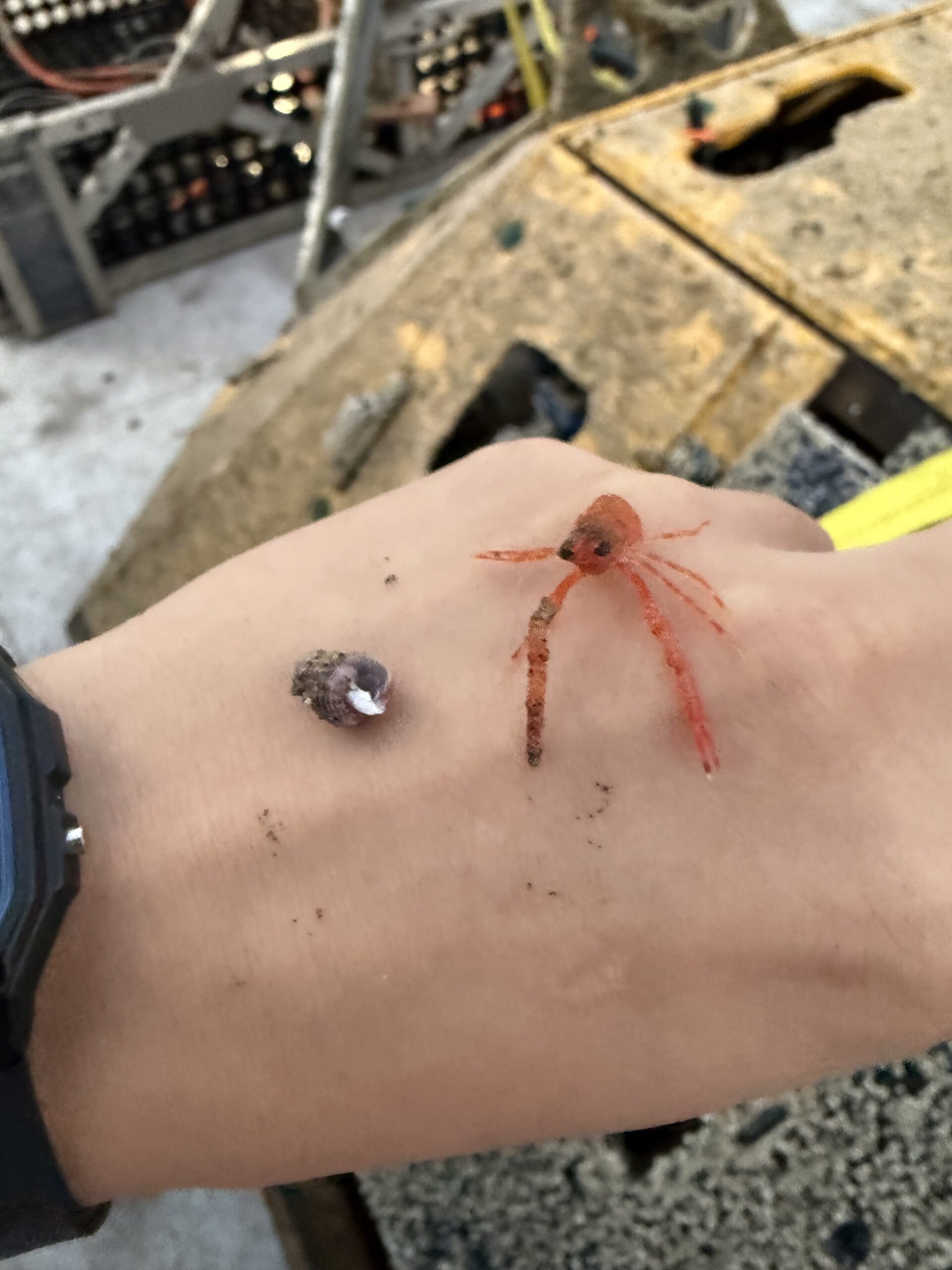
I went to the main deck to take a closer look at the 2025 BEP that was brought up and the Digital Still Camera installed in 2025 that was swapped while I napped and ate dinner. Among the thousands of barnacles crusting over the two instruments, I spotted a few critters clinging to life including a few squat lobsters, hermit crabs, and anemones. Benthic instruments often have various life forms inhabiting them, making opportunistic use of the shelter. They almost become like island-like communities on the ocean bottom. I once met a researcher at Woods Hole Oceanographic Institution whose research revolves heavily around benthic hard-bottom island habitat colonization.
We then had the third Jason dive of the day, an operation to recover the 2025 zooplankton platform that hosts a bio-acoustic sonar. I followed along with the live video feed to the Main ship lab and periodically watched from the back of the control van. The bio-acoustic sonar emits sound waves into the water column that bounce off organisms back towards the sensor creating what is known as backscatter. This is useful for estimating biomass and tracking vertical migration of zooplankton. Once again, this dive involves disconnecting cables from instrumentation deployed last year and plugging them into new ones. It is impressive how strong, mobile, and precise the arms of Jason are. The level of engineering that goes into ROVs is incredible