
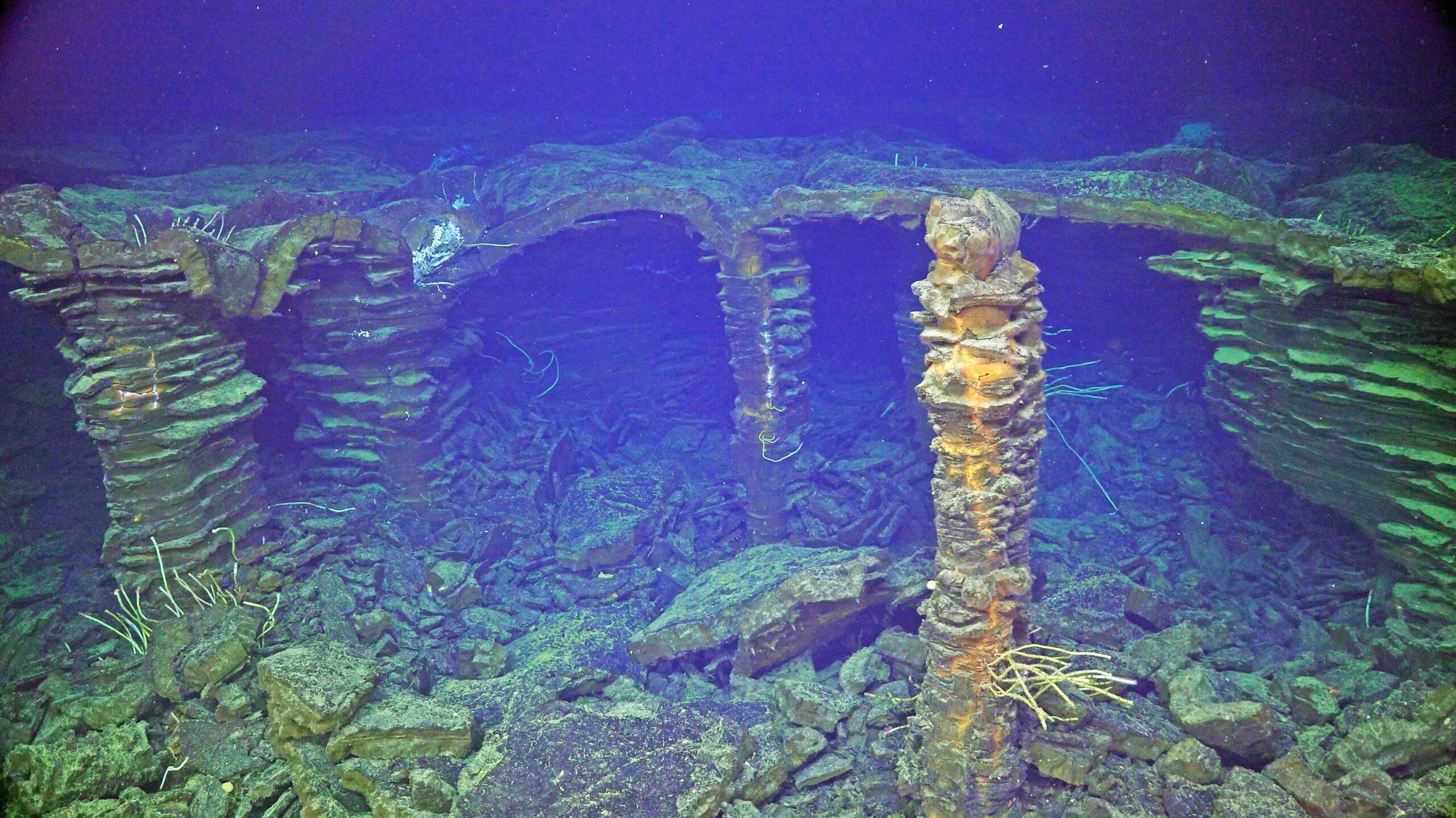
We arrived in the caldera of Axial Seamount just after midnight on August 13, eager to enter the strange, sunken world at the summit of the most active volcano on the Juan de Fuca Ridge. Axial is an old friend visited by the RCA annually for over a decade. It’s summit nearly a mile beneath the oceans’ surface hosts a broad, oval bowl cut by the spreading center and floored by lava from eruptions in 1998, 2011, and 2015. Across it, cables snake along the seafloor and instruments dot the landscape as part of the Regional Cabled Array, turning this remote volcano into one of the most intensively monitored places in the deep ocean.
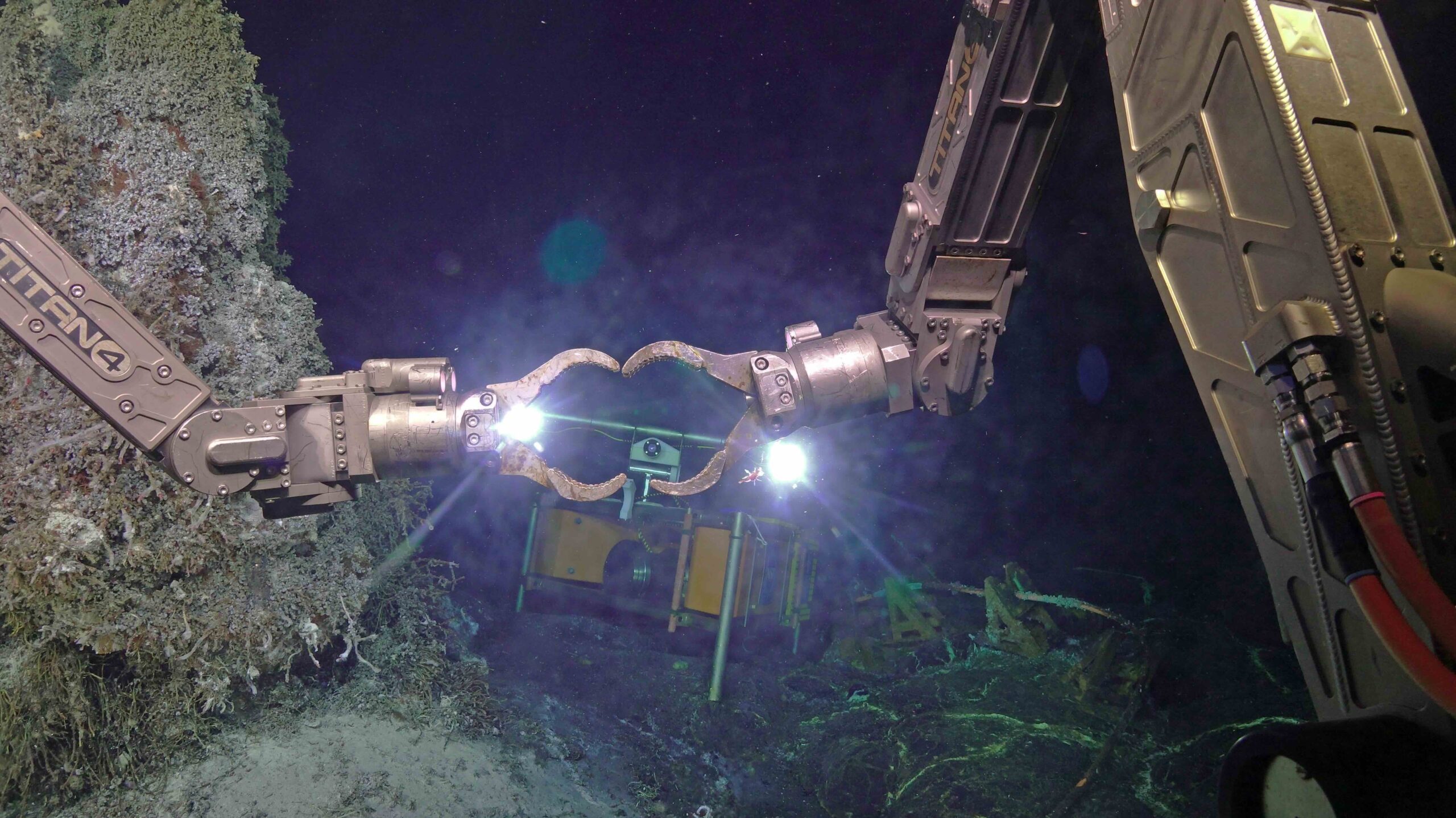
But the weather had other ideas. Winds were gusting to 30 knots when we arrived, building large swells around our work area. That matters when your job is to lower a heavy, delicate camera into the ocean. The camera in question, CAMHD, is one of the stars of the observatory. Mounted at the ASHES hydrothermal vent field, it captures high-definition images of the Mushroom vent every three hours and streams them live to shore. To replace it, Jason carries the new camera to the seafloor inside a metal basket called the “undervator,” attached beneath the vehicle like a basket hanging under a hot-air balloon. With all that weight and surface area, launching in rough seas can be tricky.
Our first attempt proved just how tricky. Three swells rolled through in quick succession, slamming Jason hard enough to shake loose the tie-downs securing the camera. The camera itself tried to be free and that was enough for the team to call the dive. Jason came back aboard so everything could be re-secured and thoroughly tested.
While engineers from the Applied Physics Laboratory worked on the camera rig, we pivoted to operations that were easier to launch in the dark and rough seas. We swapped CTD instrument stands that attach directly to Jason’s front basket, avoiding the weight and drag of the undervator. One went in near the ASHES medium power junction box, MJ03B. After a short hop, another was installed at the nearby Eastern Caldera site, MJ03E. Both operations went smoothly. By early afternoon, the sun was up, visibility was good, and the camera rigging had been triple-checked.
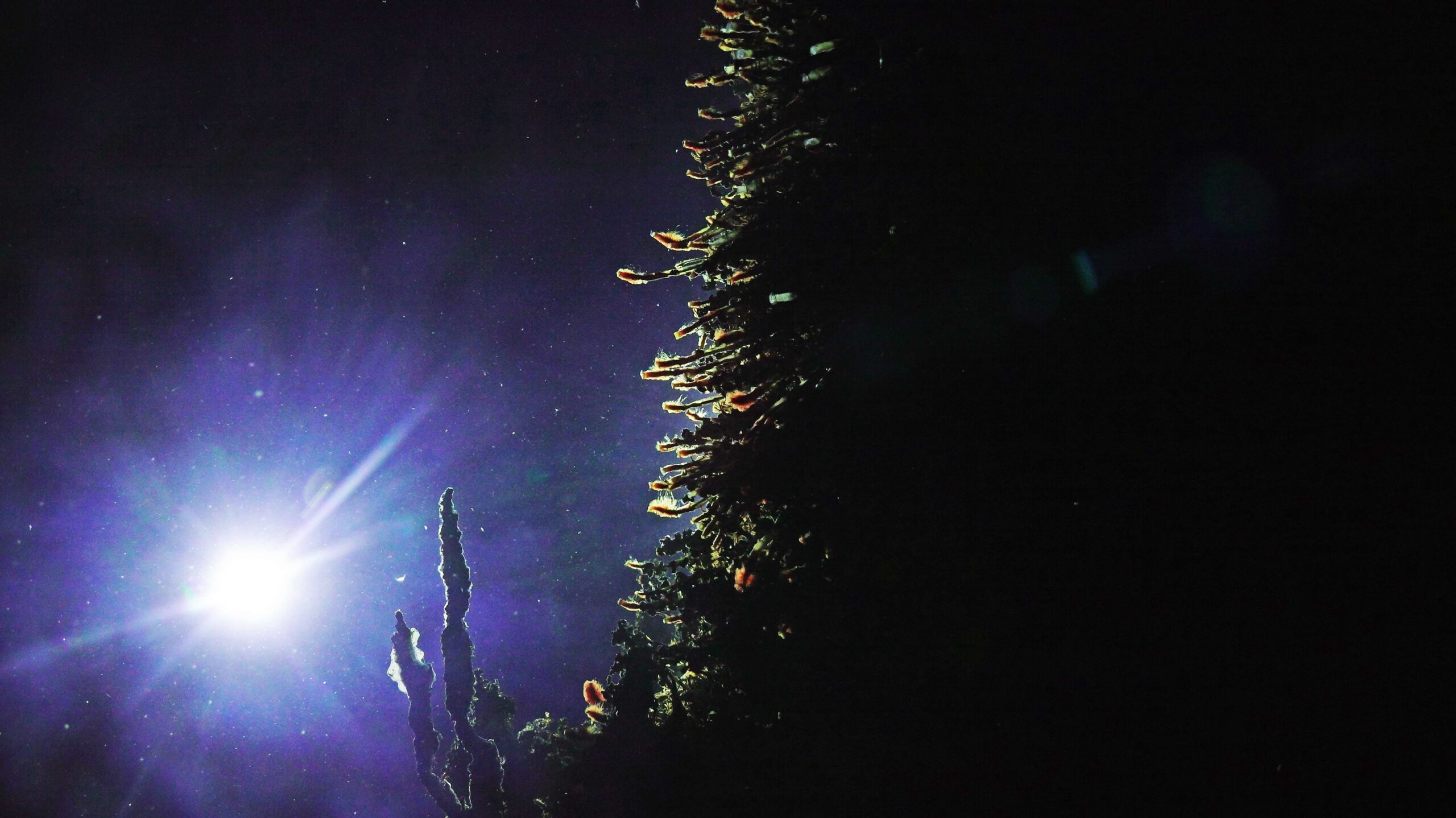
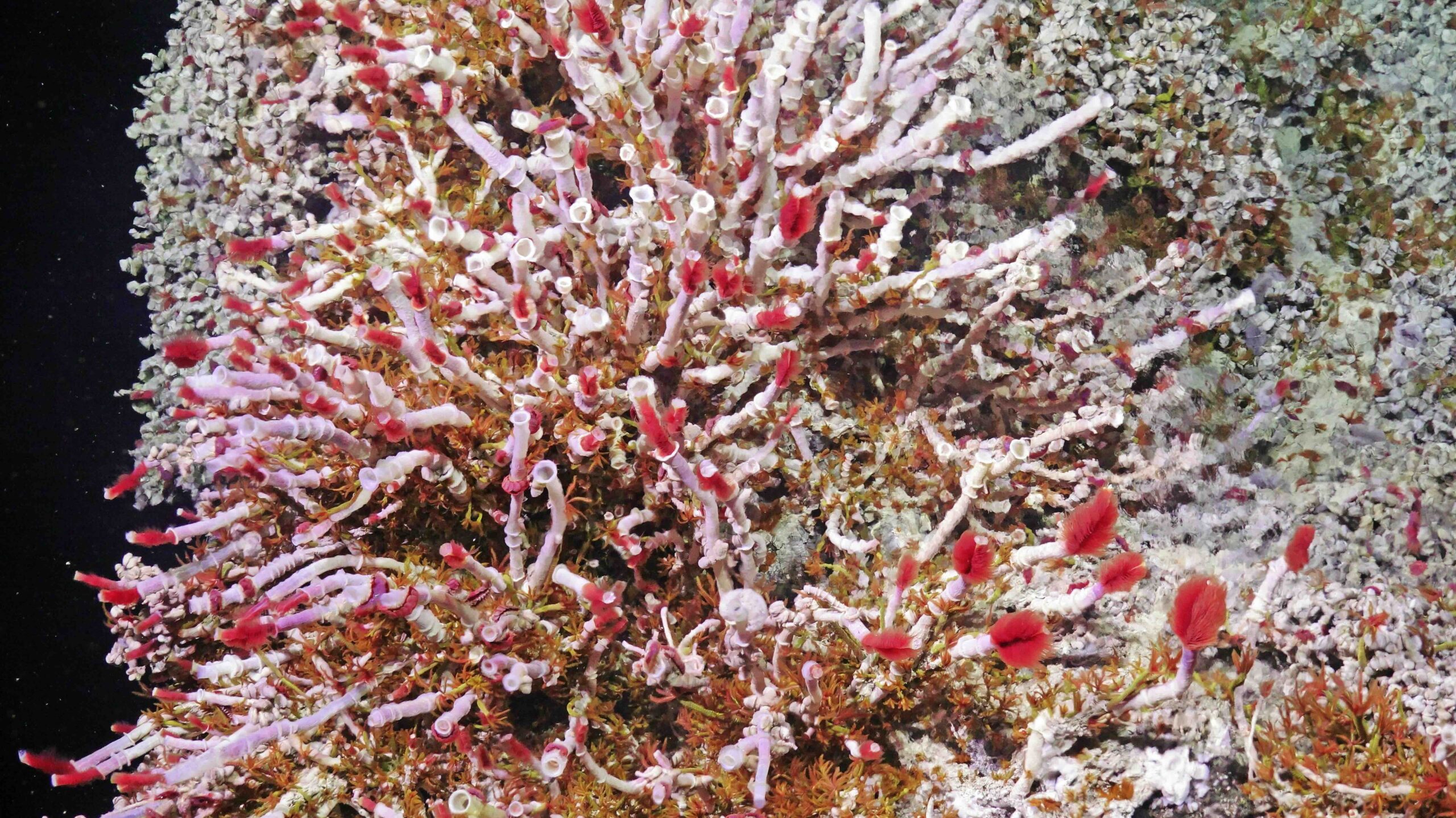
At 1:33 p.m., Jason and CAMHD went over the side again. This time, they made it cleanly through the air-sea interface and began the nearly mile-long descent to the seafloor.The reward for all that patience was spectacular. At the Mushroom hydrothermal vent, life crowded every available surface. Clusters of tubeworms, scale worms, palm worms, and brilliant orange sulfide worms covered the chimney like an overgrown garden. Curious rattails, deep-sea fish also known as grenadiers, drifted through the work area. Just 30 feet away, a vent called Inferno had grown a brand-new “beehive,” a striking sulfide structure with hot fluids gushing from its top.
Every year, Axial seems to greet us with something new: a structure, a creature, a change in the chemistry, or some unexpected sign of life. But the best moment came at the end of the dive. Once the new camera had passed all its checks, the team switched off Jason’s floodlights and left Mushroom illuminated only by CAMHD’s own lamps. The black smoke curled upward from the vent. The chimney rose out of the darkness with tubeworms in silhouette. Everything around it disappeared into the black. It was eerie, alien, dynamic—and strangely peaceful. It is the kind of view you never quite get tired of.
There are four Regional Cabled Array sites in Axial Caldera: the ASHES and International District hydrothermal vent fields, plus two geophysical sites away from the active flows, Central and Eastern Caldera. The longest transit between them aboard the Revelle is only about 30 minutes, and many take closer to 15. That proximity is a huge advantage. It means there are a lot of instruments to service, but it also means we can move quickly from one operation to another—camera, junction box, CTD stand—all in the same day.
At Central Caldera, we replaced the MJ03F junction box, which has seven instruments plugged into it. The junction box provides power to those instruments and enables continuous communication and data transmission back to shore at the speed of light. Finding the right landing spot for Jason, one that would allow the vehicle to neatly transfer and manage all those cables, took a couple of tries. While we were there, we also deployed three new instruments for other scientists: a CTD stand, an acoustic transponder for a seafloor array studying deformation of the volcano, and an uncabled hydrophone positioned near the observatory’s own hydrophone so scientists can compare their recordings of Axial’s rumblings.
Then came three dives at the International District hydrothermal field, the largest and most active vent field in the caldera. We recovered the RAS/PPS, a remarkable remote-access fluid and microbial DNA sampler that has spent the past year collecting vent fluids, preserving microbial DNA, and recording temperaure inside this dynamic ecosystem. Combined with data from the surrounding instruments, its measurements help scientists connect volcanic changes with vent chemistry and the microbes living in the warm, diffuse waters around the vents.
At a small vent called Diva, where fluids rich in magmatically derived carbon dioxide stream out of the seafloor, Jason measured temperatures of 340°C and collected gas-tight fluid samples. We then installed a fresh temperature-resistivity probe, or TRHPH. The vent will grow around the probe, eventually sealing it into place. It can remain immersed in the boiling fluids for years, monitoring changes in temperature and vent-fluid chlorinity. Our final dive brought one more CTD stand—and a chance to explore the neighborhood.
We visited El Guapo, towering roughly 60 feet above the lava-covered terrain; the chimney known as Castle; and then followed the 2011 lava flow. The landscape was bizarre and beautiful: frozen whirlpools of lava, arches and columns marking collapsed lava lakes, and broad stretches of striated basalt recording the paths taken by rivers of molten rock in 2011. And then we reached Skadi. In 2011, just three months after the eruption, Skadi was billowing billions of microbes and clouds of white flocculent material into the surrounding water. These sites, sometimes called “snowblowers,” are extraordinarily rare to see.
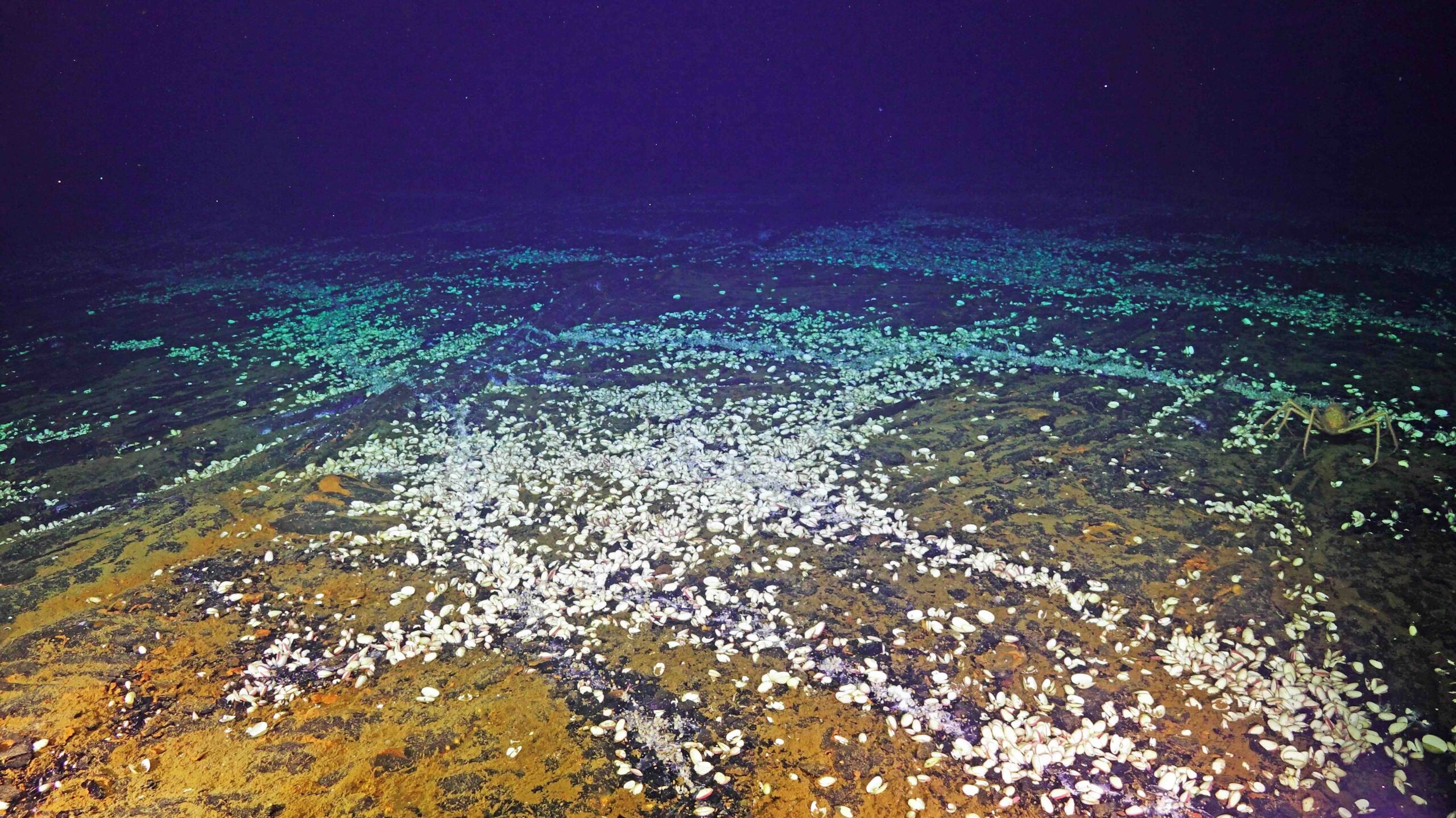
Today, the landscape looks completely different. Skadi, itself is now quiet at the main site. However, acres of small clams now cover the lava, supported by symbiotic microbes living inside their tissues. Snails and whelks weave among them, all sustained by the weak seepage of fluids rising from beneath the seafloor.
The wildlife continued to keep morale high throughout our operations. During one transit, a pod of dolphins dove alongside the Revelle in eerie synchrony. Down at depth, a Graneledone octopus squared up to Jason, puffing itself up as if to say, very clearly, that the ROV had come close enough. And throughout the water column, jellies and other drifting creatures floated past Jason during its descents and ascents—brief encounters with life in the darkness between the surface and seafloor.
On August 15, with most of the caldera work complete, we doubled back to Central Caldera to recover a cable that had stopped working for an acoustic transponder and collect a water sample to verify one of the new CTDs. Then the Revelle made a short, two-hour transit to Axial Base for one final deep dive—roughly 2,600 meters down—to recover an instrument called HPIES, which measures ocean currents and seafloor pressure. Jason was back on deck before sunrise on August 16.
Every planned operation at Axial Seamount was complete. Before breakfast, we pointed the Revelle east and began the roughly 18-hour steam back toward Slope Base, where a shallow profiler mooring and its science pod are waiting for us. After days of volcanoes, vents, cables, instruments, lava flows, strange animals, and long hours at sea, it is hard to believe that in just a few days we will be back on terra firma.