
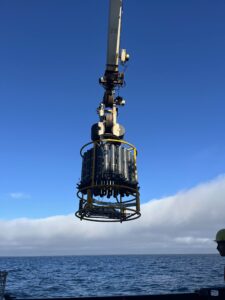
The last few days aboard the R/V Roger Revelle have carried us from the shallow, current-swept shelf off Oregon out to the deep base of the continental slope, swapping cameras and cabled instruments at each stop and pausing along the way to marvel at the creatures and unique settings. When the ROV Jason wasn’t in the water for a dive, the ship’s CTD rosette likely was instead — it has been a busy, rewarding stretch of work for the whole VISIONS’26 team.
Oregon Offshore
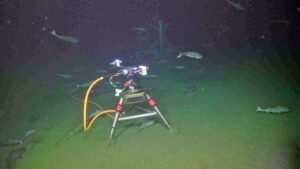
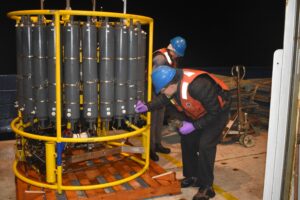
From the Oregon Shelf site the Revelle transited to Oregon Offshore (580 m water depth), where the team ran two verification CTD casts — one shallow to 220 m, one deeper to 570 m — before Jason swapped out the Benthic Experiment Package (BEP; LJ01C) and its accompanying hydrophone (Dive J2-1778), then returned to the seafloor to install the 2026 digital still camera (Dive J2-1779). Throughout, RCA team members Mariela White and Joe Duprey led the VISIONS’26 students in sampling the Niskin bottles from the CTD rosette and Jason, as well as the two onboard analyses we do — chlorophyll filtrations and Winkler titrations for oxygen.
Bubble plumes, a camera, and critters at Southern Hydrate Ridge
As the ship steamed to Southern Hydrate Ridge (SHR) from Oregon Offshore, we used the Revelle‘s hull-mounted EM124 multibeam sonar to image the seafloor along the way and when we got to the summit of SHR. Mitch Elend ran a series of survey lines across the summit of the ridge to image the methane bubble plumes streaming up from the seafloor. Southern Hydrate Ridge is an active methane hydrate seep, one of nearly a thousand along the margin where gas bubbles up through the sediment fueling a dynamic chemosynthetic ecosystem. The multibeam surveys let us see the bubbles as they climb through the water column, helping us pinpoint exactly which parts of the seep are most active so we can target them on our follow-on dive.
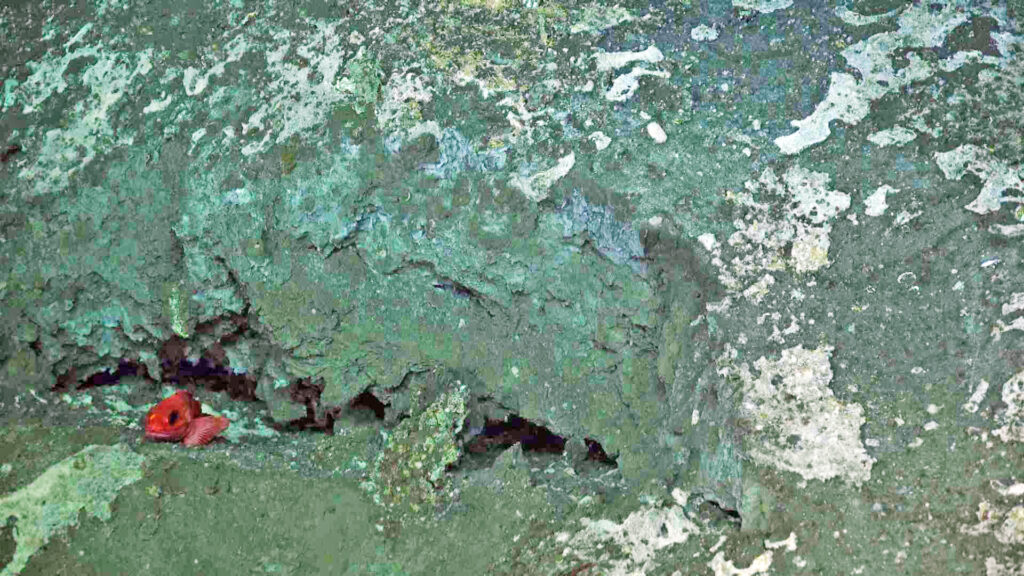
We had a single dive at SHR this year to swap the digital still camera. For this work, Jason descended to the seafloor at 778 m for Dive J2-1780. Working with the vehicle’s undervator, the team disconnected the 2025 camera, installed the 2026 camera in its place, and stowed the old one for recovery. Once the swap was complete, Jason toured the surrounding seeps — bubble plumes rising through the sediment and outcrops of gas hydrate glinting in the ROV’s lights. One of the highlights was a red rockfish settled into a crevasse in the sediment, entirely unbothered, as ribbons of methane bubbles streamed up around it. Moments like this are a reminder that this cabled observatory sits within a living, dynamic ecosystem.
A deep-sea octopus and benthic ctenophores greet us at Slope Base
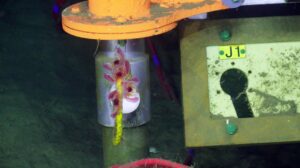
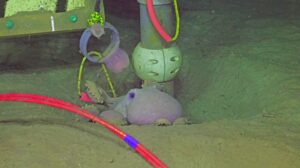
With work complete at SHR and Jason back on deck and secure, the Revelle transited to Slope Base, the deepest site for the array. Here, Dive J2-1781 sent Jason 2,900 m down to the seafloor to swap the low-power junction box LJ01A along with its accompanying CTD stand. Beautiful benthic ctenophores, that almost look like orchids, had made themselves at home on the junction box. The swap went smoothly, and the ROV had no shortage of curious visitors while it worked, including a deep-sea Pacific octopus that had tucked itself into the foot of the junction box, as if inspecting our handiwork. Jason returned to deck with the 2023 junction box in the early evening.
The CTD rosette then took over. After a short repositioning to sit down-current of the Slope Base Shallow Profiler mooring, the team ran a shallow verification cast to 220 m, followed by a deep cast to nearly 2,800 m. Joe and the VISIONS’26 students sampled the Niskins from both casts, again collecting water for the range of analyses that help calibrate the cabled sensors.
Onward to Axial
Just before midnight on August 11th, with the CTD rosette back on deck, the Revelle pointed her bow west and began the long transit out to Axial Base. Transits are never idle time on this cruise: RCA APL engineers rigged the high-definition camera (CAMHD) into the undervator and prepped CTD stands for the dives ahead, while RCA scientists Mariela and Jolee Thirtyacre processed the water samples Joe and the students had collected the night before from Slope Base. The VISIONS’26 students pitched in cleaning instrumentation and brainstorming their own research projects, which they will work on during a fall quarter class. You can see examples of previous VISIONS student projects here.
We arrived at Axial Base on the afternoon of August 12th and immediately put a deep CTD cast in the water to verify our sensors and collect deep water for priming instruments. From here, the plan is one more shallow CTD cast — the last of VISIONS’26 — before we transited roughly two hours to the summit of Axial Seamount, the most active volcano off our coast, to begin swapping the high-definition camera and instruments throughout the caldera. That work is currently ongoing, so tune in to our livestream broadcasts to see brilliant hydrothermal vents and stunning lava formations.