
August 18, 2026
Reflections:
Arriving on the ship the first day, I was unsure as what to expect. In my mind, there were already foreseen overlaps between ship life and other experiences I’ve had where people work closely together for an extended period. There were the expected conversations rife with acronyms I’d never heard, an immense amount of logistics that required closed loop communication every step of the way, and engaging conversations due to the confluence of people with diverse backgrounds and interests. Close quarters mean rapidly fostering those relationships, developing a strong social framework, and then having to say goodbye when you all go your separate ways.
Building on this foundation, the experiences unique to traveling out on the open sea become readily apparent. The first day aboard, during our abandon ship drill and amongst all the laughter resulting from putting on our immersion suits, there was an underlying somber note: the realities of the dangers of going to sea. Revelle is a large ship, and extremely safe; however, I hadn’t put as much thought into the reality of where we were headed. There is also diminished privacy, flexibility in your schedule, and weekends don’t exist. The trade-off though is amazing.
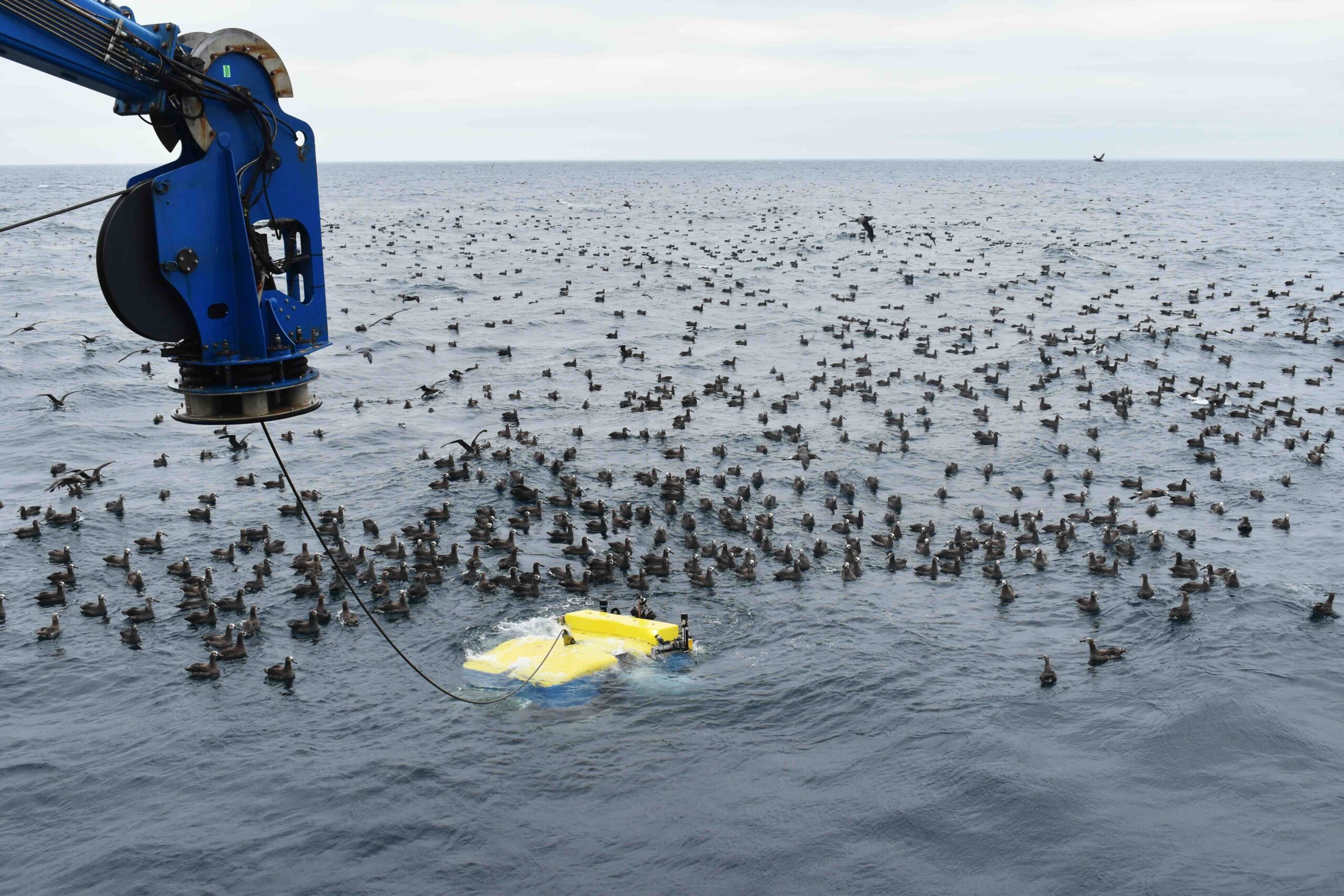
I expected to be unnerved by the lack of mountains on the horizon, a familiar sight all my life. Instead, I was endlessly mesmerized by the clean line where the sky met the sea. While we had clouds most days and every night, the sky’s dynamism made the scenery unique every day. Varying wave strengths kept the sea surface variable. Even better, the air and waves were filled with life. I had a distant hope of seeing an albatross on this trip, and we had a full day where an entire flock followed the ship. Jason allowed us to peek under the curtain of the surface ocean and see all kinds of biology in real time. Never did I think I would see Tiburonia granrojo (Big Red Jelly) in real time, but that dream was fulfilled many times over. Descending into the deep feels the same as falling into a field of stars time after time.
While the days were long, the cruise itself passed by in the blink of an eye. New experiences, new memories, new connections all caused the time to slip away. While I’m not sure when the next time I’ll be back, I am absolutely certain that I will be back.
August 16, 2026
As seemed to be the theme of our early morning arrivals in the control van, we arrived for shift change just in time to participate in the end of the dive. Jason was hooking his belly winch onto the HPIES (Horizontal Electrometer Pressure-Inverted Echosounders) carrier handle, a rope with a float block attached. Immediately after connecting, the logistics of exactly how we would get HPIES and Jason aboard commenced. With the rope an unknown length, it was unlikely we would be able to simply lift it up over the railing like we normally do with the undervator. Ultimately, it was decided that the legs would get removed while the crane lifted both as high as possible; hopefully that would give them both enough clearance.
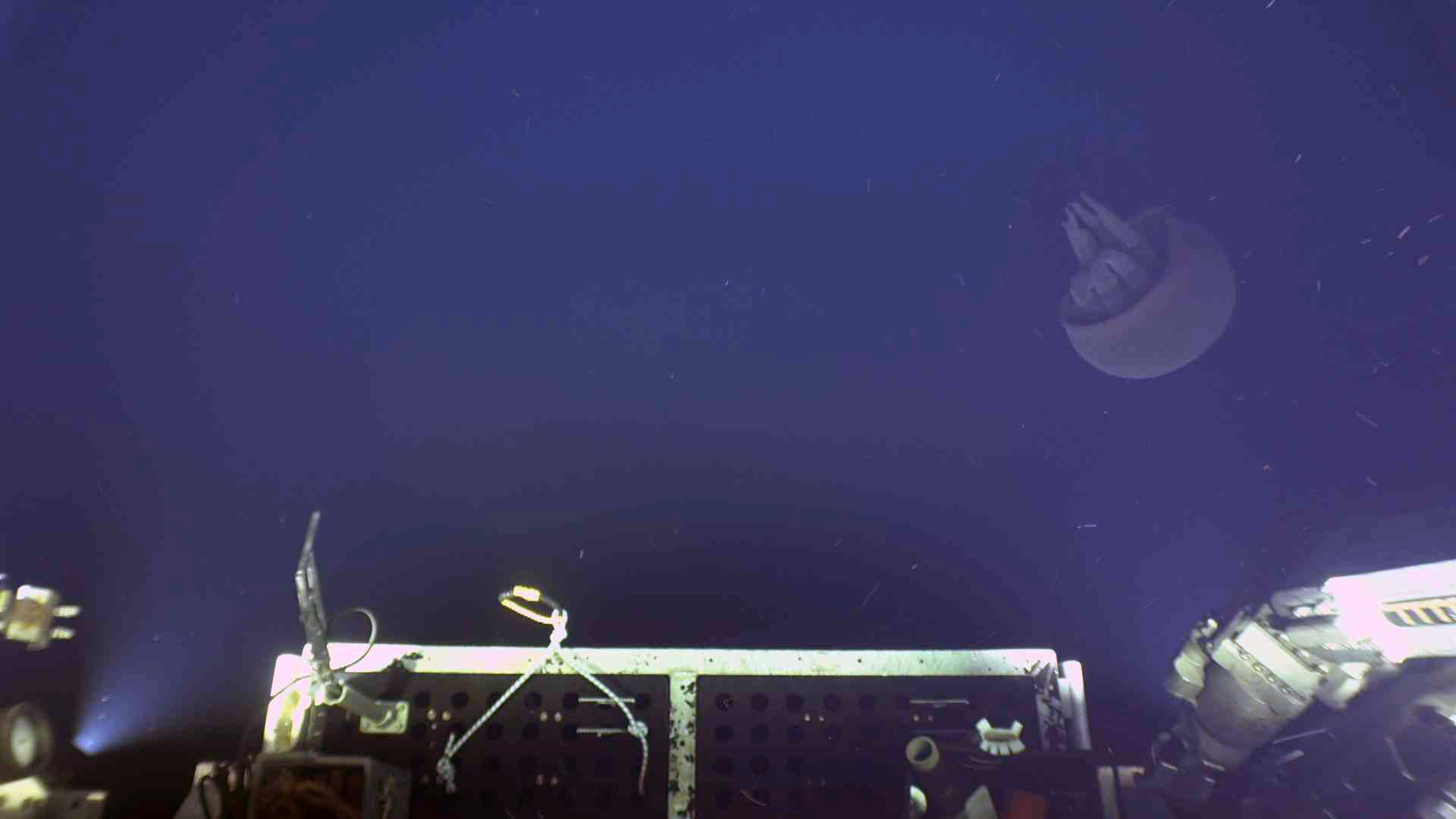
As our exit strategy developed, I snapped the photo I had been dreaming of since stepping aboard—a perfectly positioned Big Red Jelly. Tilted just so, both the bell and tendrils made it fully into the frame. While it would have been nice to have more vivid color in the photo, that may have been asking too much of an ancillary camera view. It would still be the perfect supplementary material for my inevitable Big Red Halloween costume.
Once HPIES was successfully on board, the dives at Axial were completed and our second long transit was underway. We meandered down to the main lab to see whether there was further tasking for the remainder of our shift. Stopping by the wet lab, we were able to see the pieces of obsidian brought up by Jason, as well as the large section of chalcopyrite.
After touching base with Jolee and assisting her in packing equipment in the wet lab, I turned my focus to finally making my little paracord person. Izzie was working on a veritable army of paracord people to my left, but I wanted to make one of my own to attach to my water bottle. By the time I did my quick little craft, it was already time for breakfast.
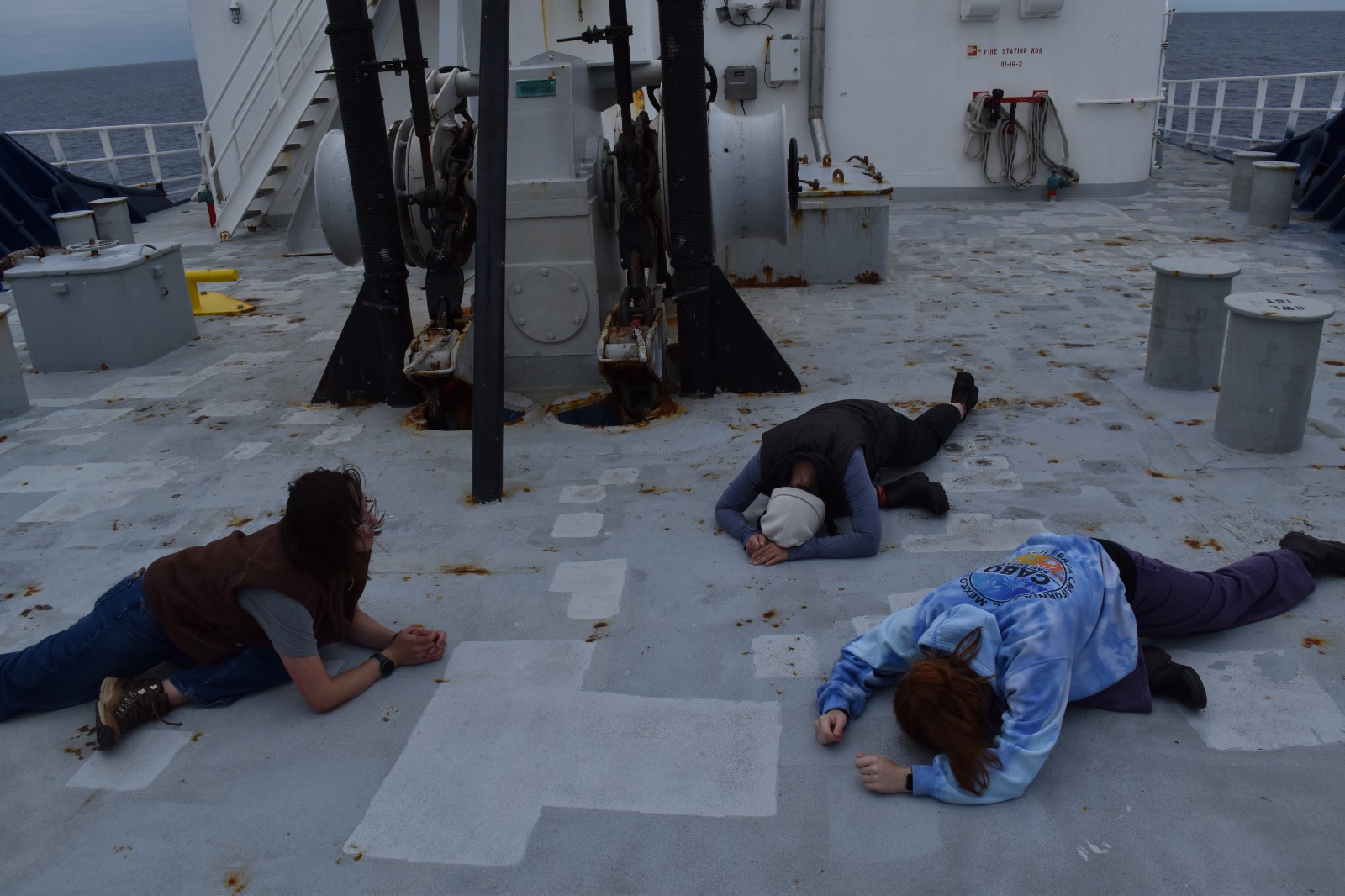
Since we wouldn’t arrive at our next site until just before midnight and all the samples were prepped and stowed, there was just a little bit of lab cleaning that was over quickly. After this, we had (relatively) free reign of the ship. Capitalizing on our newfound time, a group of us made our way out to the bow, fulfilling our dreams of deck yoga. While I’m sure a mat or a yoga towel would have made the experience more comfortable on our hands, it was nice and grounding. Avery, Izzie, and I alternated between leading the group through our favorite poses, ending classically with shavasana. While there is a cardio and weights room on the ship, not knowing this beforehand I didn’t bring appropriate footwear to utilize either. Our little session out on the deck was precisely the tonic I needed after a lack of intentional movement.
Once we decided that we had enough of being buffeted by the wind, we came back inside to continue work on our respective projects, homework, and paracord projects. Along with the paracord people, Avery and Izzie had an impressive array of bracelets that they had accrued.
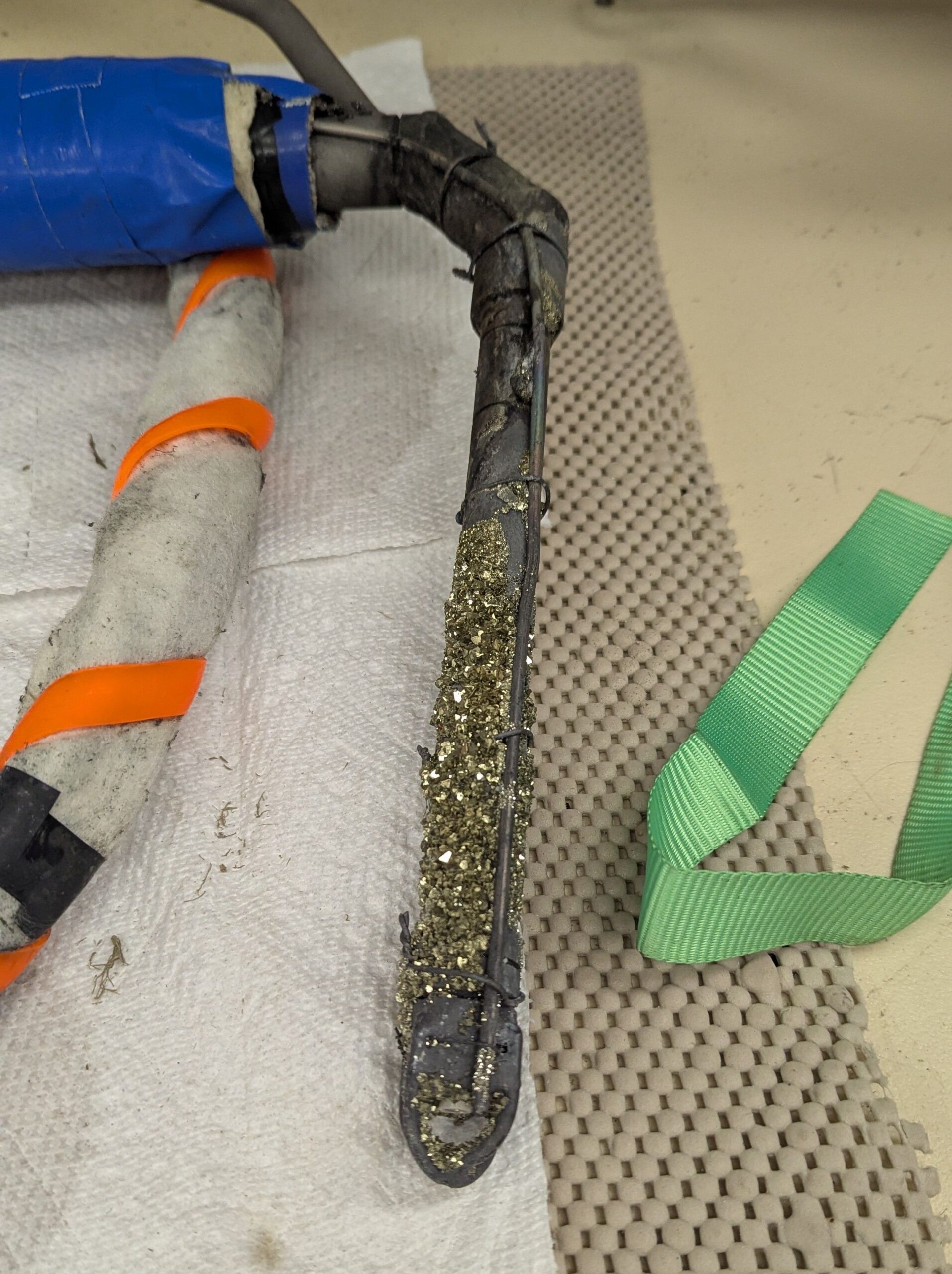
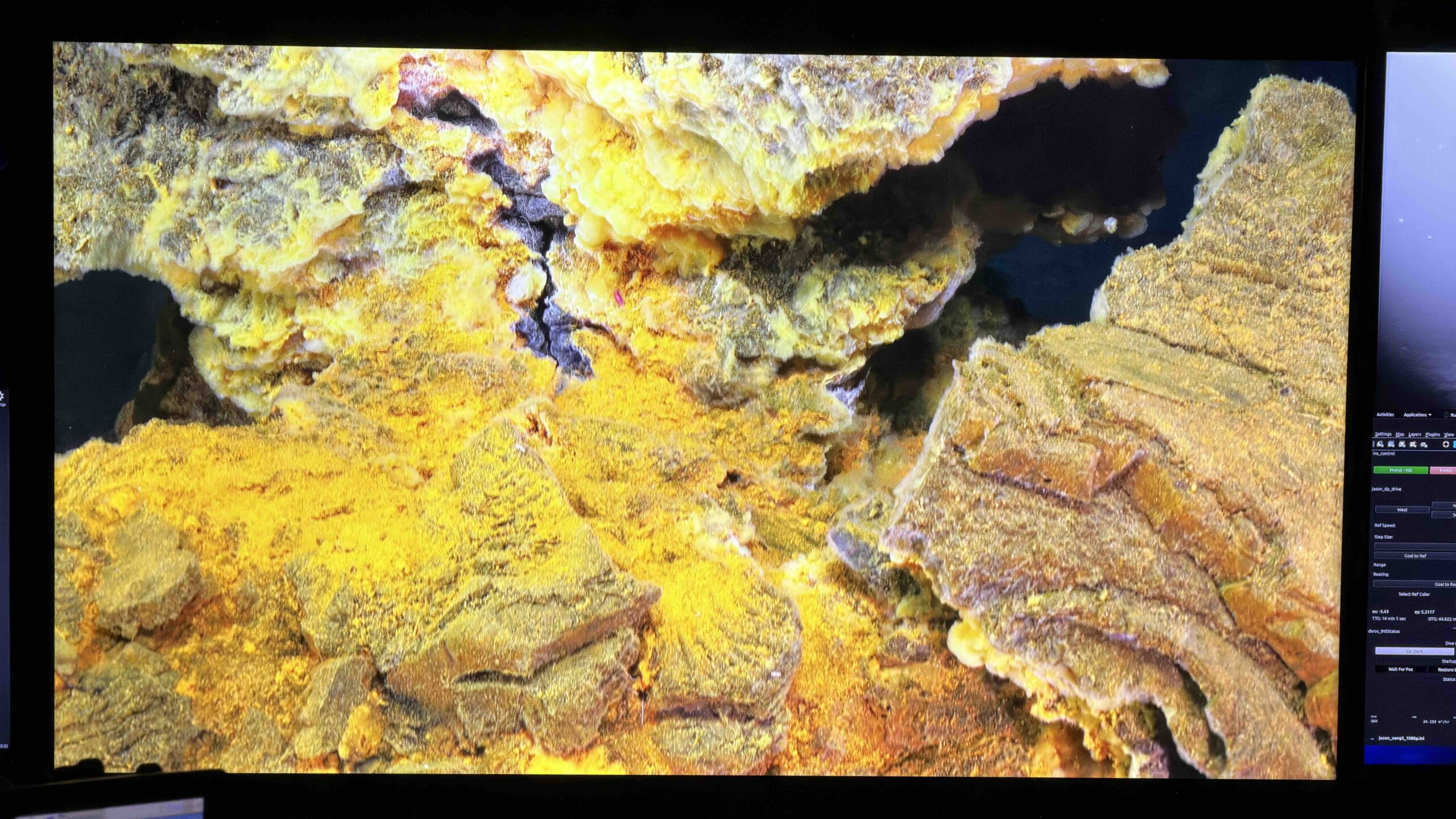
Post-dinner was much the same with one key exception. One of the retrieved temperature probes that had been sitting directly in a vent stream had accumulated chalcopyrite growth over its underwater tenure. With the APL’s team blessing, Avery went to town on gently scraping the minerals off the probe. The resulting “Diva dust”, named after the vent the probe was monitoring, appeared mostly as gold flakes with a few larger chunks that maintained the cubic structure. Some pieces were sprinkled with anhydrite, a calcium sulfate that also precipitates directly out of vent fluid.
The mood was up, music and laughter filling the lab as people rotated working with attempting to play ping pong while on a moving ship. Although we were fortunate, having fantastic weather for the cruise so far, that didn’t change the fact that the floor was shifting and rolling underneath our feet, leading to some creative strategies in keeping the ball on the table. Time passed with a quiet quickness and it was soon time for bed. Early morning would come even faster.
August 15, 2026
It was finally the morning of our big dive day. I started in down in the laundry room, mostly to refresh my towel and ensure I have enough socks to wear for the rest of the cruise.
Back up in the van, they were wrapping up a CAMDS (camera) and TRHPH (measuring vent temperature and resistivity) swap near the hydrothermal vent Diva in the International District vent field. Due to the number of instruments, the majority of our shift was spent watching and logging cable management as the Jason crew steadily disentangled them and wove them onto the undervator. By the time we were ready to ascend, the undervator was thoroughly festooned.
After the dive I snagged some much needed sleep; however, the intended hour and a half nap doubled in time. I woke up just in time for lunch, coming up to the galley to see the vent affectionately dubbed “worm city” due to the amount of biology covering the structure filling the screen in the dining area. Scarfing down lunch, I hurried off to claim a seat in the back row of the control van.
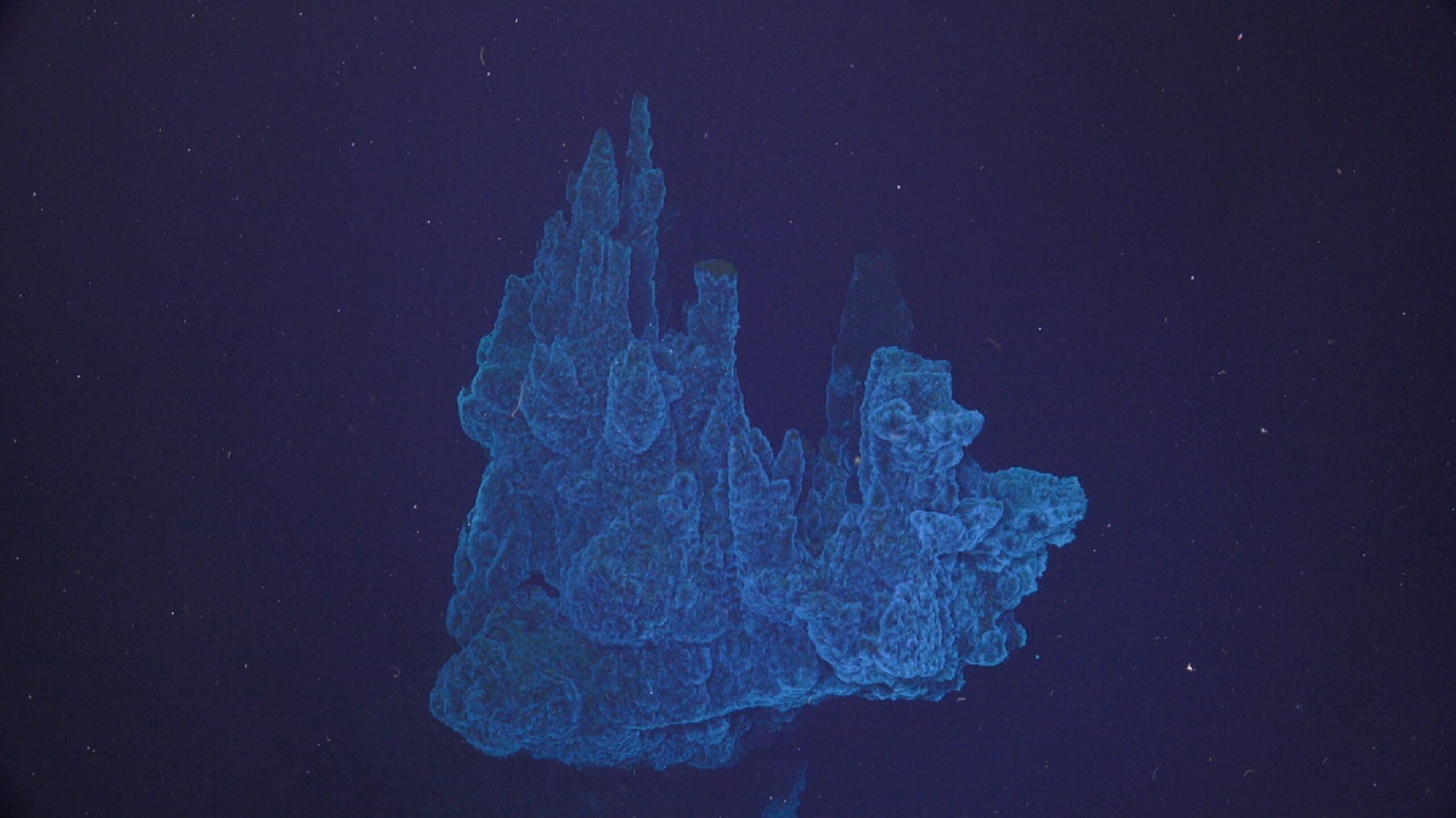
The next vent was Castle, looming ghostly in the dark. White, feathery bacterial mats underscored Castle’s otherworldly presence, turrets and spires proudly ascending. From one angle, the body of the formation projects in such a way that the whole feels suspended in space and time. Even knowing that the sites to come were just as enrapturing, it was hard to tear ourselves away.
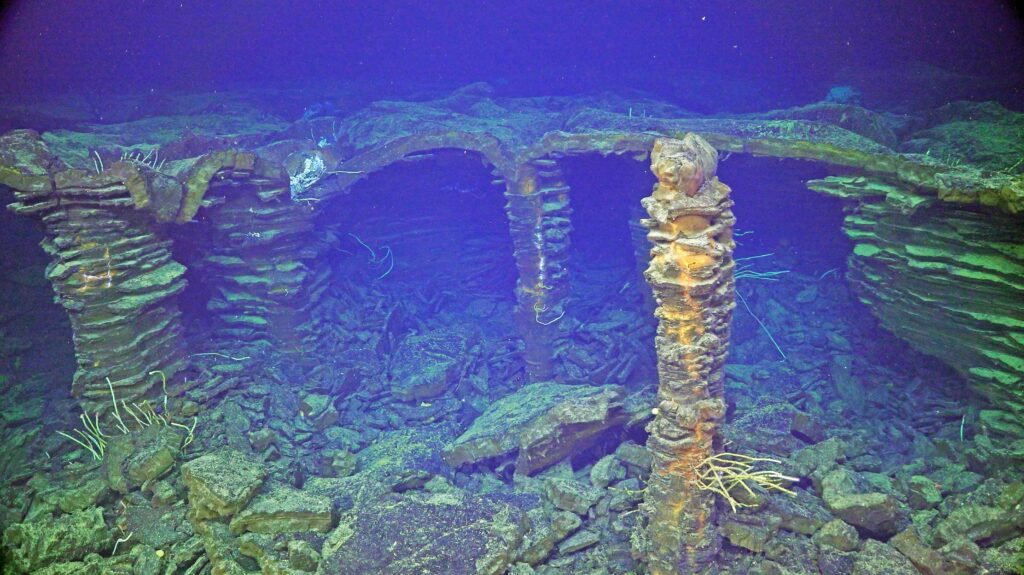
Descending further down to the seabed, we tracked to an old lava flow. The International District is rife with lava fields, but the particular flow we sought next was a lake that the surface had solidified then slowly drained. Left behind was a ceiling of basalt supported by columns created by trapped water that evaporated and escaped upwards. The slow drainage formed bathtub rings around the pillars, marking outflow progress. One slightly important feature of an ROV is that it is continuously tethered to the ship, making it difficult to traverse underwater caverns.
Moving away and on to our next feature, the lava field opened before us. Fast streams frozen in time as sheet flows with the occasional whorl creating texture in the open space. Scattered throughout the plain were clams and scattered amongst the clams were spider crabs, appearing to survey the area as if they were proud farmers gazing upon their crops. We passed over multiple “clam farms”, each larger than the last.
Finally we reached Skadi. A now defunct snowblower, when Skadi was first discovered she was incredibly productive. Snowblowers are lower temperature vents that output clouds of white bacterial bloom, hence Skadi’s namesake being the Norse goddess of winter and mountains. She now lay dormant beneath a blanket of green bacterial mats, winter abated.
Reluctantly, we made our return to the initial dive site. As a consolation, Jason picked up some geologic samples near the CTD we placed earlier. In the grab, along with the much more common obsidian, a beautiful piece of chalcopyrite was brought up.
The excitement of International District still running high in the air, our little cadre of students transitioned down to the analytical lab to continue sample processing for the RAS/PPS. Dealing solely with the primary bags of vent fluid, we first weighed them then transferred a portion of the fluid into vacuum sealed bottles. Next was the step that I actively participated in: transferring fluid from the bags to two small vials for H2S2 and a slightly larger bottle for pH. All three required filling past the brim, creating a bubble of surface tension. Since we had a respectable amount of samples, I brought in my speaker to make a production of it. While we didn’t fully finish, we got through most of the samples before it was time for dinner.
Post-dinner, Mike was eager to rotate into the analytical lab, so I left my station in his capable hands and went back out to the control van. After doing so many return to decks, I was finally able to complete my first Jason launch in the logger seat. Another deep descent meant at least an hour and a half of pure descent. Quickly after we started, it was time for the next shift to rotate in.
August 14, 2026
As we progress into the cruise, it is easier and easier to ignore my alarm. When I finally come to, my phone screen reads 0350. Scrambling out of bed and grateful for my foresight in setting my clothes out the night before, I hurried upstairs to the control van. Tapping Alex out of the videograbber position, I hunkered down, doing my best to preserve as much warmth as I could in the frigid van. It wasn’t long before he returned to ask for my blessing to access his room through our shared head (bathroom on ship).
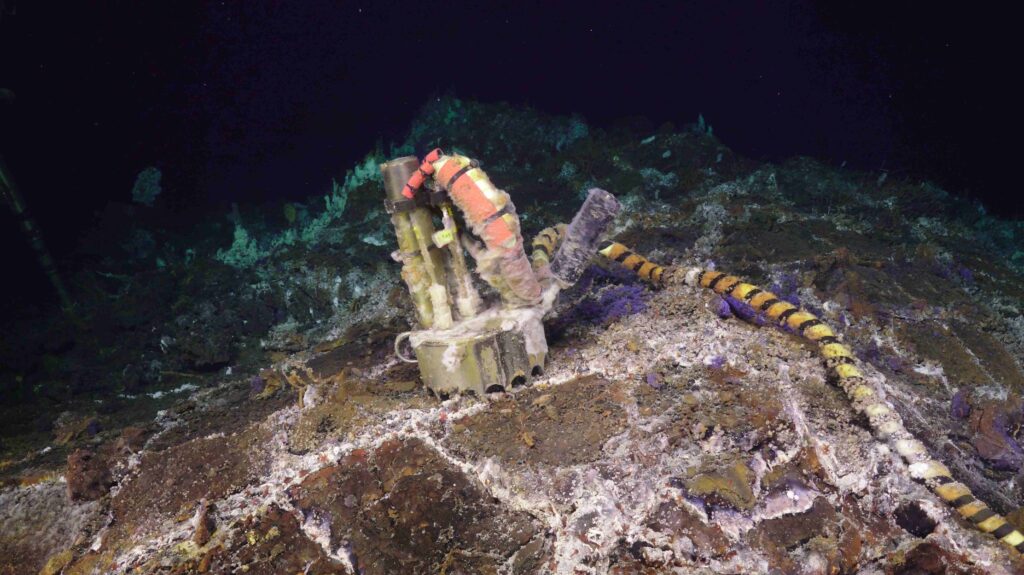
The dive that morning involved installing a new J box with a Dunker (a transponder), removing the old J box (MJ03F at Central Caldera), and performing a site survey. At the time of shift change, the ROV crew realized that the new J box was placed just far enough away from a cabled instrument that the cable would be too taught when plugged back in to the new junction box. This resulted in a meticulous readjustment with no shortage of cable management. All told there were six cables to move. Our project drew the attention of a skate, slowly meandering to the edge of our light before fading back into the black. One site summary and a smooth ascent later, it was time for breakfast.
Succumbing to what was quickly becoming a routine, I promptly took a nap just to wake up with enough time to come up to the galley for lunch. Pad kee mao, tom kha, and perfectly fried potstickers made for the perfect second breakfast.
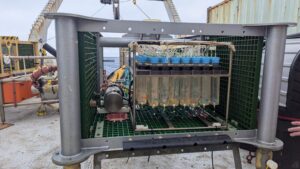
The next dive on the docket was replacing a RAS/PPS (Remote Access Sampler / Phytoplankton and Particle Sampler – used for collection of microbial DNA for the RCA). This instrument operates autonomously, taking a time series set of samples of hydrothermal vent fluid and DNA. During this operation, we had a lovely lady named Edwina who was present through a zoom call. She had had aspirations of becoming a marine biologist since she was little but didn’t have the opportunity earlier in life to pursue that passion. She asked many astute questions about the vents we were looking at and oceanography in general. One question in particular that stood out to me was how to make oceanography more accessible for underprivileged students.
This circles back to previous conversations that we’ve had aboard regarding our VISIONS projects and how to increase public engagement. Oceanography historically hasn’t had the same exposure that space science has, only recently getting integrated in small ways into middle/high school curricula. There is an obligation for marine scientists to increase the accessibility of their study area, so as to stoke enthusiasm and create opportunities for young minds as they explore their interests. For me, I hadn’t even considered the possibility that I would find myself out on the ocean, mired in a complex weave of geology, chemistry, biology, and physics. It was through conversations with people actively engaged in oceanographic work that made me think that this field was a place I could make a home. Now, I have the opportunity to consider how to start that conversation with other people, increasing my knowledge of science communication, and empowering young students to pursue whatever interests they hold.
This was still on my mind when we transitioned down to the Main Lab for the student meeting.
During the meeting, our agenda took a light-hearted turn with the emphatic introduction of the macrame box. Paracord galore, there were books on knot-tying, bracelet making, and, yes, even some net weaving. Arts and crafts to distract the hands while the mind wanders.
My last dive of the day involved Jason setting up a temperature probe that was in the shape of an upside-down crown. Straight-forward in theory, a solid chunk of time was spent positioning and re-positioning the instrument to find the hottest flow. Once we found what was the best flow within range of the cable, there was a measure of remodeling to keep the instrument in place (affectionately referred to by the pilot as “playing legos”). On our ascent, I was given the great responsibility of selecting our music. Thankfully, I had come prepared with my downloads and possessed plenty of upbeat music to keep the energy up while returning to the surface.
Though my shift was over and the responsible action would have been to get ready for bed, Mitch started sampling the RAS/PPS. Tubes filled with vent fluid beckoned and before I knew it, we were in a flow state, pulling fluid filled bags out of their containers and gathering the tube water that surrounded them. Through sampling both, we can determine whether the bags have leaked or not. During the sampling, Avery and I attempted to call the stars through the clouds by creating a star dance. Unfortunately, not even Joe dancing with the two of us could pull back the curtain of clouds. Hope springs eternal, and we would have to try again tomorrow
Thursday, August 13, 2026
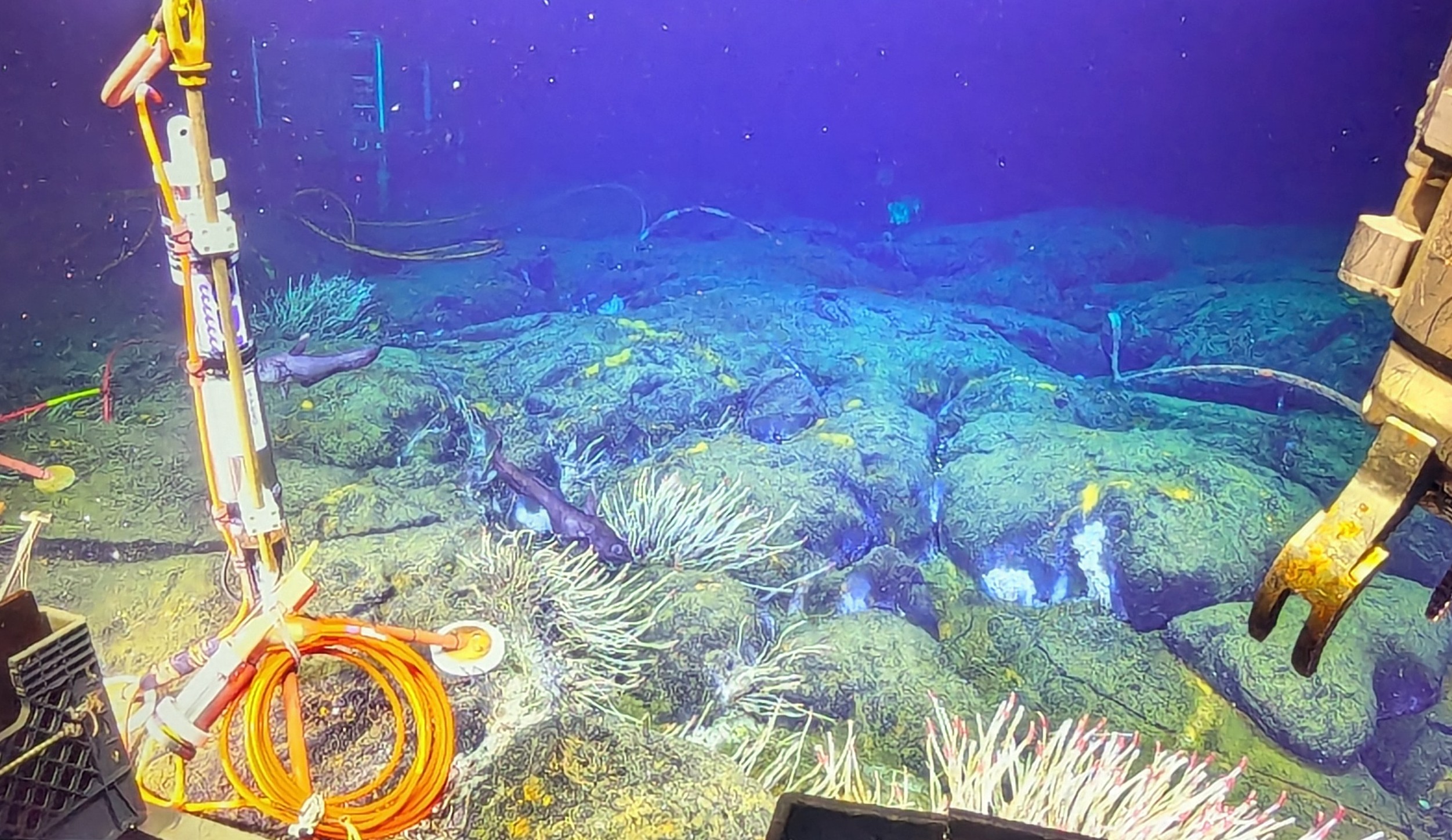
Waking up an hour early so as to not miss the site survey at the ASHES hydrothermal field (the one where they fly Jason around the location and see what has changed from the previous year), we walked into the control van only to see that the installation of the new HD camera had not gone as planned. Instead of taking the camera down, they left it on the deck to readjust the position and tie-downs to the undervator and only took the new CTD down for a swap. During this time, we were still able to get a baby site survey in, seeing lots of healthy tubeworms on the Mushroom vent. A couple of grenadiers, also affectionately known as rattails, were curious about our presence. Once the new CTD was in place and the old one was placed on Jason’s porch, we returned to the surface to iron out the wrinkles from our previous dive plan.
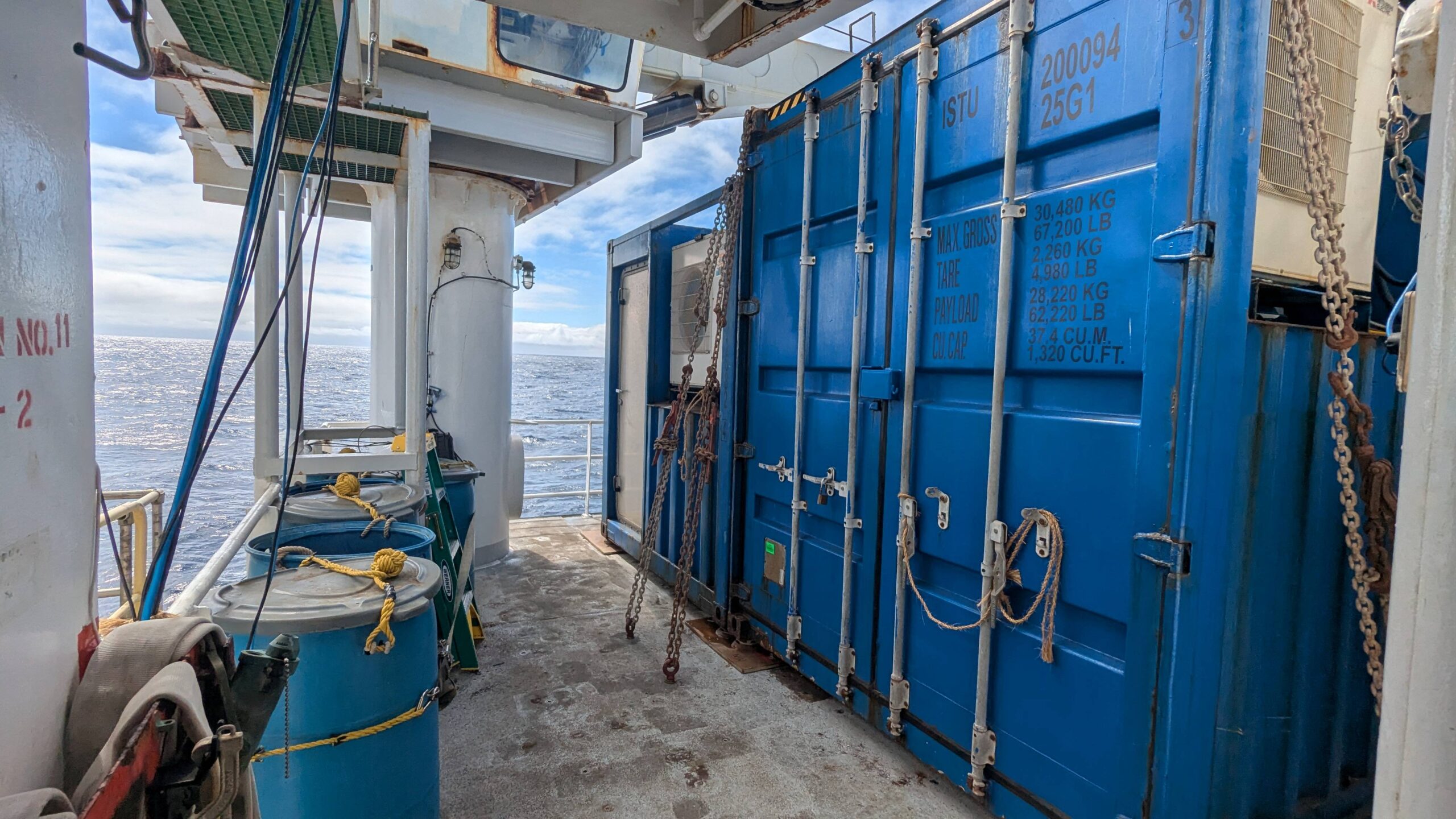
While waiting for the next dive, I came down just in time to assist Jolee with bringing the Niskin bottles off Jason into the wet lab. Doors on a ship are extremely well secured due to the rolling, rocking, and otherwise tumultuous motions that ships are prone to once out in a large body of water. There is also the small factor of fire safety through keeping the doors shut. Normally, the wet lab has a door that leads straight out to the ship’s CTD housing. Today, it was stuck impressively shut. Jolee, Mariela, and I had all attempted to get the door open. You can imagine the validation I felt when Kyle, the crew member who obligingly aided us, had to utilize a tool to gain enough leverage to yard the door open. There is also the small matter of once you have most of the handles turned open, one or more inevitably fall into a blocking position that has you contorting your body to keep them in place with whatever limbs you have available. After such a production, sampling the Niskin was light work.
Later in the afternoon, we finally arrived again at the seabed of the ASHES dive site to replace the camera as we had intended this morning. The camera is in the process of recording a 10-year time lapse of the Mushroom vent towering before it, so the placement had to be precise. This process ended up lasting well through dinner, a blessing and a curse. Blessing since none of us missed any survey time due to leaving the van to grab food. Curse due to lost potential time spent surveying.
Once the camera was in place and undergoing a test run, it was time for the survey. Two new “squigglies” had popped up off the side, creating a somewhat Seussian effect. We captured a long series of photos, focusing on the inhabitants of the vent: tubeworms, scale worms, deep-sea palm worms, and a few sulfide worms. We had entered into worm central.
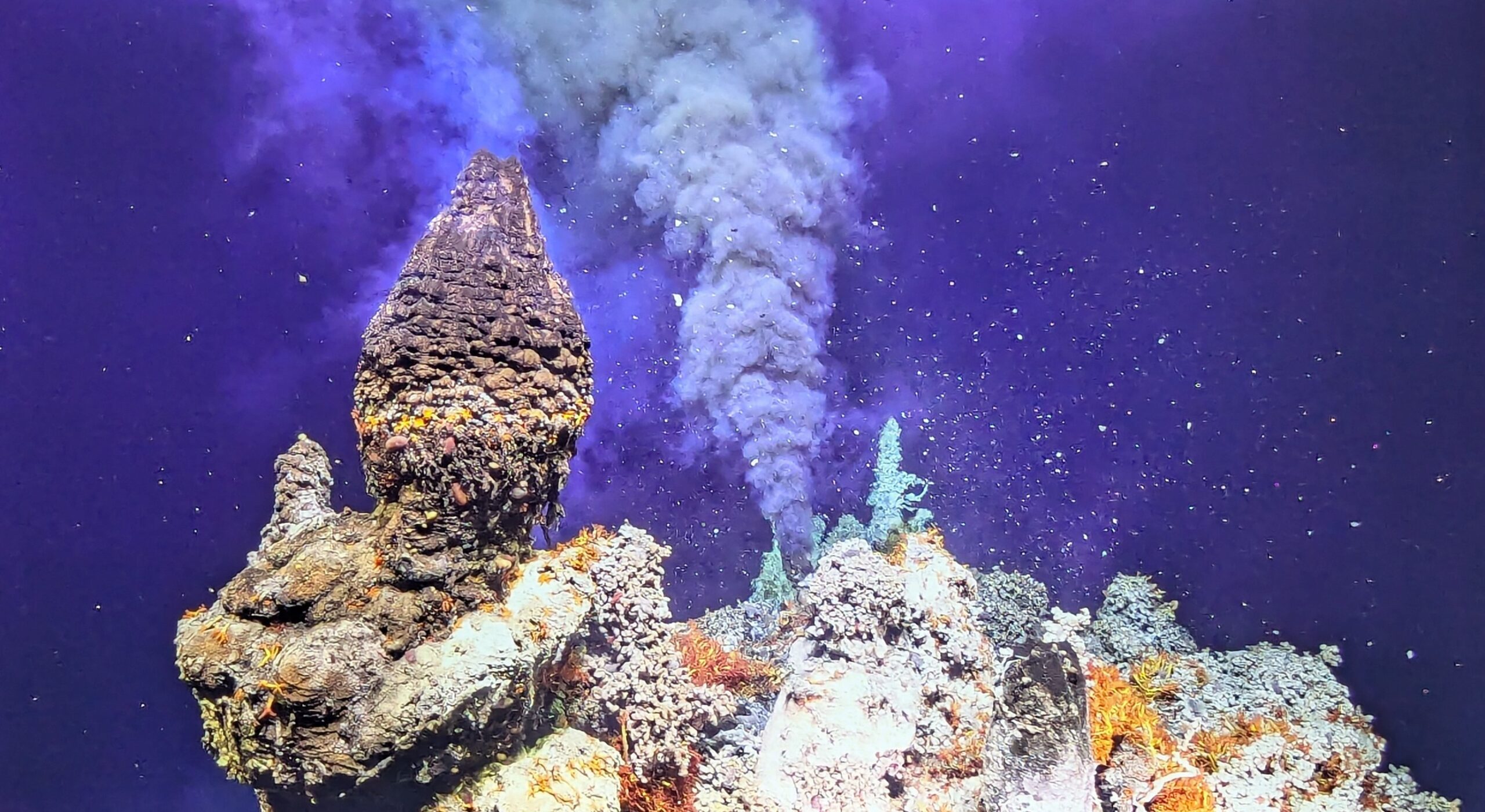
To get a proper time-lapse when Jason isn’t present to provide ancillary lighting, the camera has its own lights. We utilized that extra set of bulbs to dramatic effect by turning off Jason’s lights, relying solely on those of the camera. Illuminating the black smoke coming out of the vent towards the bottom, Mushroom stood imposingly behind. While Jason lingered there in the dark, I don’t know if there is ever enough time to get tired of that view.
In stark contrast to the vibrancy of Mushroom, Inferno, another vent at the same site, sat quiescently behind us. Chimneys knocked down, many of the fauna that had previously covered the vent had died back. A few worms were still scraping out a living amongst the wreckage; however, a large new beehive had popped up since the last visit, a promise of rebuilding. Out of the beehive streamed vent fluid that fed the few organisms around it.
Sooner rather than later, the last checks on the camera were complete and confirmed the successful installation. After a short posing session, Jason collected the old equipment and made to return to the surface. Before we emerged from the deep, it was time for me to head to bed.
August 12, 2026
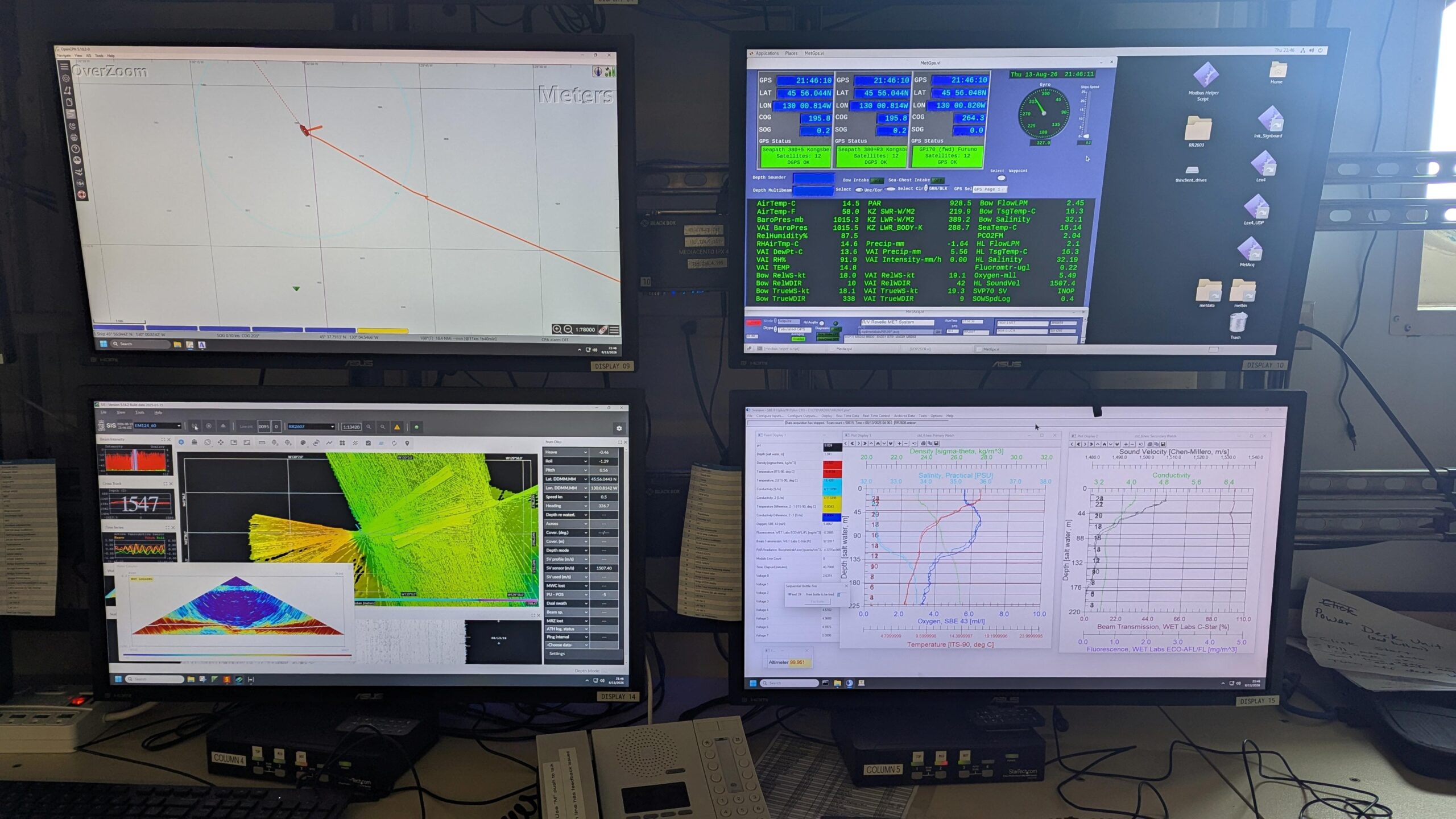
Another early morning, another expansive grey sky with calm conditions. Our big transit day had arrived, we came downstairs to the previous shift wrapping up the end of chlorophyll sample processing. Now that the samples from the most recent CTD were fully squared away and the ship was on the move for the next eighteen hours, there was no designated task. Heading up to the lounge, I sat down and worked on writing out the last few days.
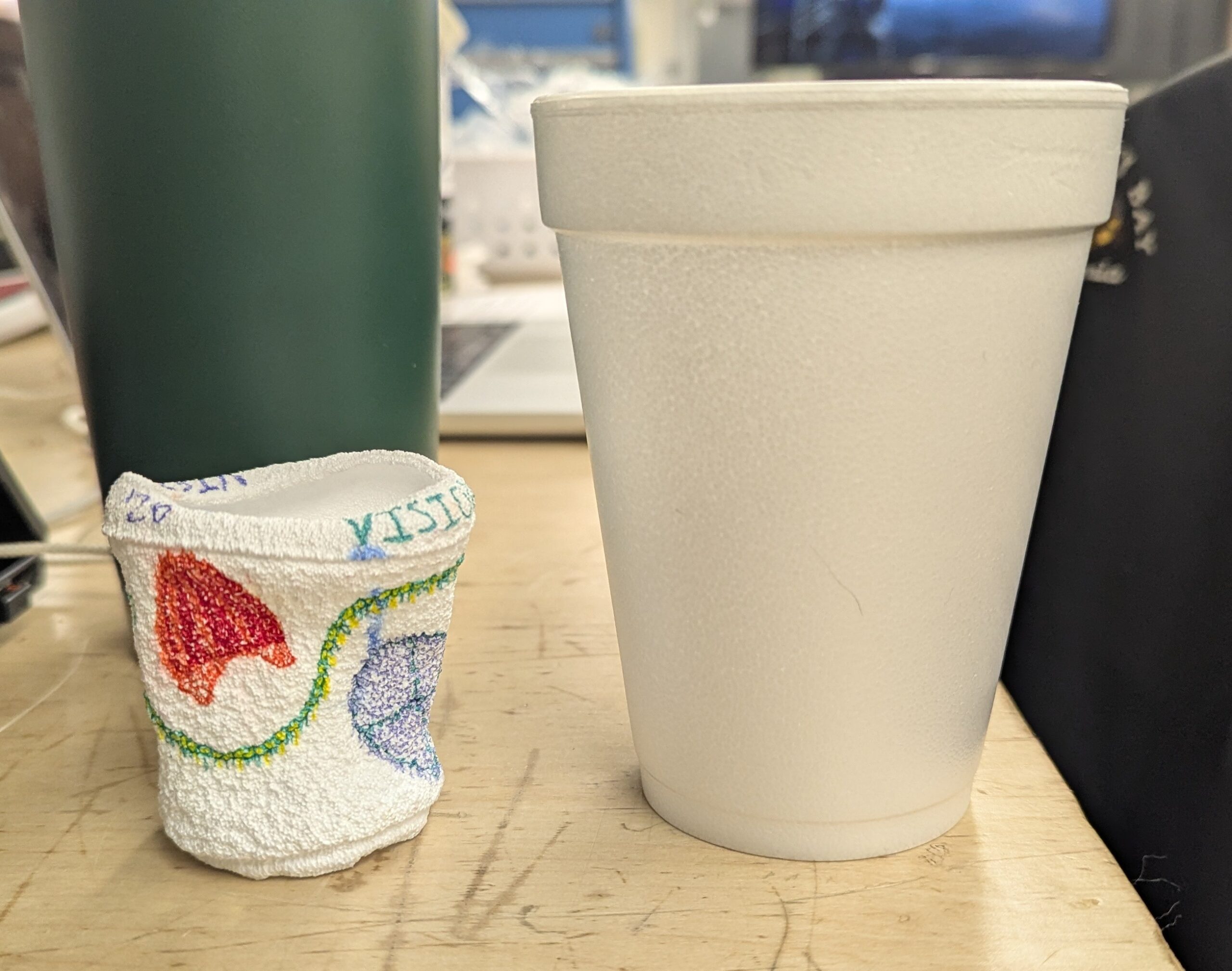
Upon my return to the Main Lab, Jolee pointed out the mesh bag on the counter that contained our shrunken cups that had returned from the deep CTD cast. Most everyone’s came back cup shaped, some of the cups shrinking much smaller than the others! I was pleased at how well the designs were preserved on the cups, albeit with a little bit of smudging.
Keeping in theme with getting work done on the computer, it was also the first day that we talked about our projects for the upcoming quarter as a group. It was interesting to see the different angles that people were considering for their projects and gave me more food for thought regarding the art of science communication. Who are the different groups we want to engage? How do we reach those desired audiences? Which topics inhabit the overlap of informative and engaging? What different levels of accessibility need to be taken into consideration? Overall, there is a lot to think about, and, while I have general ideas, I suspect that my project will undergo an evolution throughout production, especially early in the process.
Respite from my thoughts came in the form of our first CTD in the new area around 1700. We quickly prepped the CTD for another deep cast with the assistance of our ResTech, Mason. Soon we found ourselves back in the computer lab, watching the screens as the CTD descended. Due to the nature of the deep cast, there was ample time to chew the fat, and before we knew it our group was posed another thought puzzle: “What is your ‘cover of Nature’ moment?” It seems there was no escaping future-thinking today.
While none of us had that definitive cover moment, it was interesting to hear how people with such varied interests and life trajectories came together to form a team venturing to the deep sea. Along with the wide range of interests, the different stages of life and accompanying priorities framed my own aspirations.
Before we knew it, the CTD was back at the surface. Many hands make light work, and this cast was by far our fastest sample collection yet (though it helped that there are no DIC or nutrient samples for a deep cast). Preparing for another 0300 start time, I wrapped up everything in the lab and headed to bed.
August 11, 2026
Waking on the third day at sea, there were a couple of issues that the team had run into in the night. My first stop, the analytical lab, the lab techs spent a portion of the night making cornstarch from scratch since the lab starch that was brought aboard wasn’t quite the color it normally is for oxygen titration. Several trials later, with three different prep methods, it was determined that the original starch could be used—there just needed to be paper placed under and behind it to see the color change as clearly as possible.
Up in the Jason control van, the camera exchange hadn’t gone precisely as planned. Irregular terrain, characteristic of the dynamic nature of Southern Hydrate Ridge, increased the time it took to place the 2026 digital still camera precisely where they wanted, so by the time we arrived to relieve the prior shift they were just getting ready to do the site survey.
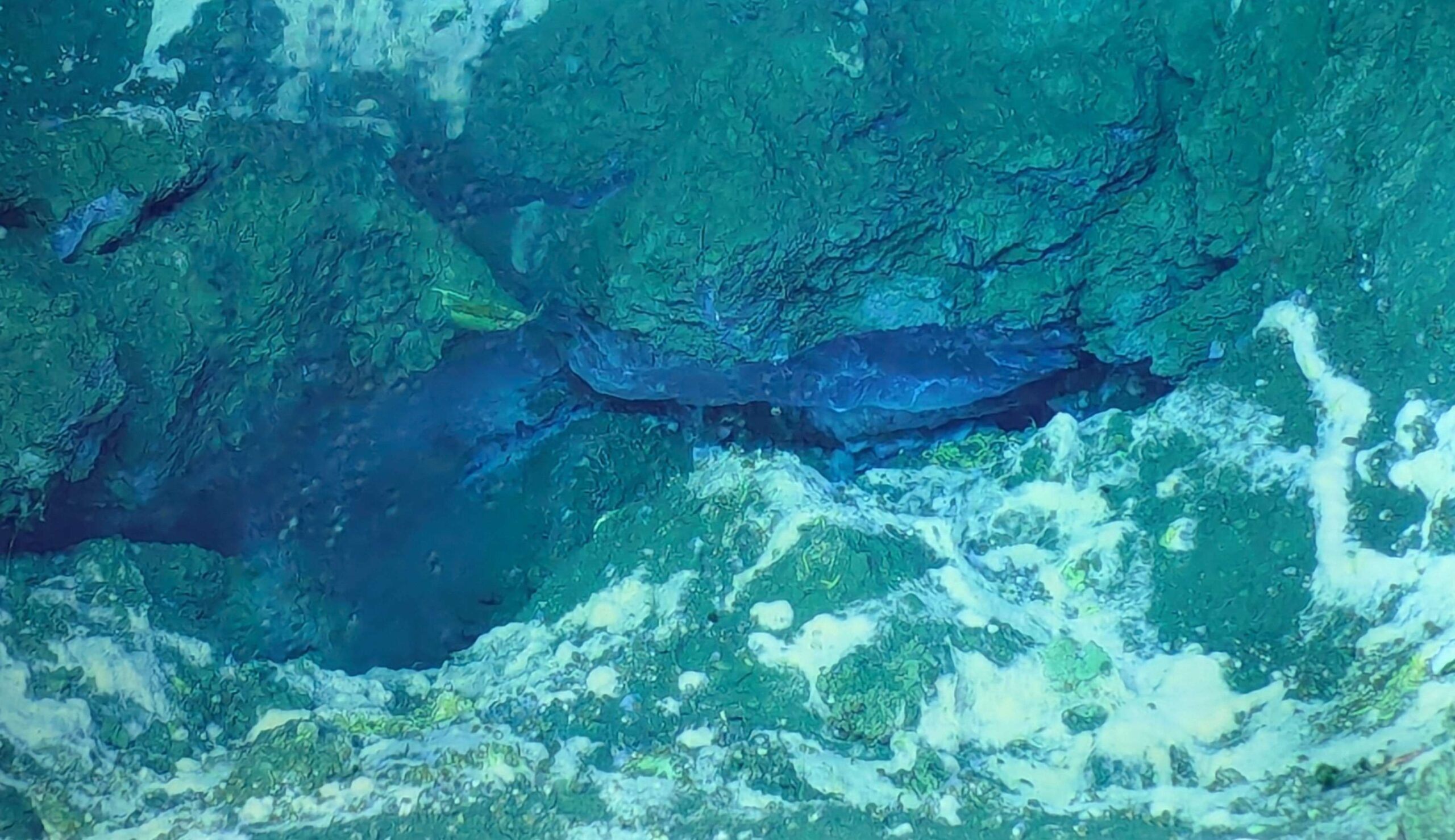
This morning’s site survey was of a place called Einstein’s Grotto. A reliable methane seep for years, we were looking for the most active methane bubble plumes and any hydrates, chunks of methane ice, associated with them. Compared to previous years, the site had filled in, the slope of hummocked mounds rounding. The area was covered in bacterial mats as if lightly dusted by snow, and plenty of biology was scattered throughout the site. Soft corals dotted the landscape along with rockfish, crabs, and clams. Hagfish seemed to prefer to curl up at the bottom of the pits we glided over, but one or two writhed their way along the seabed. When we returned to the camera, there was a methane plume that had increased activity since we left it less than an hour earlier. It was now bubbling with enough vigor to create a cloud of sediment where the bubbles emerged from the seabed. Tucked under the ledge, a chunk of hydrate peeked out.
The dive ended right in time for everyone to go to breakfast without the need for a rotation. Afterwards, I checked in with the APL folks, our engineering team, to see if they needed a hand. Disassembling the newly retrieved camera, Izzie and I scrubbed the smaller parts to remove biofoulling (undesirable or harmful biological growth). Once flat planes were scrubbed and bristles shampooed, the whole student cohort was then given guidance on how to remove barnacles from the larger equipment – for example, the BEP. Eager to get the satisfaction of removal, we made quick work of the wide faces. Detail work would come throughout the voyage.
Back on duty, the next dive was wrapping up. Since it was a deeper venture though (to 2900 m), it was going to take Jason another hour and a half to return to the surface. During this time, one of the Jason’s pilot, guided us each through handling a manipulator. To give some context, Jason has two “arms”, one on the starboard (right) and the other on the port (left), called manipulators. These allow Jason to do the fine tasks of setting up equipment, plugging/unplugging cables, and taking samples. The way they are controlled is by a smaller model of the manipulator that the pilot then moves around to cause Jason to mimic the move. The pilot watched as we extended the arm out, brought in to touch the edge of Jason’s porch, and moved back to start position. While the left hand was moving between the controls and adjusting the joints of the arm, the right hand stayed firmly gripped at the end. The most important rule was no matter what, don’t let go.
After dinner, we did another set of CTD casts. Because it was right after dinner, there was a good-sized group of students working through the set of shallow water samples. Many hands and light conversation made easy work. Setting up for the deep cast (~2900 m), it was finally time to secure a mesh bag of our Styrofoam cups to the CTD rosette. Safely anchored to the bottom of the rosette, it would be several hours until we could see the unique ways in which they deformed. That would have to wait until tomorrow for me; I was finally off to bed.
August 10, 2026
To make a pot of coffee, you venture from the lab up to the galley. Affixed to the counter is a four-burner coffee station, one directly under the drip and three to keep warm. You take out the basket, fumble a filter into it, and attempt to place it under the industrial bean grinder. It is at this point that a crew member may also stumble into the galley, take one look at the way you are struggled to figure out how the basket clips in (turns out the arms go on the outside of the basket), and decide it’s best to give a demonstration. They are sure to point out the idiosyncrasies of the system to ensure you don’t accidentally overfill the pot. While the fresh batch is brewing, they happily relate what they do and how long they’ve been a part of the fleet.
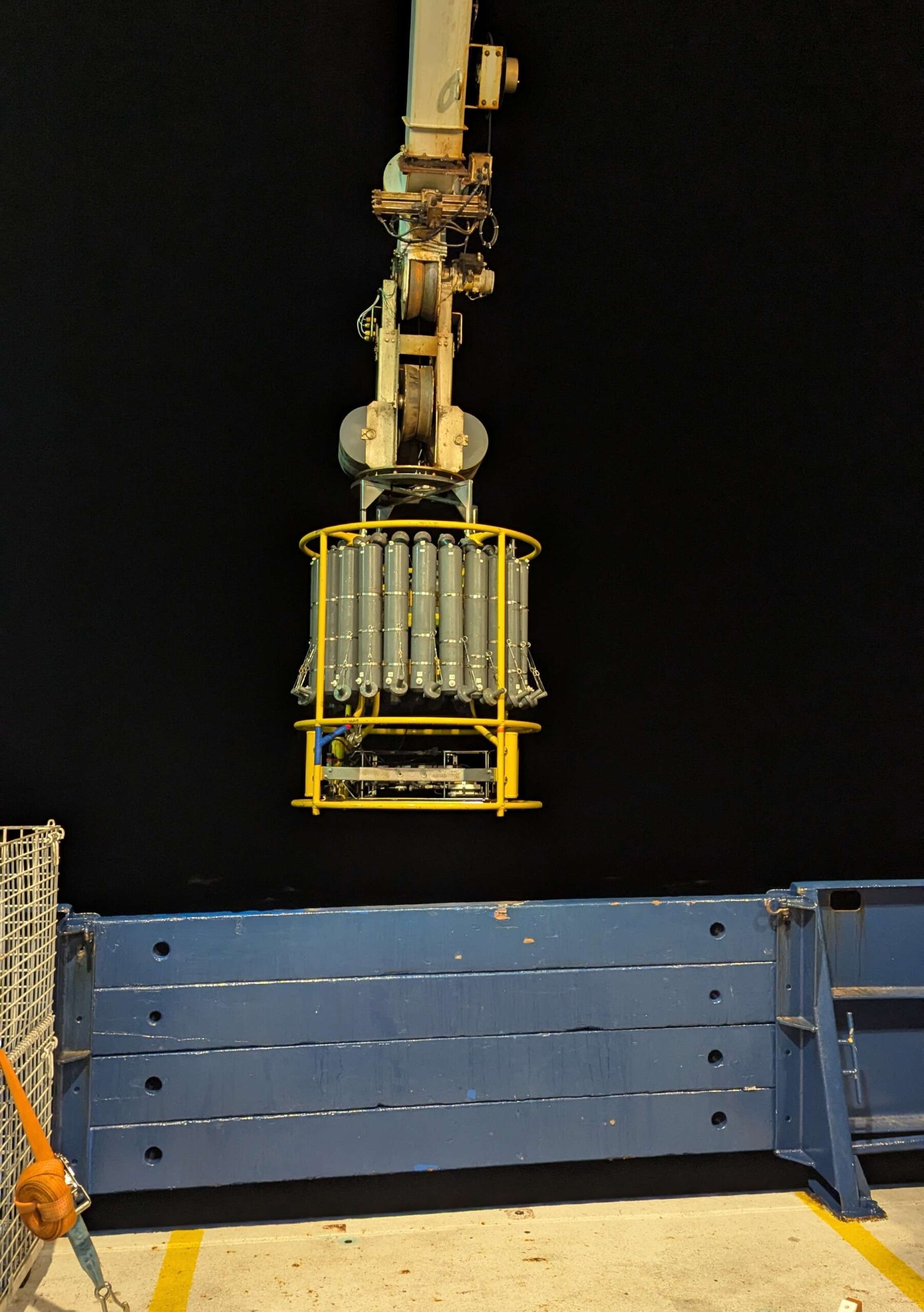
This is, at least, where I find myself around 0500 after we sent the CTD down for the second cast of the day. Since it is a deeper cast (2900 ), there is more time to take care of the small morning rituals I didn’t have time for an hour earlier. When it’s time for the CTD to return to deck, the automatic winch system pulls it from the water and is positioned over the wooden palette it is stored on before being guided down by the ResTech, one of the ship’s marine technicians.
From these Niskin bottles, we gather samples for DO, temperature, DIC, salinity, and chlorophyll. Sunrise is an understated affair with a thick veneer of clouds lining the sky. There is a small window just off the horizon though the clouds that allows a brief view of the pink-orange disc before it slips behind the curtain. We won’t see it again until tomorrow.
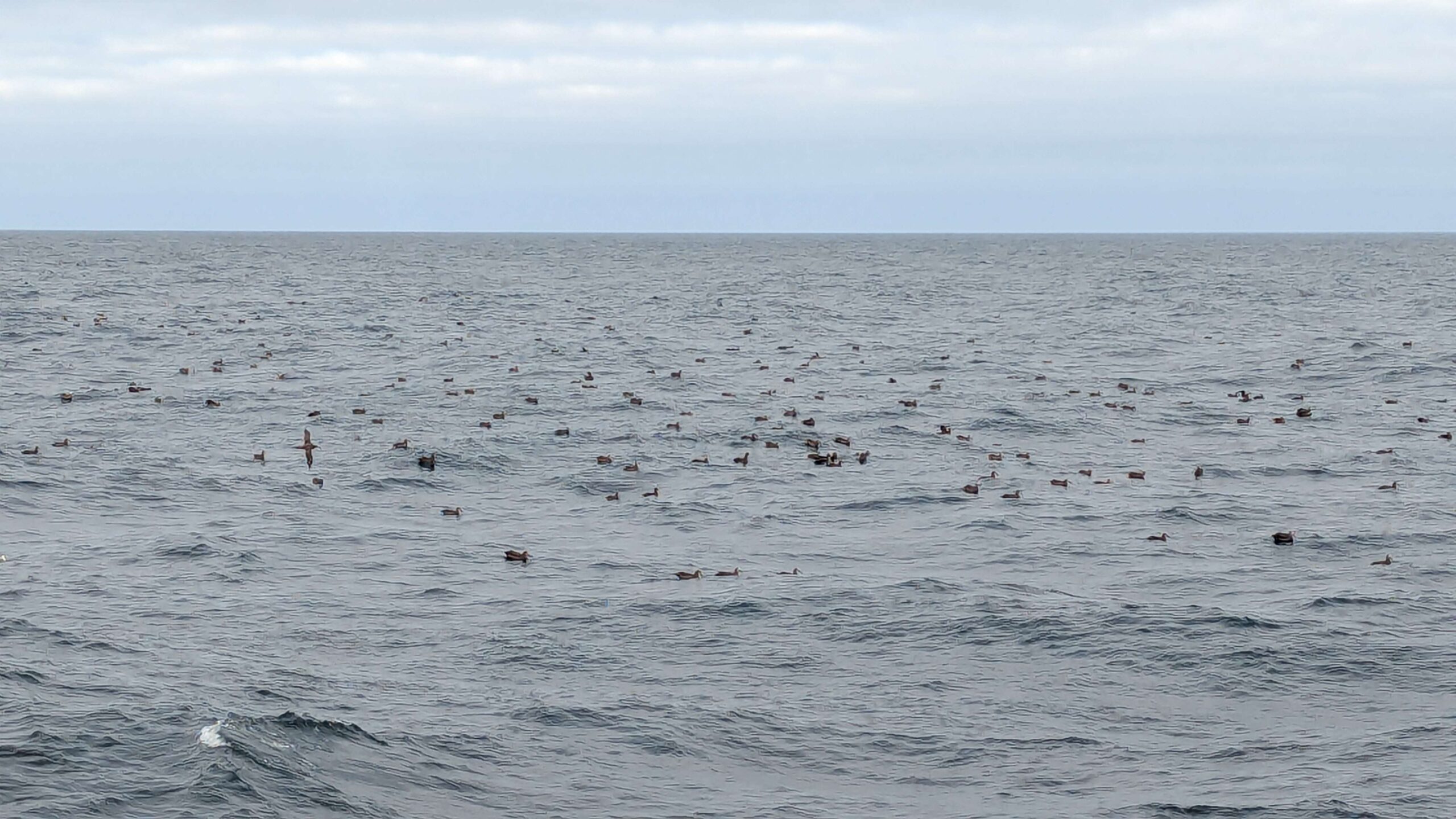
Finishing the CTD sampling, it’s time to start the next Jason dive. After another breakfast rotation, when I return to the control van there is a flock of black-footed albatross floating in the water off the port. Stunned for a moment at the numbers, I take in the first wildlife I’ve seen since the sea lions when leaving port. I quickly collect myself to send the next person to breakfast and excitedly relay the presence of the flock to everyone present. When our relief shows up fifteen minutes later, the flock is already drifting away from the ship.
The next eight hours off, a not-insignificant portion is dedicated to cup decoration. Styrofoam compresses from hydrostatic pressure when at depth, so when doing a deep CTD cast, say 2000 meters, cups will shrink into shot glass versions of themselves. Each cup shrinks in different ways, and it’s a gamble on the actual uniformity of the final product. For my first cup, I take inspiration from some of the organisms we’ve seen so far: a couple of different illuminated comb jellies, an elongated siphonophore, and a slightly more traditional true jelly.
There is also plenty of time for one of our field engineers from APL, UW’s Applied Physics Laboratory, to demonstrate how she calibrates sensors before deployment. Some instruments benefit especially from calibration out in the field; others are calibrated in the lab and then verified in the field to ensure that nothing changes during transit. She graduated from UW’s School of Oceanography with a focus in marine technology and was part of the ERIS program.
Right at the end of my second shift, Jason was ready for a second dive. This was going to be a longer one though, both deeper and including some additional time for a site survey to observe what has changed at the location since last year. Before we knew it, the next shift was on, and we were off to bed to catch some sleep. Seeing the bottom would have to wait.
August 9, 2026
With breakfast at 0730, I had a (early for me) waking time of 0700. Due to paper-thin walls, I set all my alarms to vibrate only, doubling up with alarms both on my phone and watch. The anticipation of our imminent voyage had me waking periodically, looking gratefully at the time, and promptly falling back asleep in ninety-minute intervals. Eventually, around 0650, it was time to greet the day.
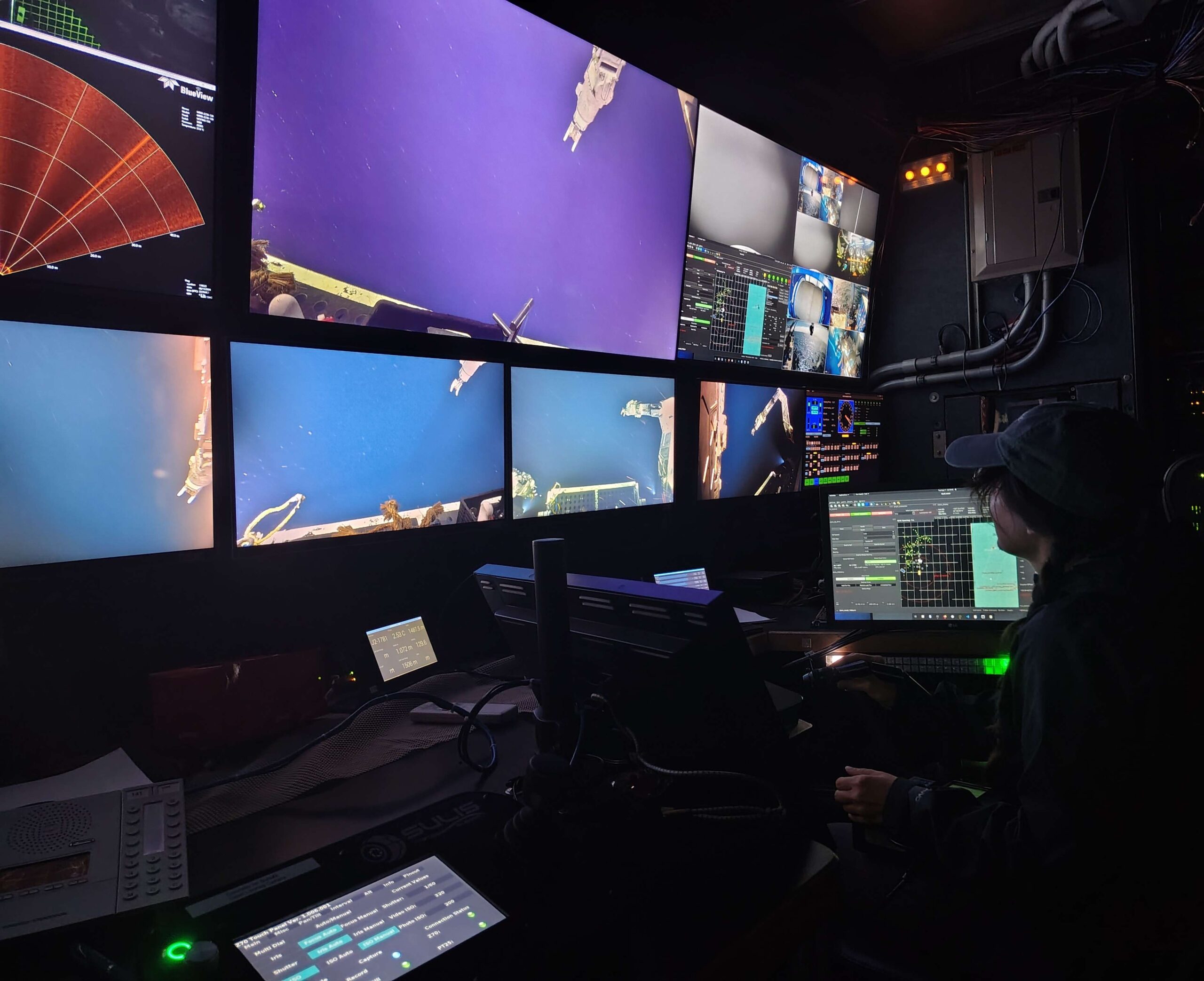
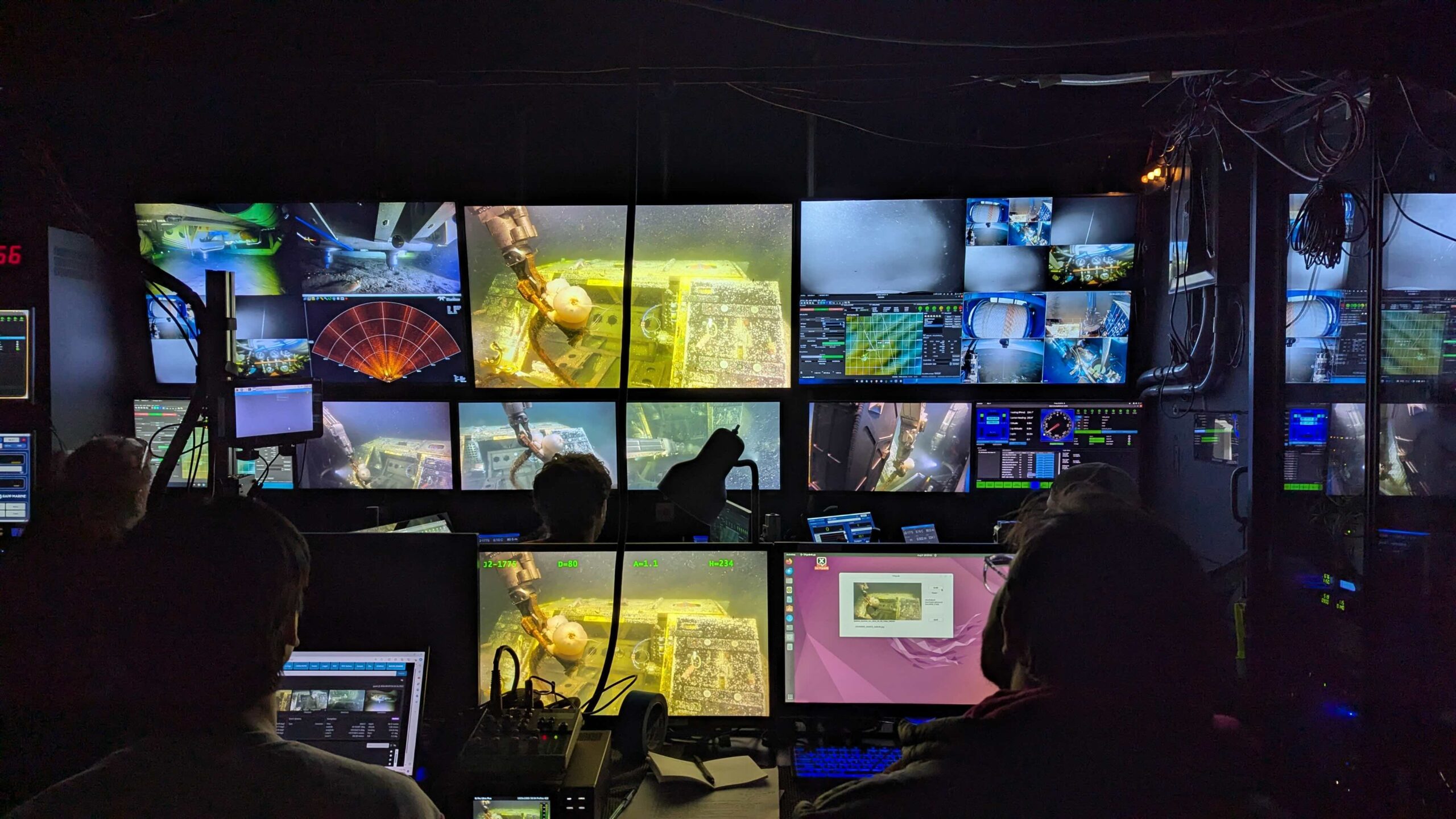
As promised, breakfast was a classic affair: fruit salad, yogurt, bacon, sausage, pancakes, and a slew of fried eggs. Afterwards we got our first introduction to the Jason control van. A wall of screens inside a large metal shipping container, there are three rows. The primary, closest to the wall of screens, is where the navigator, pilot, engineer, and science shift lead all oversee operations. In the middle, the secondary row is where the loggers (this trip, us, the students) document the dive using SeaLog and video. Lastly, along the back wall, there is a rather comfortable bench seat for spectators to perch atop with a small, stable desk for any work they bring along.
Following our brief introduction to the control van, we then got our CTD orientation. Standing for conductivity, temperature, and depth, the CTD is an iconic oceanographic instrument. Niskin bottles line the outer section of the cylinder, with a system of cables holding the tops and bottoms open for water to flow through. The primary sensor, the brain of the CTD, sits below the bottles, at the bottom of the cage. This way, as the instrument is descending in the water column, the brain collects the data first and then, when the marine tech wants, individual niskins are “fired” and capture the water sample at whichever depth the CTD is at. The Revelle’s CTD is largely the same as the Rachel Carson’s, with the addition of beads to the top lanyard and removal of the secondary loop on the carousel.
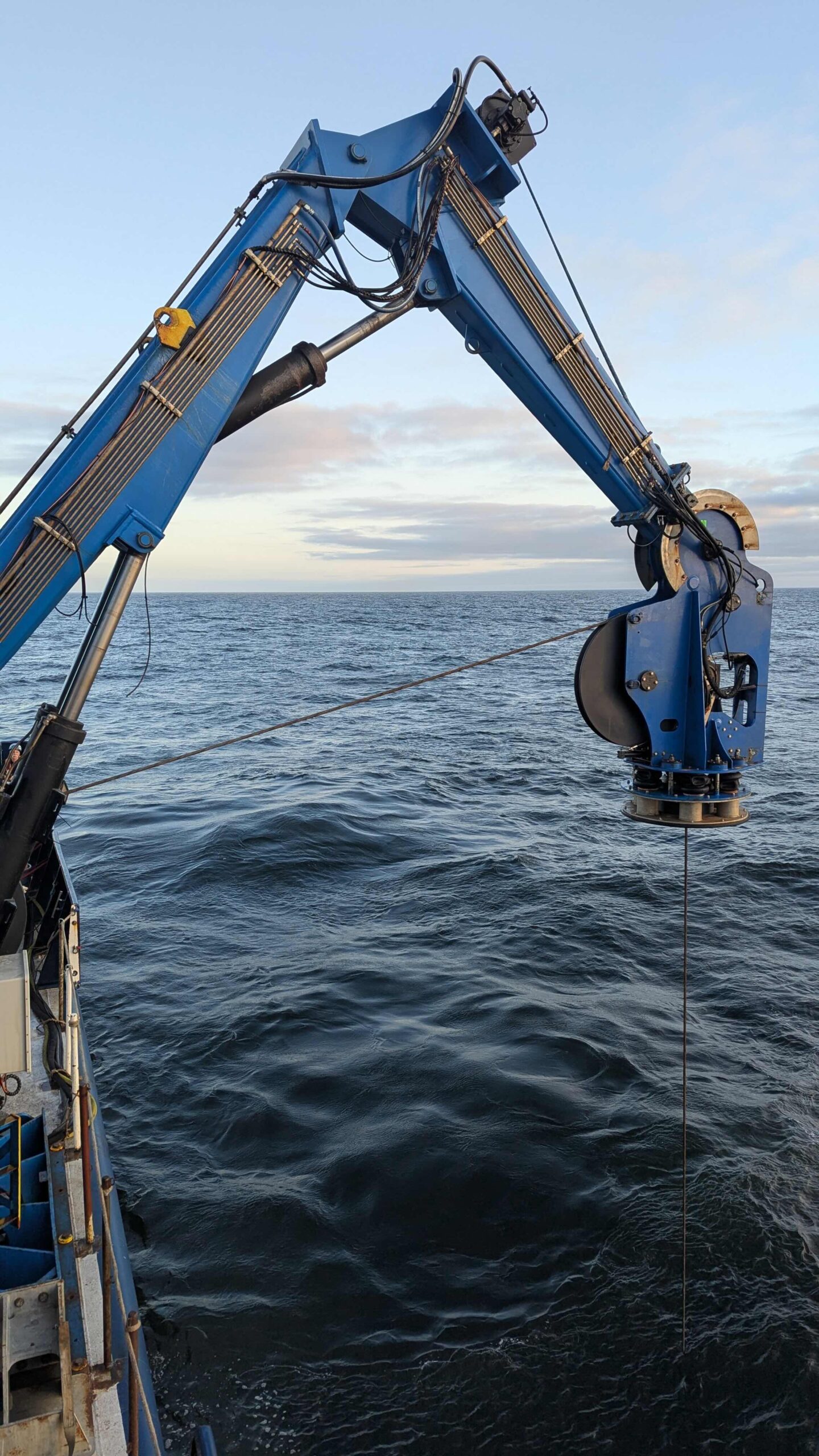
After the CTD review, the sound of the horn reverberated through the air, and we were on our way. Passing under the arched bridge acting as the gate to the port, the excitement on deck was contagious. Being on the person on the large ship as it heads out rather than a spectator, watching and wondering, was a heady feeling.
Once out of the port, a small boat sidled up next to us to retrieve their pilot who assists specially with the transit out of the Yaquina channel. Knowing that it was a reasonably sized boat, slightly larger than most I’ve been in previously if anything, didn’t change the fact that it looked like the toy boat from Ponyo next to our vessel. Carefully pulling up next to us, once they had acquired their pilot they peeled off, leaving us to start transiting to our first dive location.
After lunch, it was time for the abandon ship drill. Six short blasts followed by a long one, during the safety meeting the day before this alarm was made easy to remember by our ResTech telling us it sounds like, “get the f— out right noooooooooooow.” Hustling down from the Main Lab, we descended into the berthing area, retrieved our pfds and immersion suits, and went up to the bow on the O2 deck. I had a brief struggle with the basic stockade-strap style pfd, garnering an offer of help from one of the crew. After we all had them on, we were instructed on how to remove them and proceeded to lifeboat review. Once we were done with the rafts, the real fun began.
Down in the Main Lab, we watched a live demo on how to wriggle into the survival suit. Simultaneously too small and too large, the immersion suit is what you would get if you cross a wetsuit and an old-fashioned dive suit sans helmet. Instead, there was an overly tight hood with Velcro that was happy to attach to hair if given the chance. When fully in the suit, they somewhat resemble an older cartoon, leading to the affectionate nickname of “Gumby suits”. Many struggles later, we were all in and quickly out of our suits. Both items were re-secured in our rooms, and before we knew it, we had arrived at our first dive site.
While not on the first shift, I claimed a spot in the back row of the control van to see what was in store. The sites closest to shore are the most productive by far, shallow enough for ample nutrients to sink. This means that there is also plenty of biology growing on the equipment when we return. Upon opening the cable housing, we were greeted with a basketball sized plumose anemone perched at the end of the cable. Unplugging the cable and moving it became an even more delicate operation than normal. Not all the fauna was so lucky, a seastar getting crushed under the housing doors.
The Jason control van is a comfortable space to work. Quiet conversations lit only by the glow of transmitted video and the steady rocking of the boat underneath creates an almost soothing effect. Before nodding off entirely and to prepare for my first shift at 1600, I headed down for a nap.
After waking and getting ready for the next four hours, I checked in at the Main Lab. Jason had brought back two niskin bottles for sampling to calibrate the sensors using local ocean water samples in the lab. For the first portion of my shift, I assisted Joe and Mariela in preparing the samples for dissolved oxygen (DO), dissolved inorganic carbon (DIC), salinity, and chlorophyll. Each sample was prepped then packaged to continue back on land. Since there were only two bottles, one forward, one aft, it wasn’t long before it was time to go to the control van.
With an early dinner time between 1700 and 1800, we rotated positions to send everyone for food. Done with dinner, I began training in the logger position, ensuring as accurate documentation of the dive as possible. The other position, video logger, entails grabbing a series of photos to document the dive, as well as taking 4k video when necessary. Time flew by retrieving the old CAMDS, and before I knew it we were bringing Jason back on board.
A chilly sunset viewing followed by a hot shower meant it was time to hit the hay before the 0330 alarm rang in the start of day two.