
Image Archive


Einstein's Grotto, at the summit of Southern Hydrate Ridge, is a main target site for installation of cabled chemical and biological sensors in 2014. The area hosts extensive white bacterial mats and was a site of vigorous venting of large methane bubbles. This 2011 image, showswater sampling bottles on the arm of the Canadian robotic vehicle ROPOS. Credit: UW/NSF-OOI/CSSF. V14.
A variety of sensors will be deployed on the RSN cabled network in 2013 to investigate the dynamic environment of methane seeps, gas hydrate formation, and associated biological communities. The instruments include seismometers to detect earthquake, fluid flow sensors, digitial still cameras, and a mass spectrometer for quanitfication of gas compositions.
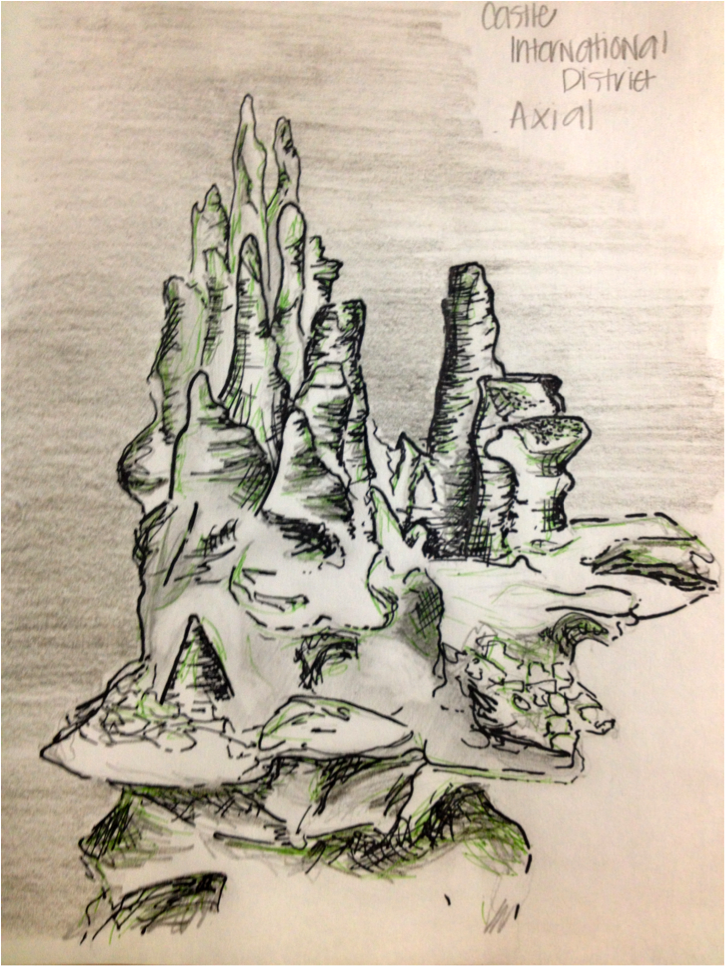
To measure vent fluid salinity at Axial, a temperature-resistivity (chlorinity) probe will be deployed in the International District in 2013. The one shown in this image, was deployed in a 380°C vent in the Main Endeavour hydrothermal field north of Axial.
Associate Scientist, WHOI
Assistant Scientist Marine Biological Laboratory
Teos Bisbee
UW Graduate Student
Doug Luther, OOI-RSN Project Scientist
UW Undergraduate Student
Mikelle Nuwer, UW
UW Undergraduate Student
Michael F. Vardaro, Assistant Professor College of Earth, Ocean, and Atmospheric Sciences
Chris Hoyt
Dennis Manning
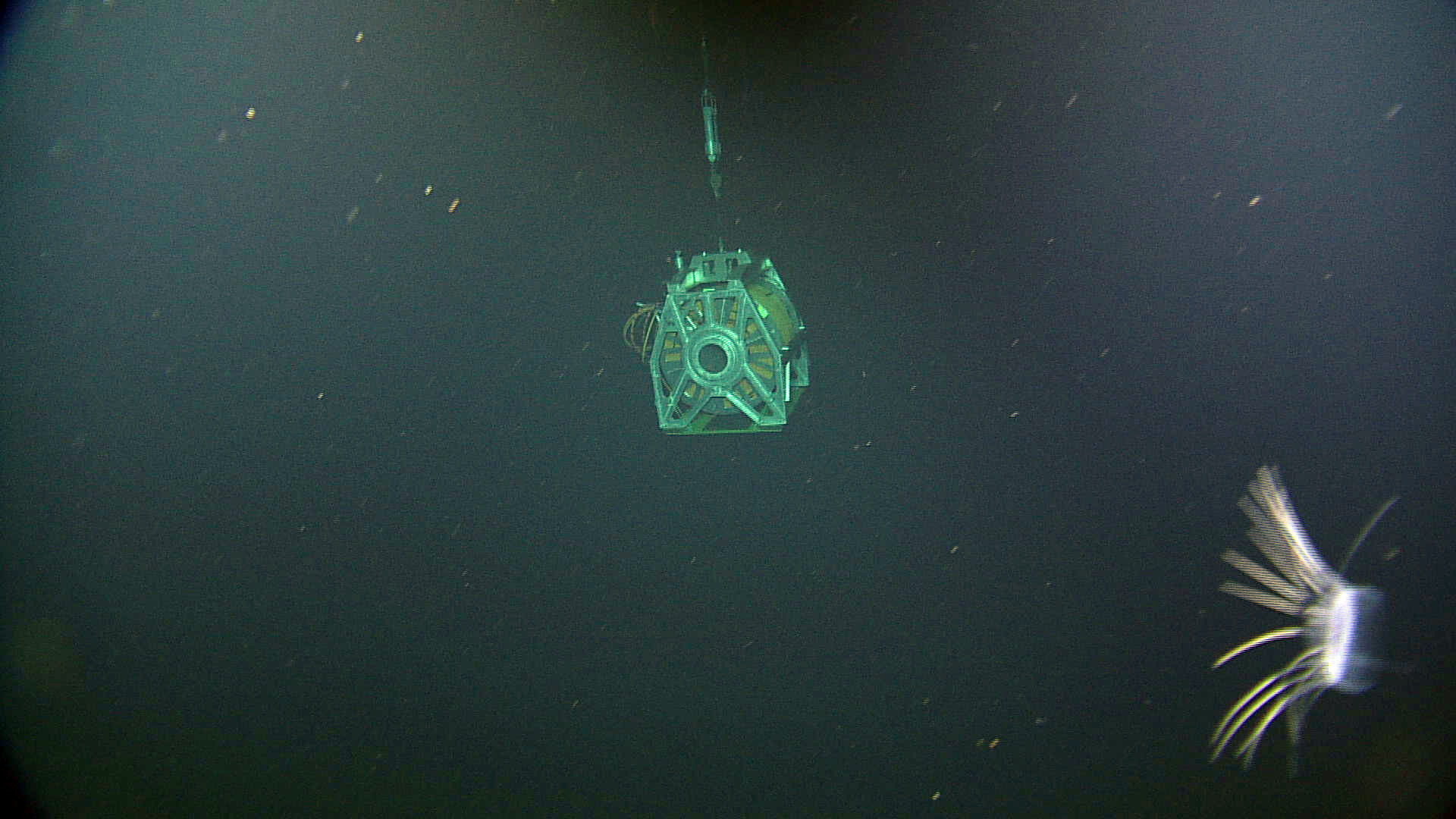
OOI RSN Primary Node 3B was launched from the aft deck of the TE SubCom Dependable at 0705h PDT on 18 August 2012. This was the seventh, and final, node installation on the OOI RSN cabled infrastructure. --Photo by Brian Ittig
OOI RSN Primary Node 3A (PN3A) on the aft deck of the TE SubCom Dependable. Cable segment 6 is on the port sheave (to the right in this photo) and cable segment 7 is on the center sheave (to the left in this photo). --Photo by Brian Ittig
PN3A was launched from the aft deck of the TE SubCom Dependable at 2245h PDT on 16 August. --Photo by Brian Ittig
Location of the 900 km high-power and bandwidth US Regional Scale Nodes cabled observatory in the Northeast Pacific. The backbone cables and seven primary nodes provide power and bandwidth to secondary infrastructure (instruments, junction boxes, medium power nodes, full water column moorings) at key scientific study sites along the Juan de Fuca plate and in the overlying ocean. A shore station located at Pacific City, Oregon brings the power and communications onshore where data are passed off to the terrestrial fiber. Real-time capabilities of the RSN through the Internet will provide unprecedented data flow and two-way communications to many hundreds of sensors. OOI infrastructure also includes a series of uncabled moorings as part of the Coastal Scale nodes, with data transmission through satellite communications.
Down looking mosaic of the ~ 4 m tall black smoker chimneys 'Inferno' and 'Mushroom' in the ASHES vent field. A network of fractures with variable intensity of diffuse flow host white bacterial mats and tube worms. Also shown is a corresponding vertical mosaic of Inferno hosting dense colonies of tube worms and limpets. PLEASE NOTE: This image is not available for usage.
RSN is developing state-of-the-art high power (3 kW) and bandwidth (1 Gbs) full water column moorings that will include a broad suite of sensors, an instrumented deep profiler, a 200 m platform and an instrumented winched shallow profiler.
Final pre-deployment configuration of OOI RSN Primary Node 5A. --Photo by Brian Ittig
Before deployment of OOI RSN Primary Node 5A, the spare Science Interface Assembly that had been used in the node for on-deck testing, was transfered back to the spare primary node carried on board the TE SubCom Dependable. --Photo by Brian Ittig
OOI RSN Primary Node 5A is deployed in the middle of the night off the aft deck of the TE SubCom Dependable. --Photo by Brian Ittig
The TE SubCom Dependable maneuvers close to the buoy to recover the attached cable end. --Photo by Brian Ittig
Assist vessel, F/V Iron Lady, repositions the cable segment 5 buoy for recovery by the TE SubCom Dependable. --Photo by Brian Ittig
- Anemone
- Animal
- Arthropod
- ASHES
- Axial
- Axial Base
- Axial Biology
- Axial Caldera
- Bacteria
- Basalt Lava
- BEP
- Biofouling
- biolgoy
- Biology
- Camds
- Camera
- Camhd
- Central Caldera
- Ciliates
- Cnidaria
- Coastal Biology
- Crab
- Deep Profiler Mooring
- Dive Highlights
- Eastern Caldera
- Echinoderms
- Endurance Array
- Engineering Team
- ENLIGHTEN 10
- Exploratorium
- Fish
- Geology
- HD Camera
- HPIES
- Hydrate Ridge
- Hydrates
- Hydrophone
- Hydrothermal Vents
- Illustration
- Inshore 80 Meters
- Instrument
- International District
- J-BOX
- Jason
- Jellyfish
- Junction Box
- K12
- Lava
- Mollusk
- Moorings
- Nodes
- Nudibranch
- Octopus
- OOI
- Oregon Offshore
- Oregon Offshore 600 m
- Oregon Shelf
- Oregon Slope Base
- People
- PN1B
- PN1D
- Polychaetes
- PPSDN
- Primary Node
- RASFL
- ROCLS
- ROPOS
- ROPOS Dives
- ROV Team
- RV Revelle
- RV Sikuliaq
- RV Thompson
- Salp
- Sample
- SC13
- Science Team
- Sea Cucumber
- Sea Star
- Sea Urchin
- Seafloor
- Seismometer
- Sensors
- Shallow Profiler Mooring
- Shark
- Shipboard
- Shore Station
- Slope Base
- Smoker
- Soft Coral
- Southern Hydrate Ridge
- Sponge
- Squid
- Students
- Students & Guest Participants
- Tmpsf
- Tubeworms
- VISIONS 11 Leg 1
- VISIONS 11 Leg 2
- VISIONS 11 Viewers
- VISIONS 13
- VISIONS 14
- VISIONS 15
- VISIONS 16
- VISIONS 17
- VISIONS 18
- VISIONS 20
- VISIONS 22
- VISIONS 23
- Visualization