Image Archive


A Cedar Waxwing rests atop an RCA platform on the fantail of the R/V Thompson. Credit: M. Elend, University of Washington, V20
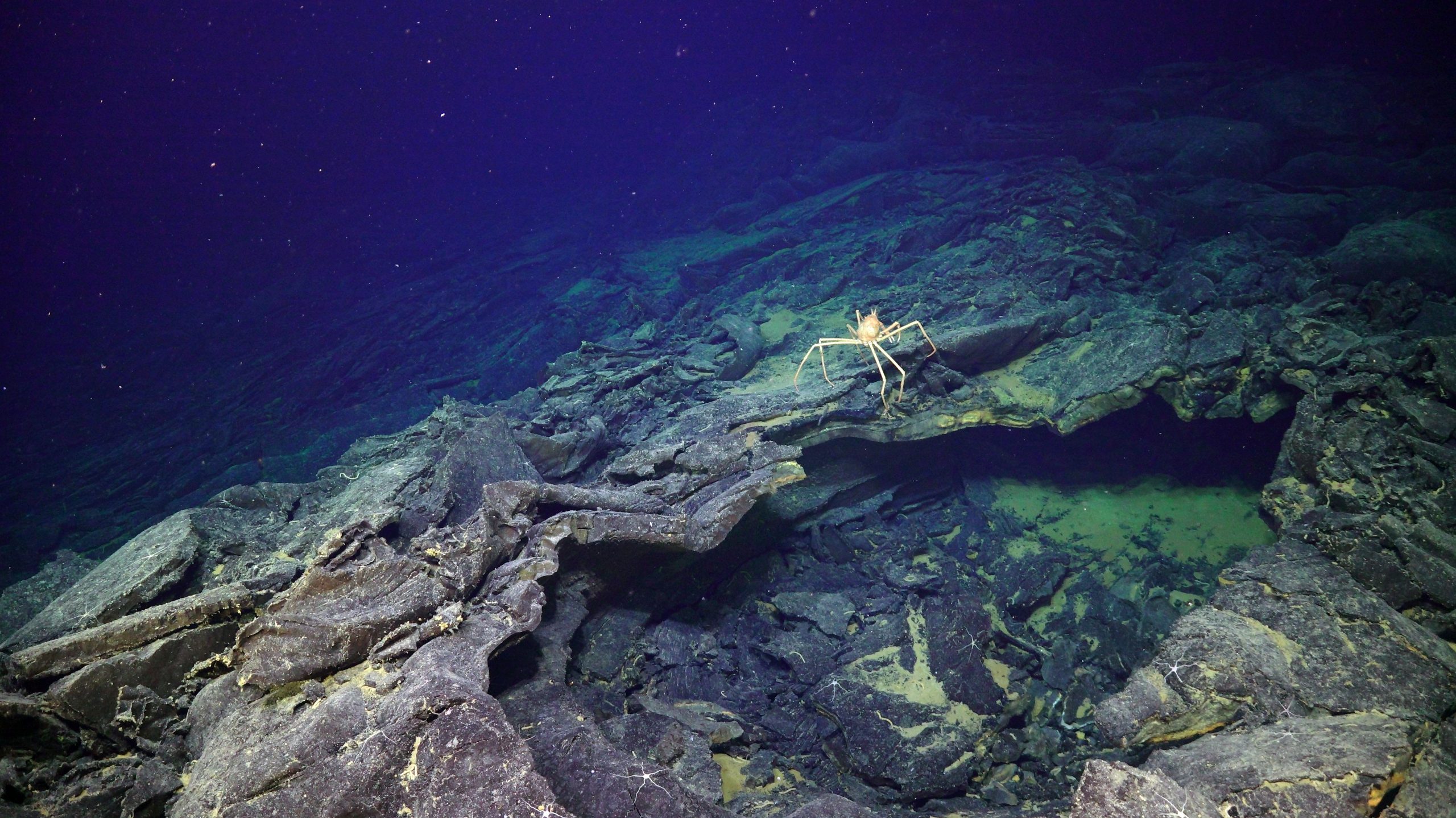
A spider crab explores a small collapse pit floored by glass lava talus on the summit of Axial Seamount. Credit: UW/NSF-OOI/WHOI: V20.
A spider crab delicately walks across glassy rubble in a small collapse pit. Credit: UW/NSF-OOI/WHOI: V20.
A spider crab at the International District inspects the edge of a small collapse zone. Credit: UW/NSF-OOI/WHOI. V20.
A brush is used to clear away anemones that are hiding access to the junction box at the Oregon Shelf site. Credit: UW/NSF-OOI/WHOI; V20
A blob sculpin (Psychrolutes sp.) aka blobfish, at International District on Axial Seamount during VISIONS'20. Credit: UW/NSF-OOI/WHOI V20.
Beautiful purple-blue ciliates, white filamentous bacteria and tube worms with red hemoglobin-filled plumes, and limpets colonize the outside of the Mushroom edifice at ASHES. Credit: UW/NSF-OOI/WHOI V20.
A tanner crab next to bacterial mat at Southern Hydrate Ridge (780m). Credit: UW/NSF-OOI/WHOI, V19
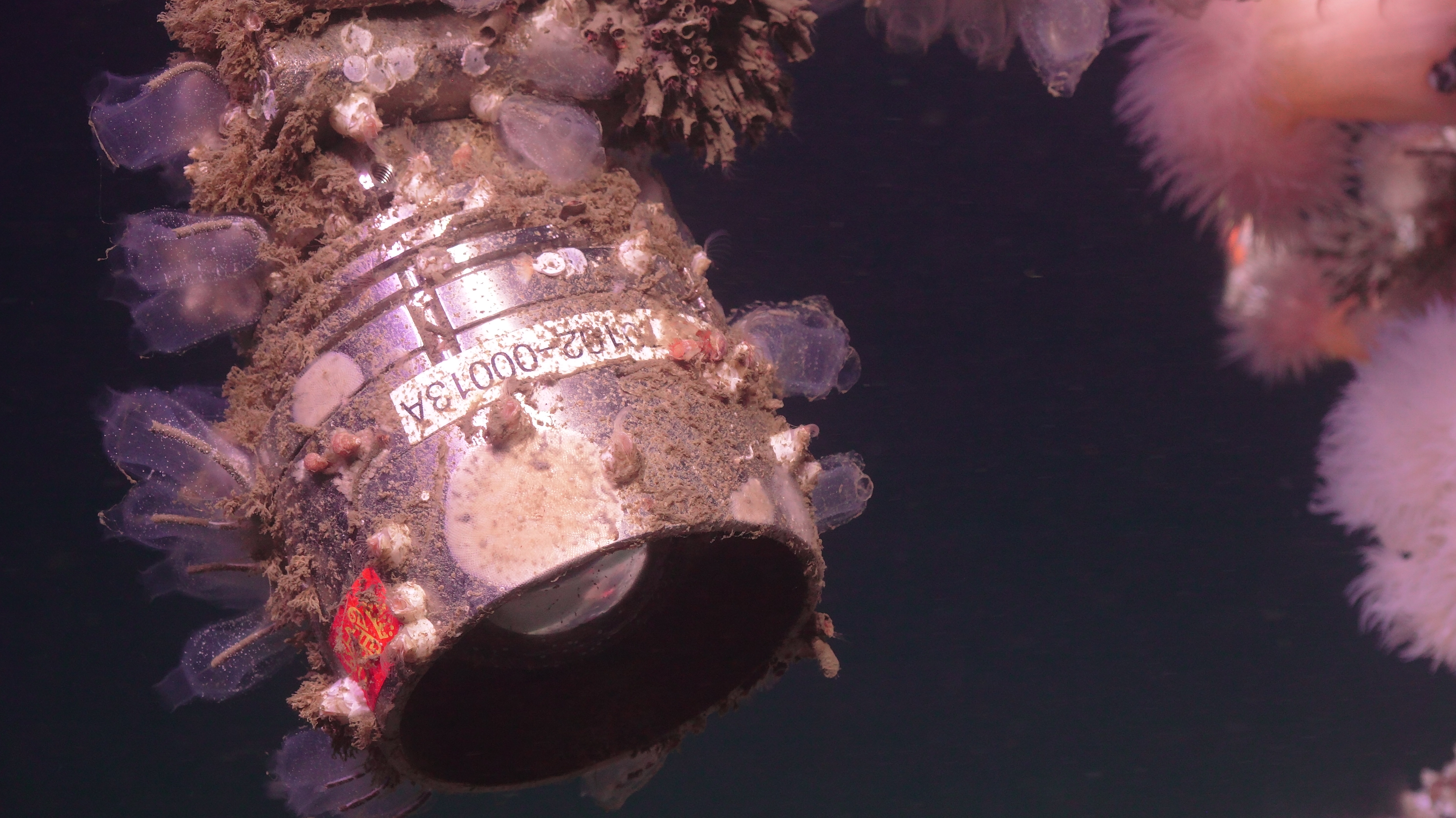
Tunicates (aka sea squirts) covering the lamp of the Oregon Shelf digital still camera. Tunicates are chordates that start life as a swimming, fish-like animal and then settle on a surface and become sessile (attached) organisms that filter food out of the water flowing by. Photo Credit: UW/NSF-OOI/WHOI, V19
Different shapes and sizes of anemones covering the upper surface of the Oregon Shelf junction box. Photo Credit: UW/NSF-OOI/WHOI, V19
Close-up video of the Metridium anemones covering the upper surface of Oregon Shelf junction box. Photo Credit: UW/NSF-OOI/WHOI, V19
The Jason pilots carefully use a manipulator to cover the open socket of the Oregon Shelf junction box with a protective 'dummy plug' after disconnecting the digital still camera. Anemones cover most of the rest of the surface of the platform. Photo Credit: UW/NSF-OOI/WHOI, V19
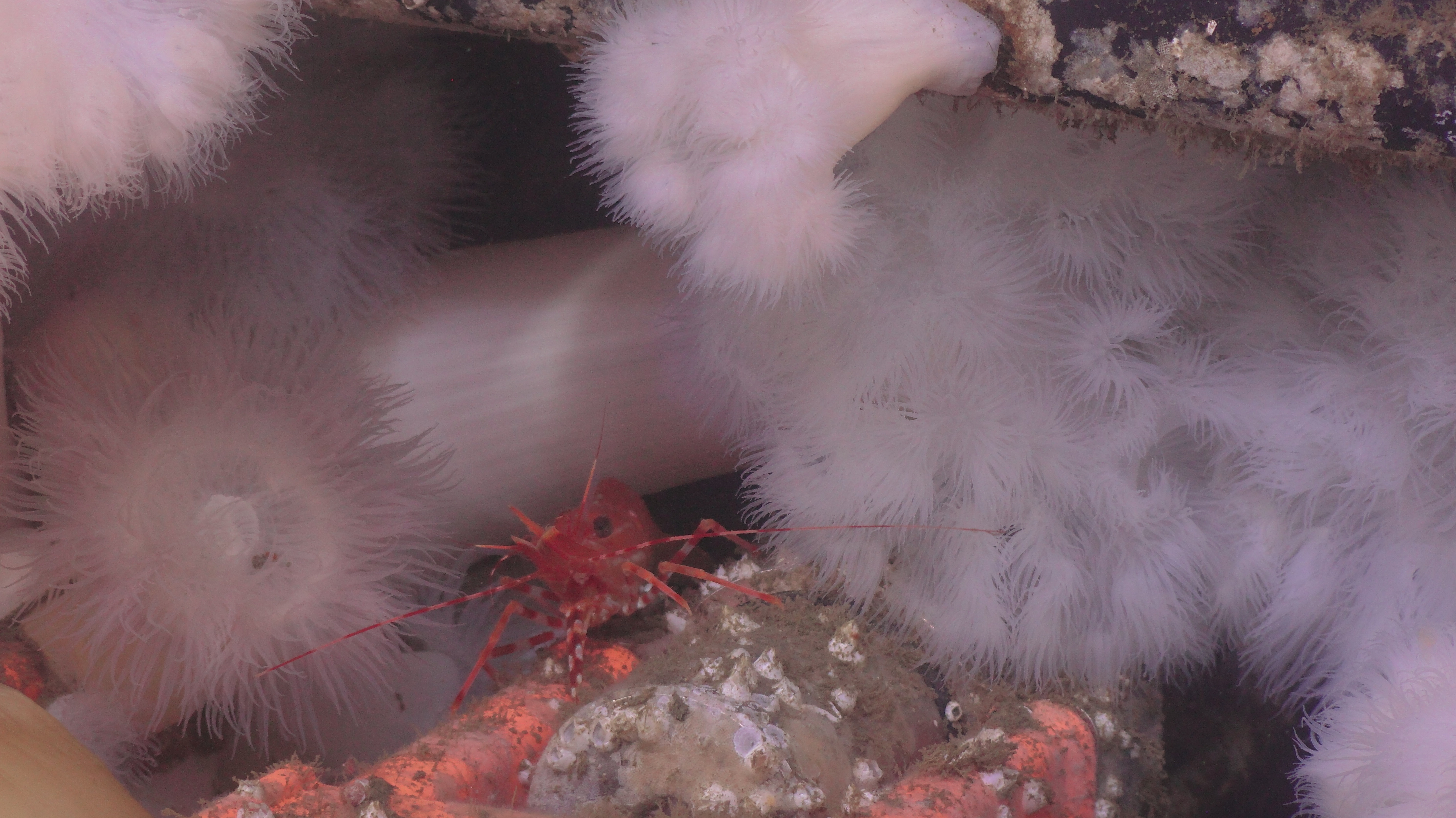
A possessive shrimp colonized the junction box plug that we needed to disconnect to recover the Oregon Shelf digital still camera. The Jason ROV won the battle. Photo Credit: UW/NSF-OOI/WHOI, V19
Anemones flourish on the hard surfaces of the Oregon Shelf junction box, luckily leaving a gap wide enough for the orange handle of the power plug needed to disconnect the digital still camera. Photo Credit: UW/NSF-OOI/WHOI, V19
There are so many anemones covering the Oregon Shelf (80m) junction box that it can be hard to see the frame. Photo Credit: UW/NSF-OOI/WHOI, V19
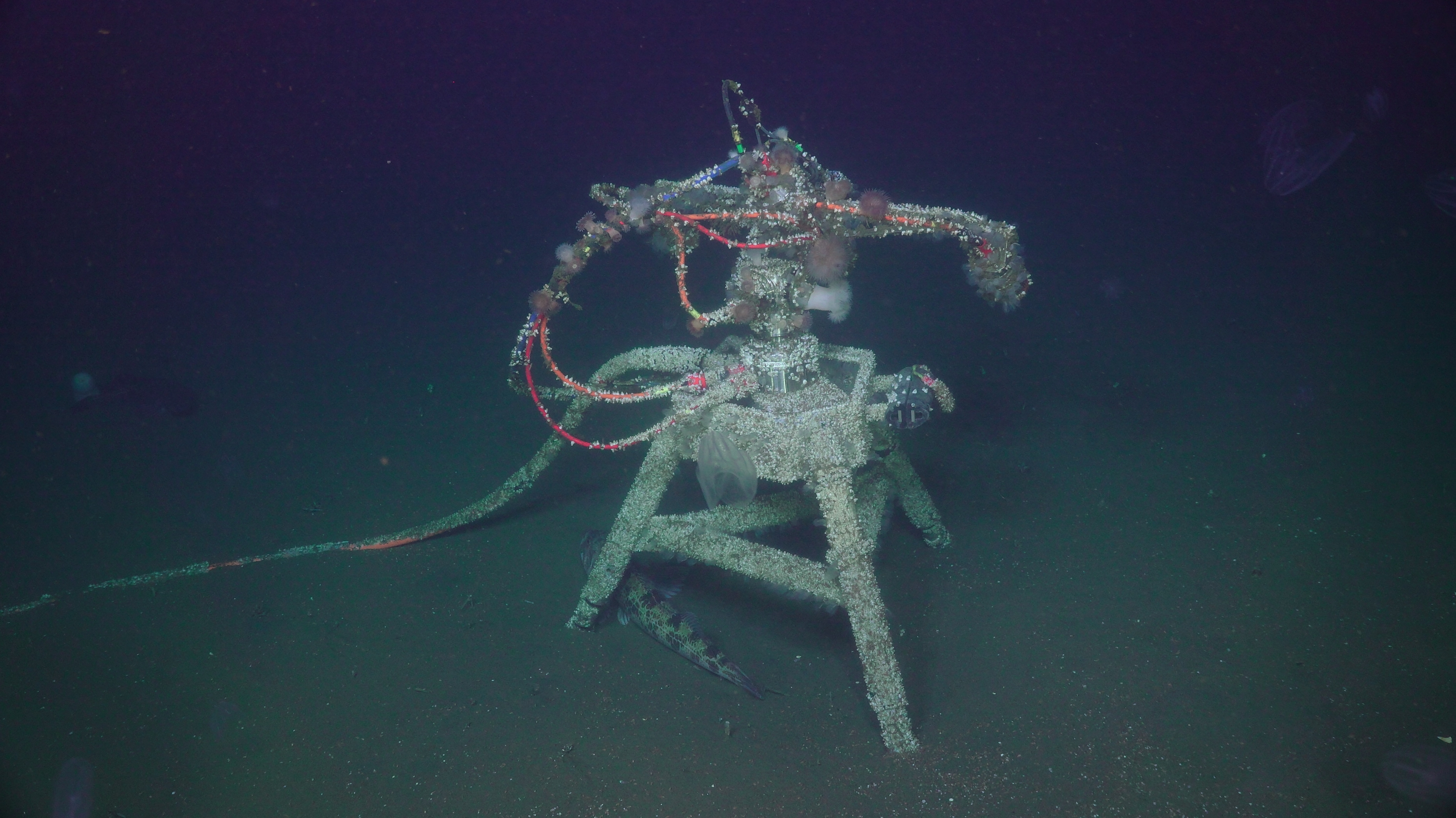
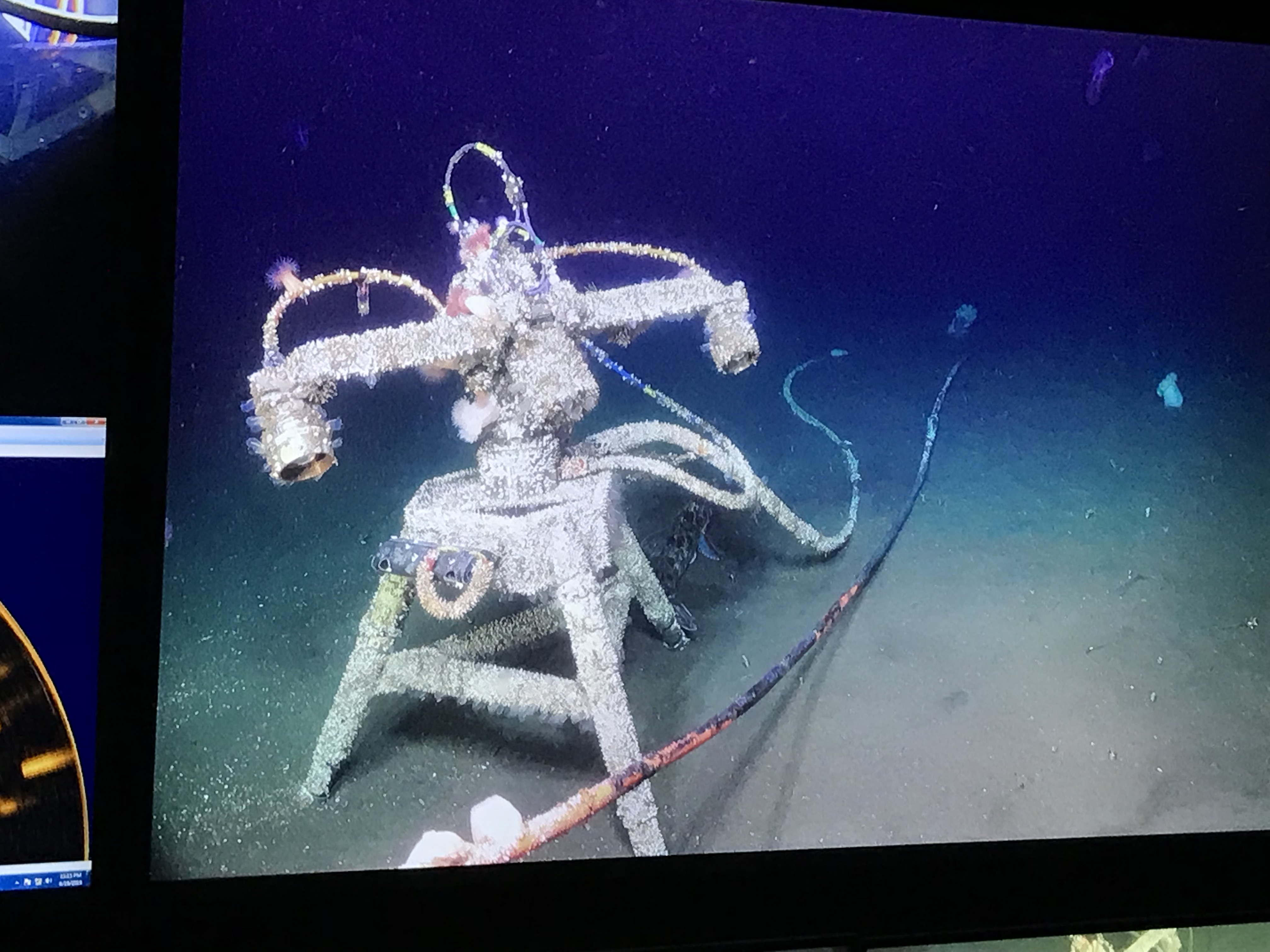
A rear view of the anemones, barnacles, and tunicates covering the Oregon Shelf digital camera after a one year deployment. A lingcod fish is hanging out beneath the tripod, and a large number of ctenophores (comb jellies) were also seen at the site. Photo Credit: UW/NSF-OOI/WHOI, V19
The Oregon Shelf digital still camera, covered in barnacles, anemones, and tunicates (sea squirts), and sheltering a large lingcod, following a one-year deployment. Photo Credit: UW/NSF-OOI/WHOI, V19
Barnacles, anemones, and tunicates encrust the Oregon Shelf digital still camera tripod, with a lingcod hiding beneath. Credit: UW/NSF-OOI/WHOI, V19.
Fish school around the Oregon Offshore hydrophone (underwater microphone) tripod as it is prepared for recovery in 2019. Photo Credit: UW/NSF-OOI/WHOI, V19
A black cod fish swimming away from the Oregon Offshore BEP as it is prepared for recovery in 2019. Photo Credit: UW/NSF-OOI/WHOI, V19.
Zoroasterid (top left) and Solaster (center bottom) sea stars and a flatfish (top right) at the Oregon Offshore site. Photo Credit: UW/NSF-OOI/WHOI, V19
A sea pen (a colonial, stalked cnidarian, related to jellyfish) at Slope Base. Photo Credit: UW/NSF-OOI/WHOI, V19
A fringed sea cucumber next to the Slope Base junction box in 2019. Photo Credit: UW/NSF-OOI/WHOI, V19.
Barnacles, tunicates, and anemones biofouling the digital still camera at the Oregon Shelf site. Photo Credit: M. Vardaro, UW, V19
Close-up shot of white anemones on top of Oregon Shelf junction box MJ01C. Photo Credit: M. Vardaro, UW, V19
Close-up shot of shrimp hiding among the anemones encrusting Oregon Shelf junction box MJ01C. Photo Credit: M. Vardaro, UW, V19
A shrimp hiding among the anemones biofouling junction box MJ01C at the Oregon Shelf Site, deployed since 2014. Photo Credit: M. Vardaro, UW, V19
Deep-sea octopus (Muusoctopus sp.) at Axial Base 2600 m; Photo Credit: UW/NSF-OOI/WHOI, V19
- Anemone
- Animal
- Arthropod
- ASHES
- Axial
- Axial Base
- Axial Biology
- Axial Caldera
- Bacteria
- Basalt Lava
- BEP
- Biofouling
- Biology
- Camds
- Camera
- Camhd
- Central Caldera
- Ciliates
- Cnidaria
- Coastal Biology
- Crab
- Deep Profiler Mooring
- Dive Highlights
- Eastern Caldera
- Echinoderms
- Endurance Array
- Engineering Team
- ENLIGHTEN 10
- Exploratorium
- Fish
- Geology
- HD Camera
- HPIES
- Hydrate Ridge
- Hydrates
- Hydrophone
- Hydrothermal Vents
- Illustration
- Inshore 80 Meters
- Instrument
- International District
- J-BOX
- Jason
- Jellyfish
- Junction Box
- K12
- Lava
- Mollusk
- Moorings
- Nodes
- Nudibranch
- Octopus
- OOI
- Oregon Offshore
- Oregon Offshore 600 m
- Oregon Shelf
- Oregon Slope Base
- People
- PN1B
- PN1D
- Polychaetes
- PPSDN
- Primary Node
- RASFL
- ROCLS
- ROPOS
- ROPOS Dives
- ROV Team
- RV Revelle
- RV Sikuliaq
- RV Thompson
- Salp
- Sample
- SC13
- Science Team
- Sea Cucumber
- Sea Star
- Sea Urchin
- Seafloor
- Seismometer
- Sensors
- Shallow Profiler Mooring
- Shark
- Shipboard
- Shore Station
- Slope Base
- Smoker
- Soft Coral
- Southern Hydrate Ridge
- Sponge
- Squid
- Students
- Students & Guest Participants
- Tmpsf
- Tubeworms
- VISIONS 11 Leg 1
- VISIONS 11 Leg 2
- VISIONS 11 Viewers
- VISIONS 13
- VISIONS 14
- VISIONS 15
- VISIONS 16
- VISIONS 17
- VISIONS 18
- VISIONS 20
- VISIONS 22
- VISIONS 23
- Visualization