Image Archive


A Seastar on a sheet flow at Axial Seamount. Credit: UW/NSF-OOI/CSSF; ROPOS Dive R1724; V14.
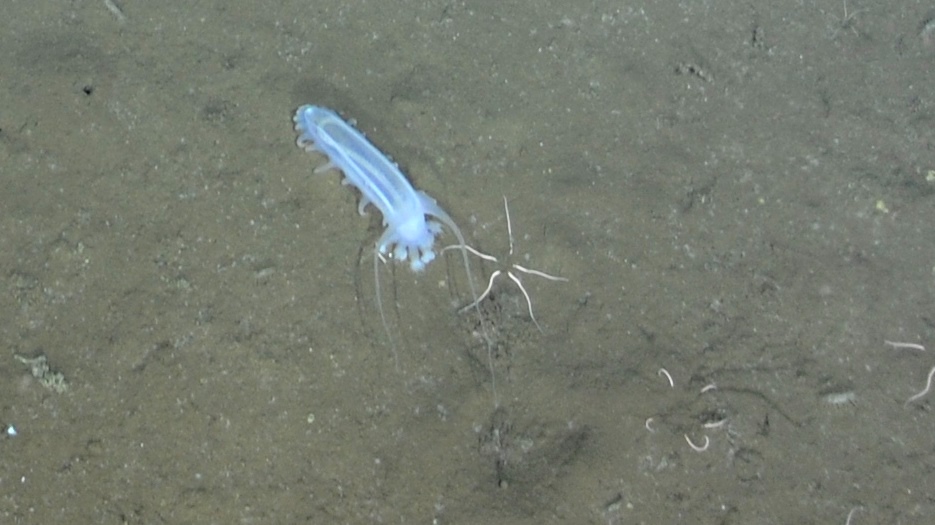
This small sea cucumber (Holothurian) belongs to the Peniagone genus. It is common at the base of Axial. Photo credit: NSF-OOI/UW/CSSF; Dive R1714; V14
This small sea cucumber (Holothurian) belongs to the Peniagone genus. It is common at the base of Axial. Its undulating motion allows it to swim from place to place. Photo credit: NSF-OOI/UW/CSSF; Dive R1599; V13
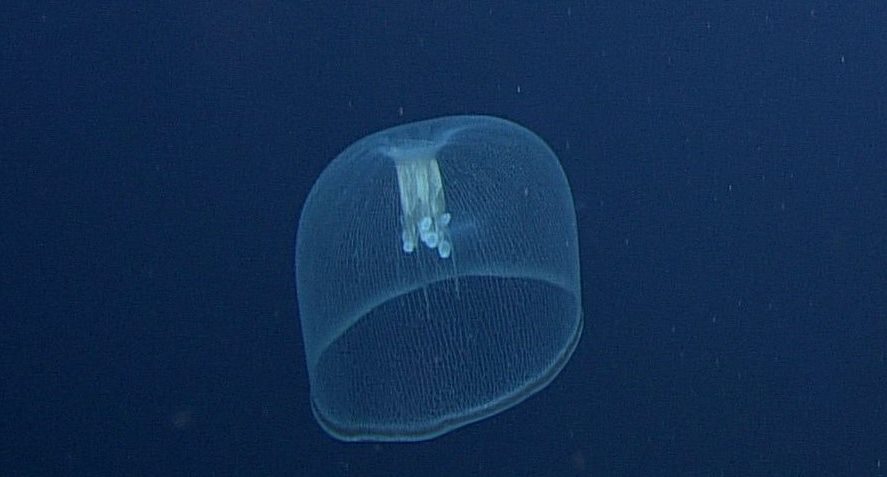
This jellyfish looks something like a lampshade. Photo credit: NSF-OOI/UW/CSSF; Dive R1723; V14
Palm Worms inhabit the toxic waters of El Guapo hydrothermal vent on Axial Seamount. Photo credit: UW/NSF-OOI/CSSF; V11.
Palm Worms at top of El Guapo. Credit: UW/NSF-OOI/CSSF; V11.
A Cockatoo Squid swam by the ROV camera. Credit: UW/NSF-OOI/CSSF; ROPOS Dive R1712; V14.
This curious Cockatoo Squid (Taonius borealis) inspected the ROV ROPOS's camera. Credit: UW/NSF-OOI/CSSF; V13.
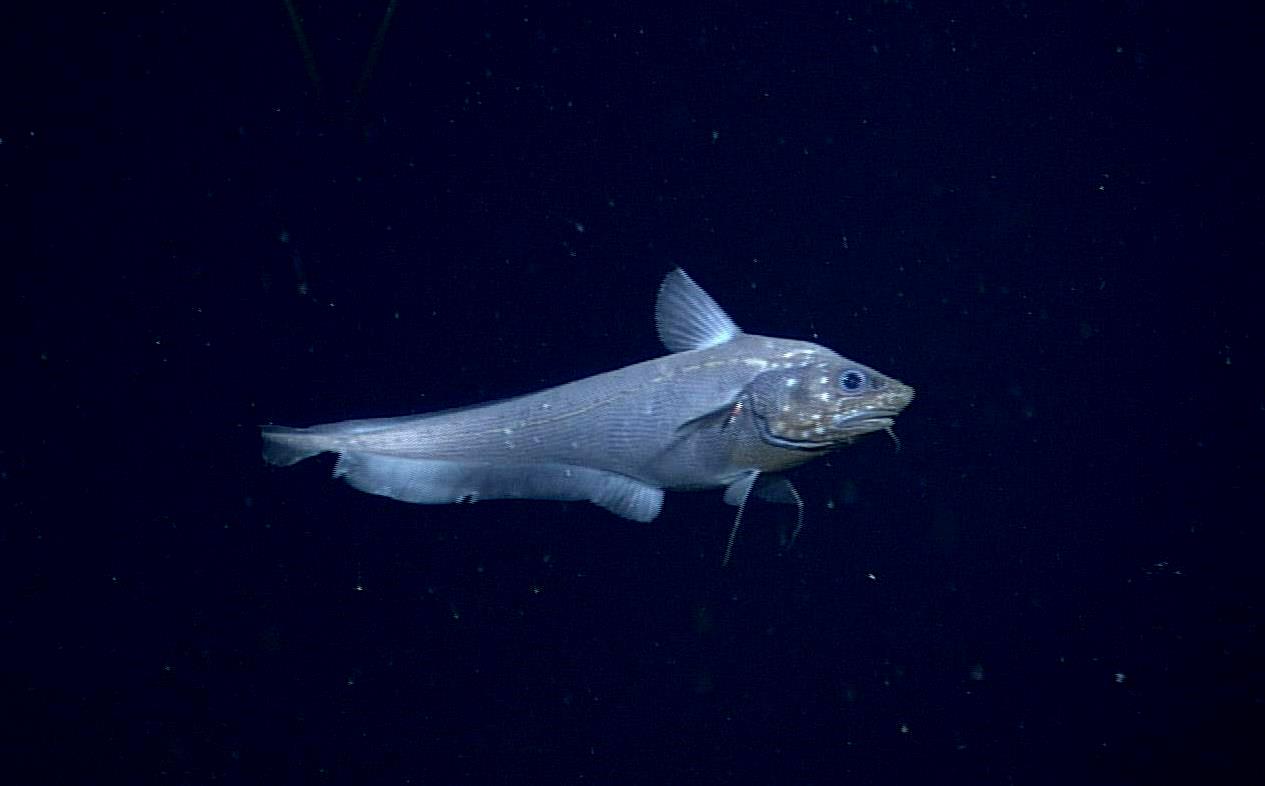
A Rattail Fish (Coryphaenoides acrolepis) is by far the most common fish on Axial. Credit: UW/NSF-OOI/CSSF; ROPOS Dive R1601; V13.
The Deep Sea Skate (Bathyraja abyssicola) is a fairly frequent visitor to Axial Seamount; Credit: UW/NSF-OOI/CSSF; V13.
A Rattail checks out the fiber optic cable at Axial Seamount. Credit: UW/NSF-OOI/CSSF; ROPOS Dive R1608; V13.
A Roughtail skate (Bathyraja trachura) resting near a vent on Axial Seamount. Credit: UW/NSF-OOI/CSSF; ROPOS Dive R1617; V13.
This deep sea, purple spiny sea urchin (possibly Tromikosoma panamense) was seen at the base of Axial. Photo credit: NSF-OOI/UW/CSSF; Dive R1715; V14
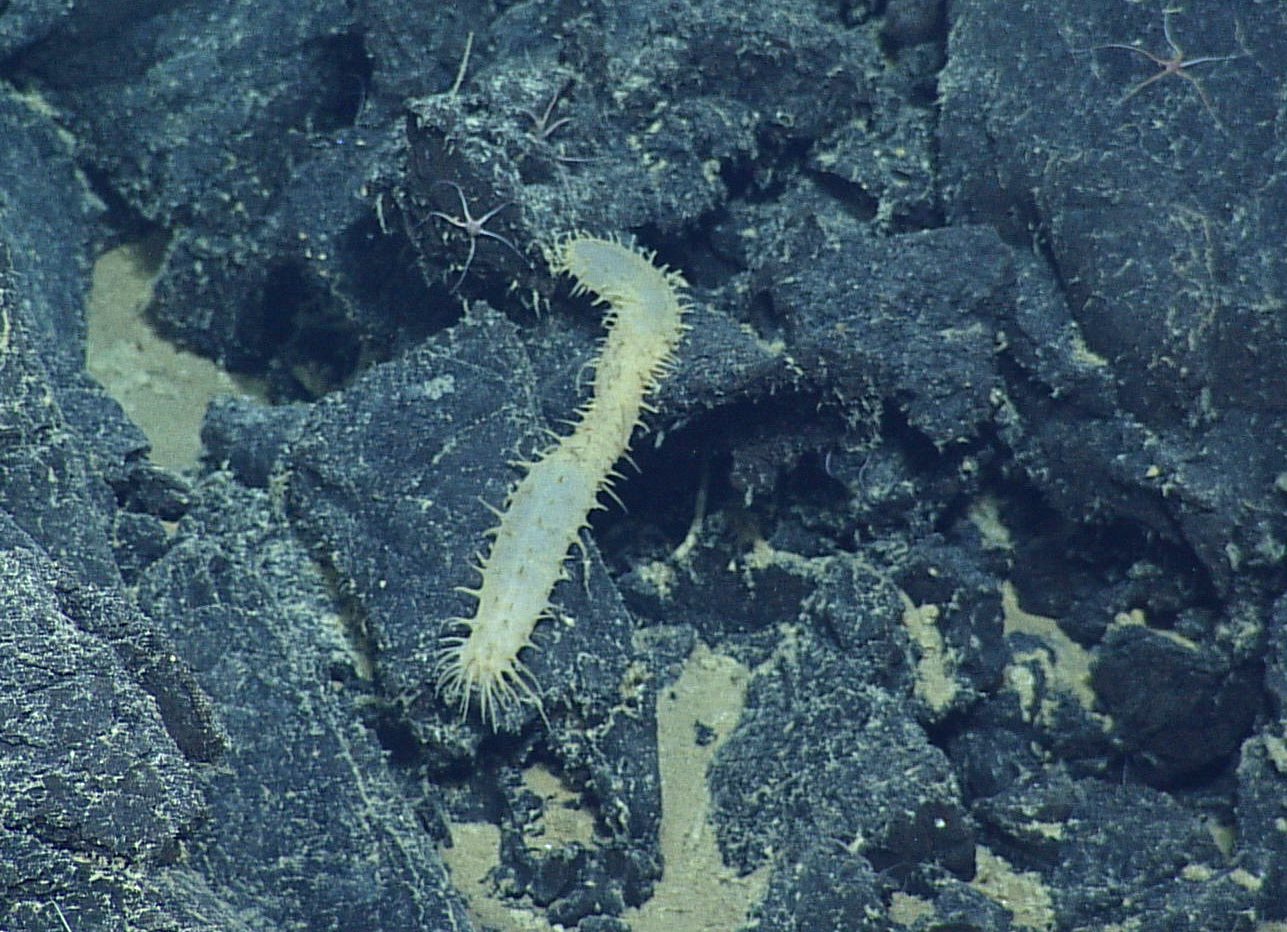
This unknown sea cucumber was found at the base of Axial Seamount, living among the brittle stars. Photo credit: NSF-OOI/UW/CSSF; Dive R1716; V14
This spiny Holothurian Deep-Sea Cucumber (possibly of Genus Pannychia) has been seen on many regions of Axial Seamount. Photo credit: NSF-OOI/UW/CSSF; V13
This large purple sea cucumber (Holothurian) was seen at the base of Axial Seamount, foraging through the sediments. This one is likely Paelopadites confundens. Photo credit: NSF-OOI/UW/CSSF; V14.
These small sea spiders are Pycnogonids (Phylum Arthropoda) and live among the tube worms and limpets on hydrothermal vents of Axial Seamount. Photo credit: NSF-OOI/UW/WHOI; V11
An interesting perspective of this Dinner Plate Jelly (Solmissus sp.) and the Remotely Operated Cable Laying System (ROCLS) spool, makes the jelly look enormous. Photo credit: Photo credit: NSF-OOI/UW/CSSF; Dive R1604; V13
These dinner plate jellies are a frequent sight during ROPOS dives on Axial Seamount. Photo credit: NSF-OOI/UW/CSSF; Dive R1713; V14
This large jelly is called a Fried Egg Jelly (Phacellophora cantschatica). It normally is a pelagic organism, however this one is on the seafloor, making it vulnerable to spider crab feasting. Photo credit: NSF-OOI/UW/CSSF; Dive R1619; V13
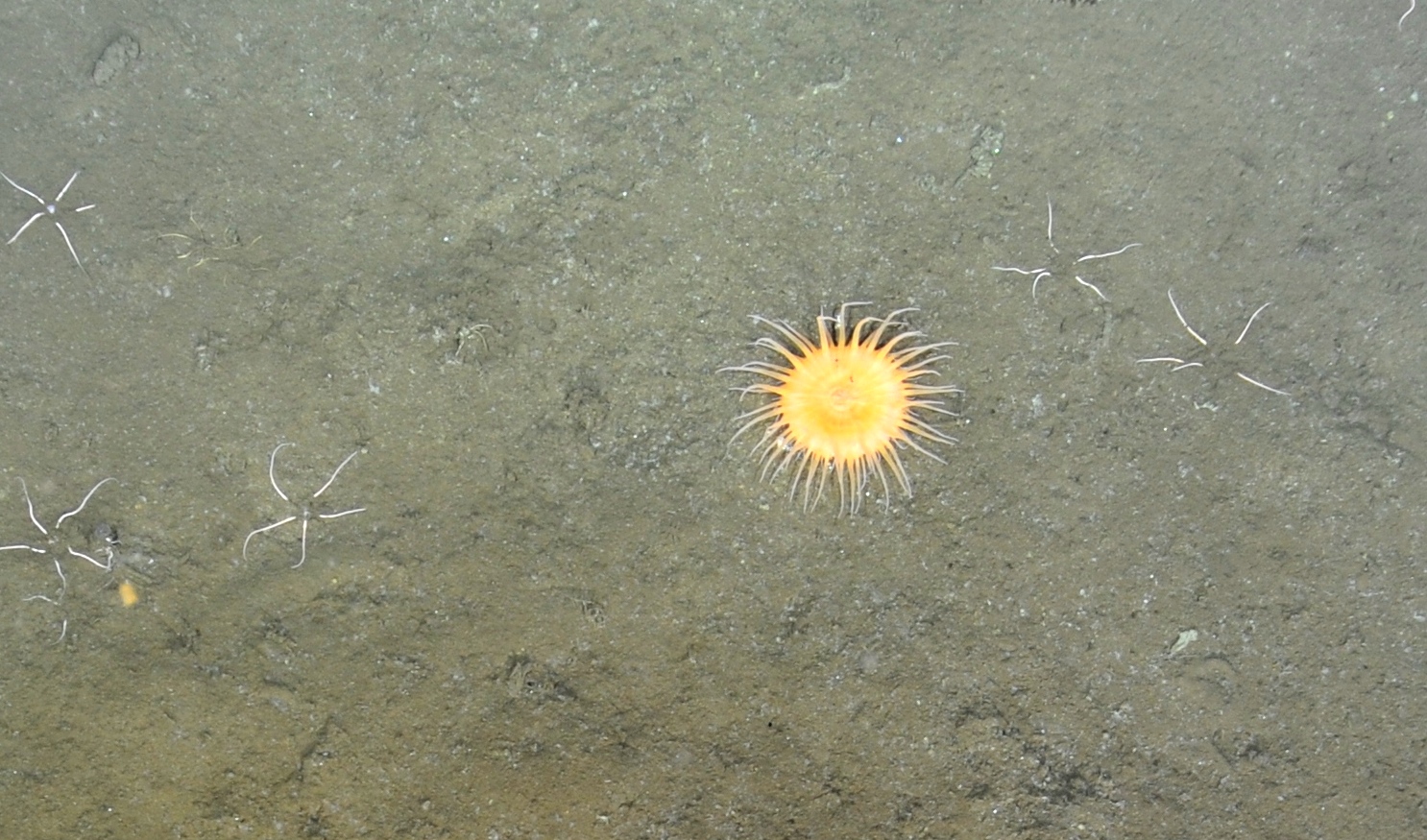
A solitary anemone lives on the sediment seafloor with brittle stars at the base of Axial Seamount. This may be a Jack-o-Lantern Lid anemone. Photo credit: NSF-OOI/UW/CSSF; Dive R1715, V14.
This unknown species of anemone was found on the sediments at the base of Axial Seamount. Photo credit: NSF-OOI/UW/CSSF; Dive R1624; V13
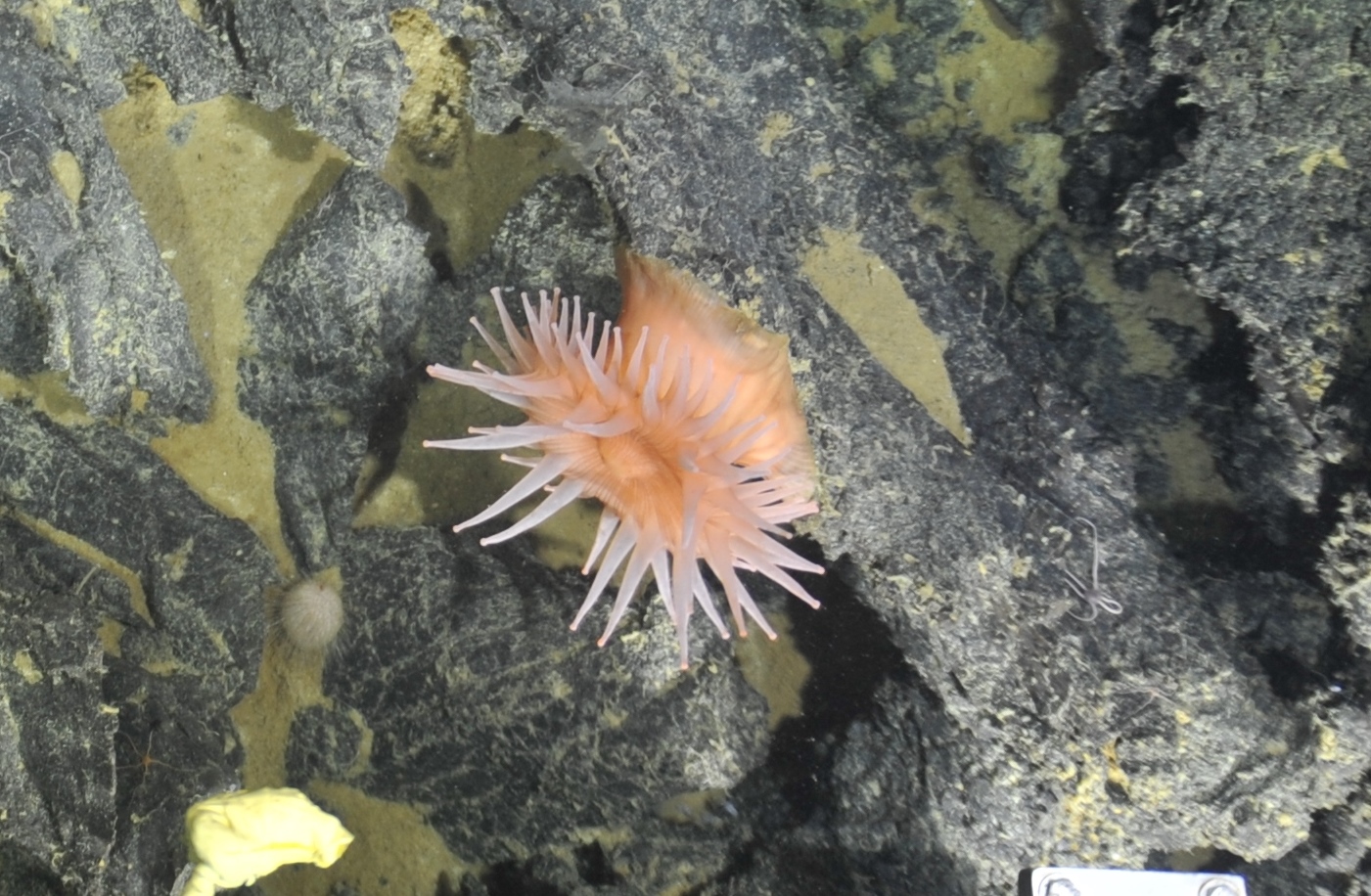
This pink anemone was found at Axial Seamount, affixed to the lava rocks. Photo credit: NSF-OOI/UW/CSSF; Dive R1712; V14
An unknown anemone is attached to the lava rocks at Axial Seamount. Photo credit: NSF-OOI/UW/CSSF; Dive R1608; V13
Two Squat Lobsters on Escargot vent, Axial Seamount. Credit: UW/NSF-OOI/CSSF; V11
A rattail fish (Coryphaenoides acrolepis) is a common site at the summit of Axial Seamount. Credit: UW/NSF-OOI/CSSF; Dive R1720; V14.
A Deep-Sea Cucumber (possibly Pannychia moseleyi) inhabits the lava flows of Axial. Credit: UW/NSF-OOI/CSSF; ROPOS Dive R1721; V14.
A zoroasterid sea star at Axial Seamount, likely Zoroaster spinulosus. Photo credit: NSF-OOI/UW/CSSF; Dive R1721; V14.
- Anemone
- Animal
- Arthropod
- ASHES
- Axial
- Axial Base
- Axial Biology
- Axial Caldera
- Bacteria
- Basalt Lava
- BEP
- Biofouling
- Biology
- Camds
- Camera
- Camhd
- Central Caldera
- Ciliates
- Cnidaria
- Coastal Biology
- Crab
- Deep Profiler Mooring
- Dive Highlights
- Eastern Caldera
- Echinoderms
- Endurance Array
- Engineering Team
- ENLIGHTEN 10
- Exploratorium
- Fish
- Geology
- HD Camera
- HPIES
- Hydrate Ridge
- Hydrates
- Hydrophone
- Hydrothermal Vents
- Illustration
- Inshore 80 Meters
- Instrument
- International District
- J-BOX
- Jason
- Jellyfish
- Junction Box
- K12
- Lava
- Mollusk
- Moorings
- Nodes
- Nudibranch
- Octopus
- OOI
- Oregon Offshore
- Oregon Offshore 600 m
- Oregon Shelf
- Oregon Slope Base
- People
- PN1B
- PN1D
- Polychaetes
- PPSDN
- Primary Node
- RASFL
- ROCLS
- ROPOS
- ROPOS Dives
- ROV Team
- RV Revelle
- RV Sikuliaq
- RV Thompson
- Salp
- Sample
- SC13
- Science Team
- Sea Cucumber
- Sea Star
- Sea Urchin
- Seafloor
- Seismometer
- Sensors
- Shallow Profiler Mooring
- Shark
- Shipboard
- Shore Station
- Slope Base
- Smoker
- Soft Coral
- Southern Hydrate Ridge
- Sponge
- Squid
- Students
- Students & Guest Participants
- Tmpsf
- Tubeworms
- VISIONS 11 Leg 1
- VISIONS 11 Leg 2
- VISIONS 11 Viewers
- VISIONS 13
- VISIONS 14
- VISIONS 15
- VISIONS 16
- VISIONS 17
- VISIONS 18
- VISIONS 20
- VISIONS 22
- VISIONS 23
- visions 26
- Visualization