
Image Archive









j907highlights-poster
The ROV Jason takes a digital still camera in their elevator latched beneath the vehicle to the seafloor at Southern Hydrate Ridge. Credit: M. Elend, University of Washington, V16.
A view of the myriad screens inside the Jason control van during Jason Dive 921 at Southern Hydrate Ridge. Credit. M. Elend, University of Washington, V16.
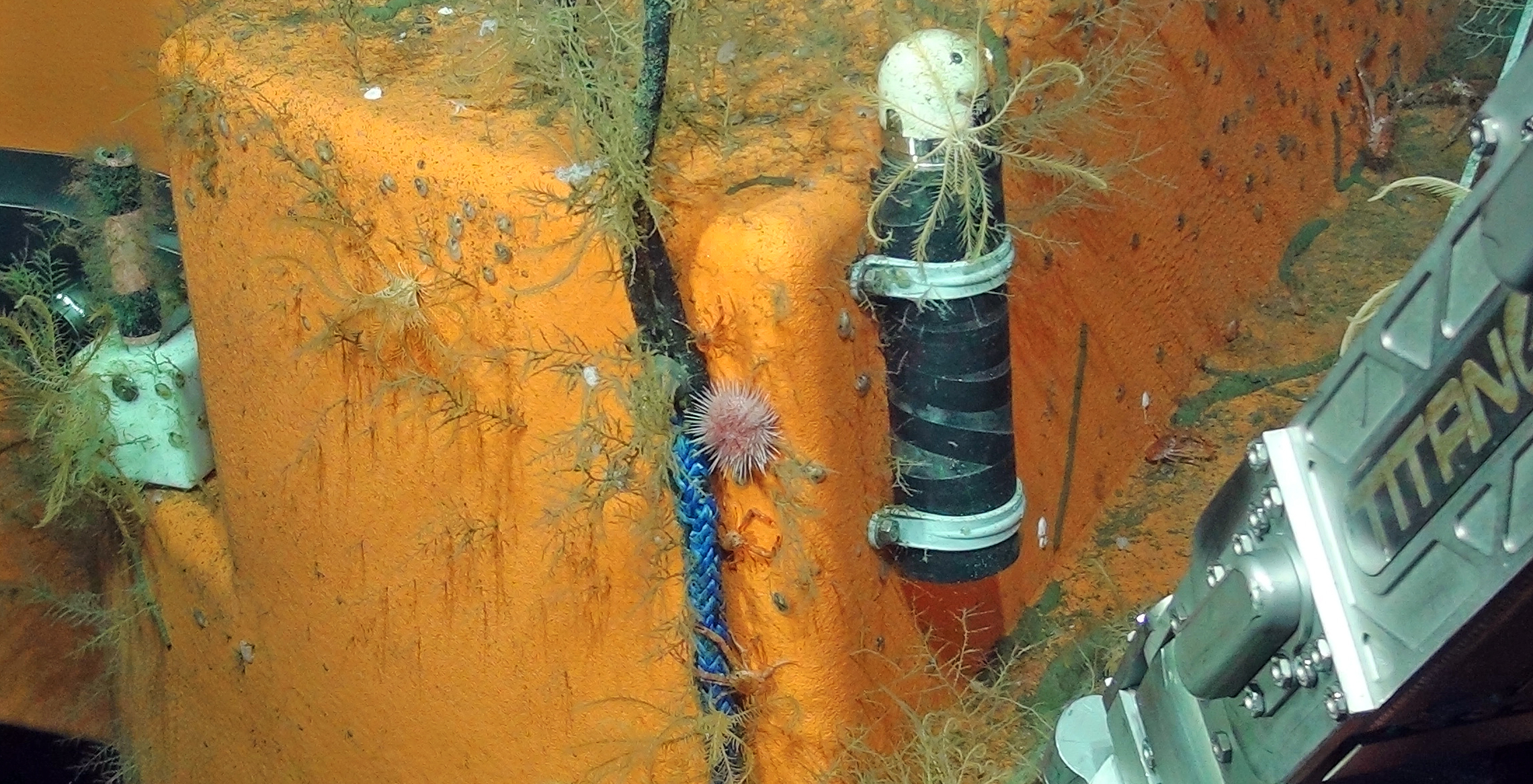
The mooring platform at the Oregon Offshore Site (~600 ft beneath the oceans' surface) abounds with life, supported by the nutrient-rich waters that characterize this area. Small crabs, urchins, and sea stars have colonized the platform since installed in 2014 during the VISIONS'14 cruise. Credit: UW/NSF-OOI/WHOI; J2-919, V16.
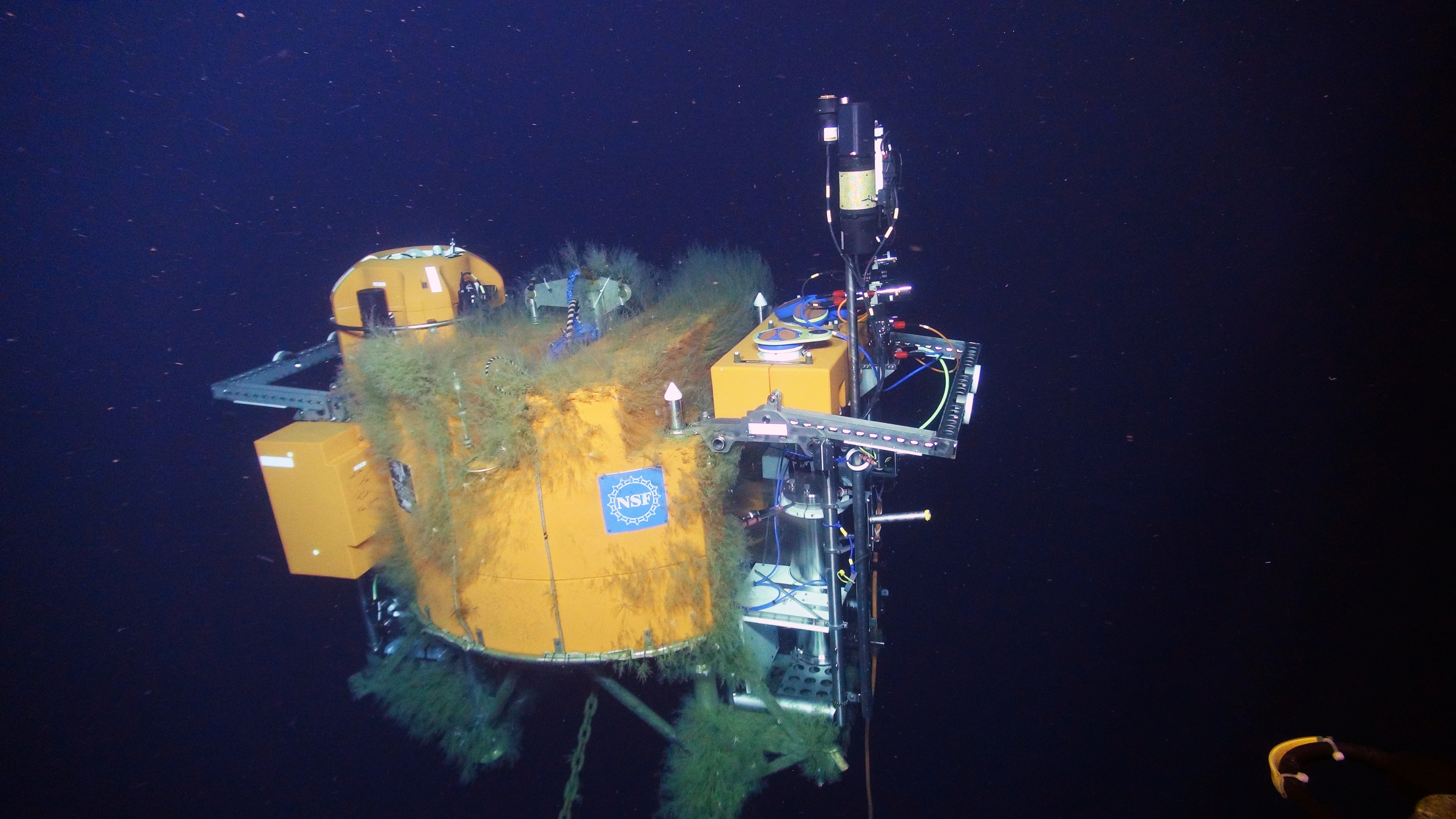
The Shallow Profiler Mooring 12-ft across, 7 ton platform hosts a new Science Pod (left) and Platform Interface Assembly (PIA, right) installed on Jason Dive J2-917 as part of the annual maintenance operations for these moorings. The 'mother' platform sprouts a variety of life that was not present last year when we turned the Science Pod and PIA. Credit: UW/OOI-NSF/WHOI; V16.
A Hydrothermal Vent Cap at the top of the actively venting chimney called ‘El Gordo’, traps high temperature hydrothermal fluid. An intake nozzle from the mass spectrometer allows measurement of gas chemistry in real-time, sending data at the speed of light back to shore. Another nozzle sucks in vent fluids for sampling and for filtering of microbial DNA: the samples fluids and DNA are recovered during annual Cabled Array maintenance cruises for follow-on shore-based analyses. Credit: UW/NSF-OOI/WHOI; Dive J2-912, V16.
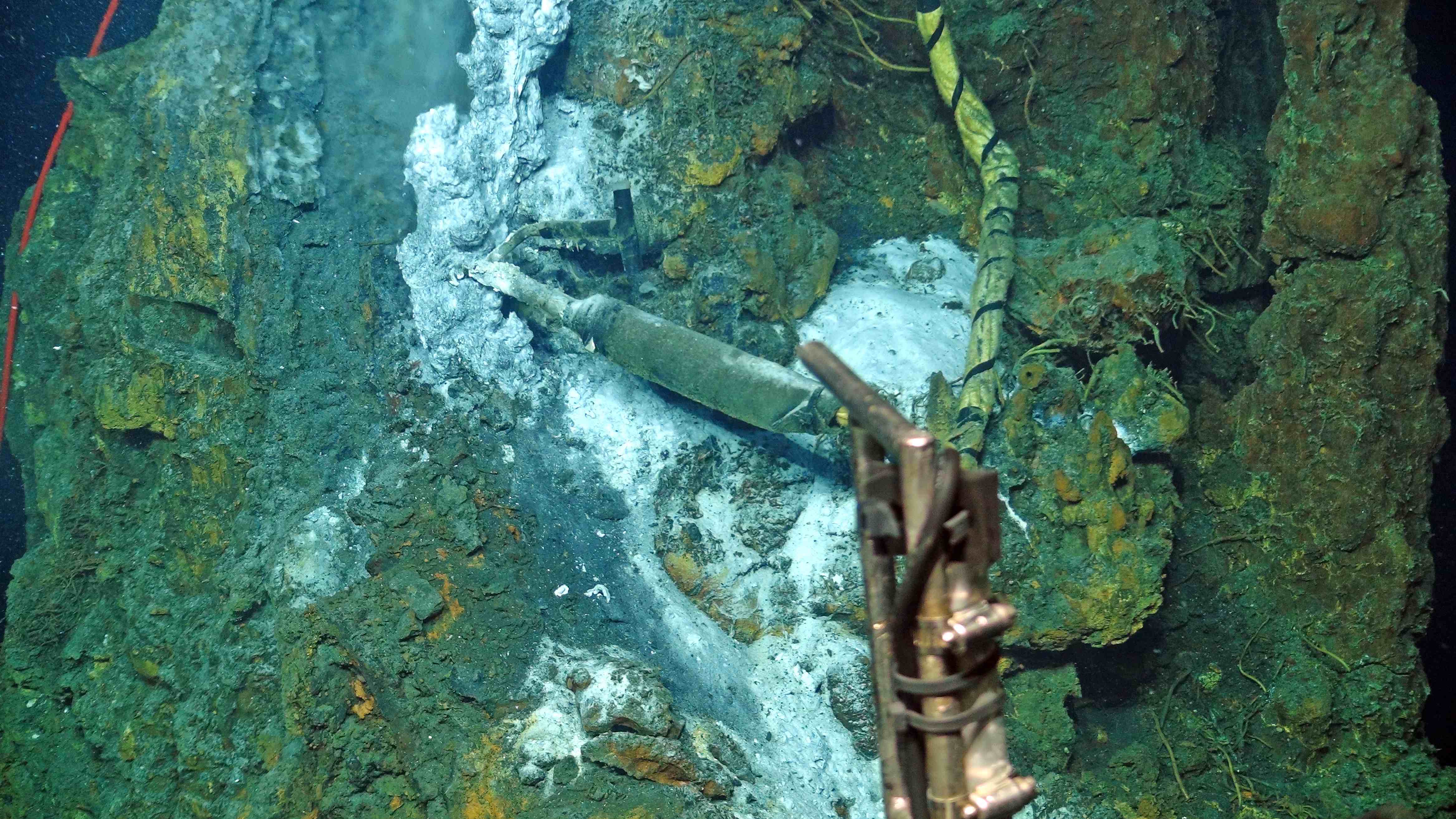
The wand of the temperature and resistivity sensor is embedded in 1-year old metal sulfide and sulfate minerals precipitated from hot hydrothermal fluid. This novel instrument, built by M. Lilley at the University of Washington, measures real-time changes in fluid temperature and resistivity as an analogue for chlorinity. Boiling vents often emit low-salinity, low pH fluids. Credit: UW/NSF-OOI/WHOI; Dive J2-912, V16.
Close up of the Remote Access Fluid Sampler (RAS) built by D. Butterfield at NOAA-PMEL-UW. A nozzle is installed in an active venting site on the El Gordo chimney. Controlled from shore, or by a mission plan, a pump sucks in hydrothermal fluid into sterile bags (and also onto filters for collection of DNA in a similar system above the RAS). During annual Cabled Array maintenance cruises, this coupled mooring is recovered and collected material analyzed, with results provide at oceanobservatories.org. Credit: UW/NSF-OOI/WHOI; Dive J2-212, V16.
A temperature probe (HOBO) installed by NOAA last year in the hydrothermal vent ‘Diva’ is now enclosed in the sulfate-rich, white mineral called anhydrite. The high temperature fluids at this site host very high concentrations of carbon dioxide being outgassed from the underlying magma chamber. Credit: UW/OOI-NSF/WHOI; Dive J2-912, V16.
A digital still camera (left), mass spectrometer (middle) and a fluid and microbial DNA sampler at the El Gordo vent in the International District Hydrothermal Field measure and sample fluids, animals, and microbes in this active processes within this hydrothermal system to understand linkages amoung seismicity (seismometers extend away from the field), venting and life in this extreme environment. Credit: UW/OOI-NSF/WHOI; Dive J2-212, V16.
A temperature-resistivity sensor, with its wand now embedded in a sulfate-rich chimney (white, right) sends real-time data to shore from the Escargot chimney, 5000 ft beneath the oceans' surface and >300 miles offshore. Resistivity is an analogue for fluid chlorinity. Numerous hydrothermal vents in the International District Hydrothermal Field at the summit of Axial Seamount are boiling. Credit. UW/OOI-NSF/WHOI; Dive J2-912, V16.
The ROV Jason plugs in the low-power junction box 9500 ft beneath the oceans surface at the Slope Base site. Credit: UW/OOI-NSF/WHOI, V16.
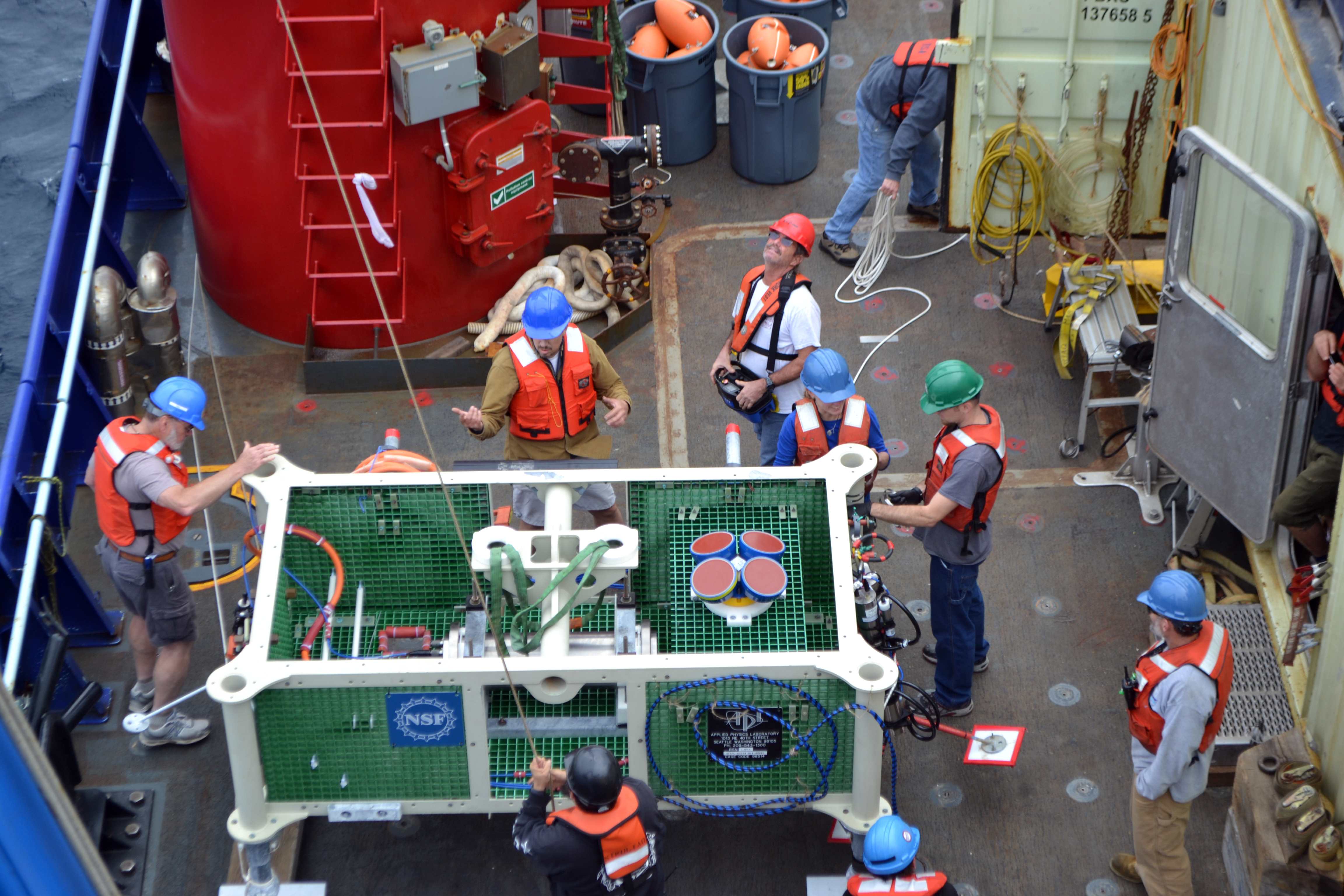
The engineeing team from the Applied Physics Laboratory at the UW and the crew of the R/V Sikuliaq prepare the low-power junction box for installation at the Slope Base site near the Cascadia Margin, 9500 ft beneath the oceans' surface. Credit. M. Elend, University of Washington, V16.
A digital still camera (left), mass spectrometer (middle) and hydrothermal fluid and microbial DNA sampler (right) document changes in animal life, gas and fluid chemistry, temperature, and chimney growth at the El Gordo vent site in the International District Hydrothermal Field at the summit of Axial Seamount - water depth is ~ 5000 ft (1500 m). Data are streaming live to shore 24/7. Credit: UW/OOI-NSF/WHOI, V16.
Final preparations on the winched, instrumented Science Pod before it is latched under the belly of the ROV Jason for installation on the Shallow Profiler Mooring at Axial Base. Credit: M. Elend, University of Washington, V16.
A 12 pin electrical wet-mate connector on a junction box at the base of Axial Seamount awaits its mate during turning of the platforms and instruments at this site. The oil-filled mates, allow the ROV to disconnect and connect extension cables on platforms, junction boxes, and instruments without bringing the entire assembly to the surface. They are used heavily on our system to reduce operations and maintenance costs. Credit: UW/OOI-NSF/WHOI, DIve J907, V16.
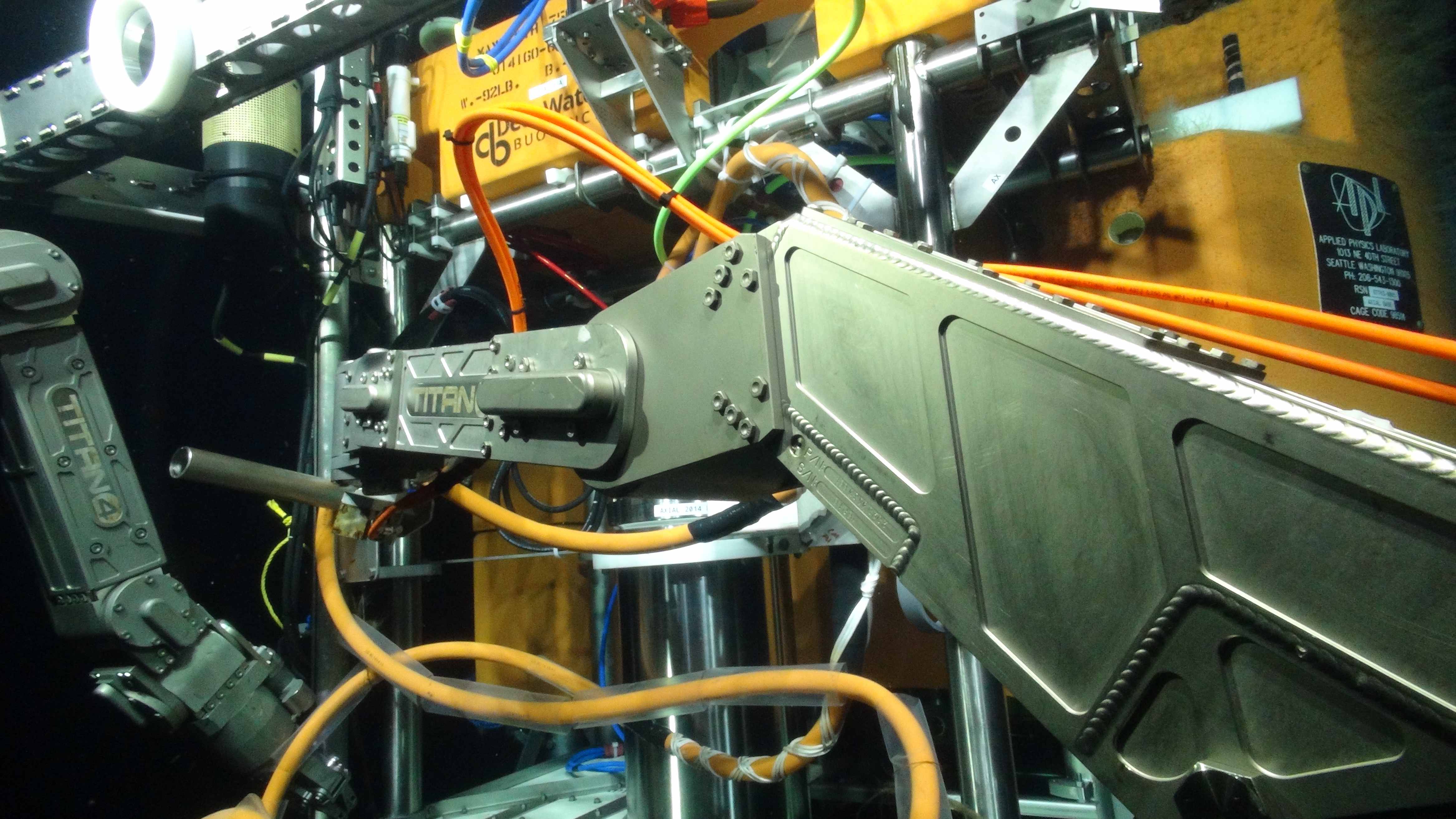
The Titan manipulators on the ROV Jason conduct complex operations during installation of the Platform Interface Assembly hosting multiple instruments. The PIA is attached to the 200 m deep, 12 foot across platform on the two-legged Shallow Profiler Mooring at Axial Base. Credit: UW/OOI-NSF/WHOI, Dive J911,V16.
Krill surroung the small "cage" housing the cable connection from the Shallow Profiler at Axial Base to the extension cable connecting the Profiler to the power and communications. Credit: UW/OOI-NSF/WHOI, Dive J910, V16.
The new instrumented science pod, all bright and shiney, is installed on the Shallow Profiler Mooring at Axial Base. Credit: UW/OOI-NSF/WHOI, V16.
The ROV Jason surveys the Shallow Profiler platform located ~ 600 ft beneath the oceans' surface. Eighteen instruments on the platform and profiling science pod have been sending data live to shore for a year, all connected to the Internet. Both science pods have now been replaced during the annual, planned maintenance of this system. Operation of this infrastructure takes place at the University of Washington Operations Center in the School of Oceanography. Credit: UW/OOI-NSF/WHOI; V16.
The ROV Jason breaches the oceans surface latched into an instrumented Platform Interface Assembly that has been installed for a year on a Shallow Profiler Mooring at the base of Axial Seamount. Connected to the submarine cable, the instruments have been sending sending data live back to shore since summer 2015 from 600 ft beneath the oceans' surface. Credit: M. Elend, University of Washington, V16.
The ROV Jason is latched into a recovered, instrumented Science Pod on a Shallow Profiler Mooring at the base of Axial Seamount. The winched profiler has made >2000 trips up and down through the water column. Connected to the submarine cable, the instruments have been sending sending data live back to shore since summer 2015 from 600 ft beneath the oceans' surface. Credit: M. Elend, University of Washington, V16.
The LJ03A-2016 junction box hosting a variety of instruments to investigate water-column properties was successfully installed at the base of Axial Seamount. An instrument package hosting a CTD, dissolved oxygen, and absorption spectrophotometer is held in the manipulator of the ROV Jason. Credit. UW/OOI-NSF/Jason.
The ROV Jason enters the NE Pacific waters for the first time during the VISIONS'16 cruise. Credit: M. Elend, University of Washington; V16.
Junction Box LJ03A being moved into position at the start of Jason Dive 907. Credit: M. Elend, University of Washington; V16.
The fantail of the R/V Sikuliaq has little room to walk subsequent to loading all the equipment to be installed during VISIONS'16. Credit: S. Denny, University of Washington; V16.
The ROV Jason is about to enter the ocean above Axial Seamount on its first launch of the VISIONS'16 program. Credit. S. Denny, University of Washington, V16.
Junction box LJ03A rests on the deck of the R/V Sikuliaq, fully tested and ready for installation at the base of Axial Seamount. Credit: M. Elend, University of Washington. V16.
- Anemone
- Animal
- Arthropod
- ASHES
- Axial
- Axial Base
- Axial Biology
- Axial Caldera
- Bacteria
- Basalt Lava
- BEP
- Biofouling
- Biology
- Camds
- Camera
- Camhd
- Central Caldera
- Ciliates
- Cnidaria
- Coastal Biology
- Crab
- Deep Profiler Mooring
- Dive Highlights
- Eastern Caldera
- Echinoderms
- Endurance Array
- Engineering Team
- ENLIGHTEN 10
- Exploratorium
- Fish
- Geology
- HD Camera
- HPIES
- Hydrate Ridge
- Hydrates
- Hydrophone
- Hydrothermal Vents
- Illustration
- Inshore 80 Meters
- Instrument
- International District
- J-BOX
- Jason
- Jellyfish
- Junction Box
- K12
- Lava
- Mollusk
- Moorings
- Nodes
- Nudibranch
- Octopus
- OOI
- Oregon Offshore
- Oregon Offshore 600 m
- Oregon Shelf
- Oregon Slope Base
- People
- PN1B
- PN1D
- Polychaetes
- PPSDN
- Primary Node
- RASFL
- ROCLS
- ROPOS
- ROPOS Dives
- ROV Team
- RV Revelle
- RV Sikuliaq
- RV Thompson
- Salp
- Sample
- SC13
- Science Team
- Sea Cucumber
- Sea Star
- Sea Urchin
- Seafloor
- Seismometer
- Sensors
- Shallow Profiler Mooring
- Shark
- Shipboard
- Shore Station
- Slope Base
- Smoker
- Soft Coral
- Southern Hydrate Ridge
- Sponge
- Squid
- Students
- Students & Guest Participants
- Tmpsf
- Tubeworms
- VISIONS 11 Leg 1
- VISIONS 11 Leg 2
- VISIONS 11 Viewers
- VISIONS 13
- VISIONS 14
- VISIONS 15
- VISIONS 16
- VISIONS 17
- VISIONS 18
- VISIONS 20
- VISIONS 22
- VISIONS 23
- visions 26
- Visualization