Image Archive


ROPOS connecting the P2 end of seafloor cable RS01W9 into the J1 port on LV01C. RS01W9 runs between PN1C and LV01C at the Endurance Offshore site, 600 meters deep. Photo Credit: NSF-OOI/UW/CSSF, Dive 1744, V14
In 2007, the remotely operated vehicle ROPOS captured this video of humboldt squid playing 'laser tag' with green lasers emanating from the vehicle. The lasers are used for scale and are 10 cm apart. The video was taken in during a survey at Barkely Canyon off the west coast of Vancouver Island. Credit: Video credit: UW/CSSF/W.M. Keck. Foundation; ROPOS Dive R1074, 2007.
squid.
Primary Node PN1C 1 km from the Oregon Offshore site ais home to numerous crabs. Credit: UW/NSF-OOI/CSSF, ROPOS Dive 1743, V14.
Clearing cable RS01W9 away from ROPOS ROCLS cable laying system during installation in 2014 at the Offshore site, prior to the cable lay. Credit: UW/NSF-OOI/CSSF, ROPSO Dive 1743, V14.
A Brisingid sea star (possibly Novodinia pacifica?) encountered during a cable lay survey at the Oregon Offshore site, 600 m water depth. Credit: UW/NSF-OOI/CSSF, ROPOS Dive 1743, V14.
A rockfish (Pacific Ocean perch) encountered during a cable lay survey at the Oregon Offshore site, 600 m water depth. Credit: UW/NSF-OOI/CSSF, ROPOS Dive 1743, V14.
A sunstar (Solaster) encountered during a cable lay survey at the Oregon Offshore site, 600 meters water depth. Credit: UW/NSF-OOI/CSSF, ROPOS Dive 1743, V14.
A large Grooved Tanner crab and a sole (flatfish) seen during a cable lay survey at the Oregon Offshore site, 600 meters water depth. Credit: UW/NSF-OOI/CSSF, ROPOS Dive 1743, V14.
Closeup of a Blacktail Snailfish (Careproctus melanurus) encountered during a cable lay survey at the Oregon Offshore site, 600 m water depth. Credit: UW/NSF-OOI/CSSF, ROPOS Dive R1743, V14.
A Deepsea sole (Embassichthys bathybius) encountered during a cable lay survey at the Oregon Offshore site, 600 m water depth. Credit: UW/NSF-OOI/CSSF, ROPOS Dive 1743, V14.
A Blacktail Snailfish (Careproctus melanurus) observed during the survey prior to laying cable RS01W9 at the Endurance Offshore site. Photo Credit: NSF-OOI/UW/CSSF, Dive R1743, V14
A Deepsea sole (Embassichthys bathybius) observed during the survey prior to laying cable RS01W9 at the Endurance Offshore site. Photo Credit: NSF-OOI/UW/CSSF, Dive R1743, V14
Primary node PN1C at Endurance Offshore was deployed in a trawl-resistant frame, including doors over the connection points. ROPOS cut through the straps and opened the doors in preparation for laying cable RS01W9 from PN1C to LV01C. Photo Credit: NSF-OOI/UW/CSSF, Dive R1743, V14
The equipment and instruments to be deployed at Endurance Offshore and Slope Base during Leg 3 of VISIONS 14. Photo Credit: Skip Denny, APL-UW
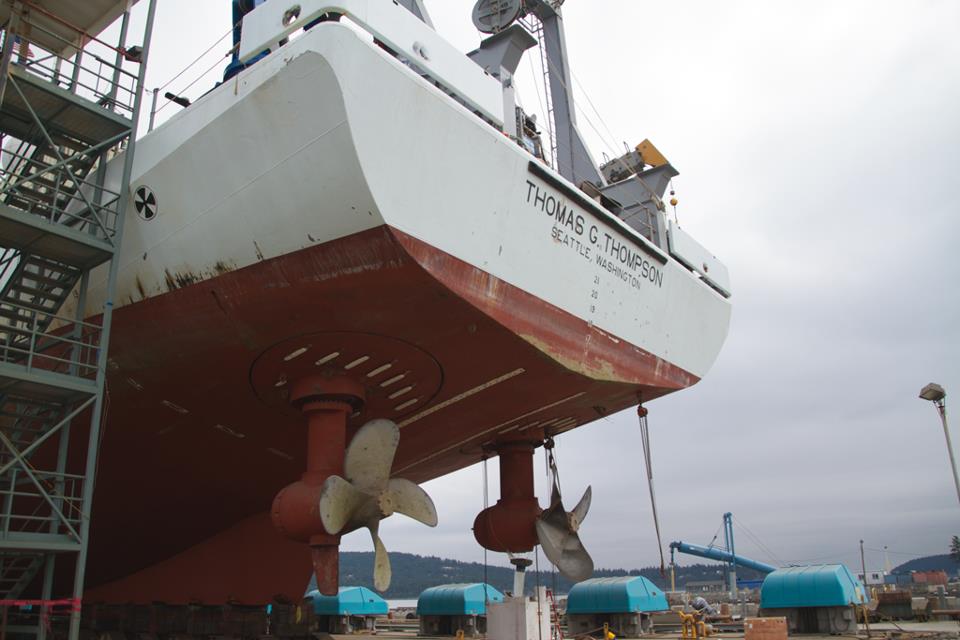
Leg 2 VISIONS'14 students gather with Chief Scientist John Delaney and Co-Chief Scientist Kendra Daly on the upper deck of the R/V Thompson for a final group image. Photo Credit: Ed McNichol, University of Washington and © 2014 Mumbian Enterprises, Inc. V14
An Acousitic Doppler Current Profiler (four blue-red cyllinders with yellow housing) is installed at the base of Axial Seamount near PN3A on ROPOS Dive R1735. It is housed within the medium powered junction box MJ03A. Photo Credit: NSF-OOI/UW/CSSF; Dive R1735; V14
On August 8, 2014 all secondary infrastructure at the summit of Axial Seamount was connected to the Primary Infrastructure. Image Credit: University of Washington, V14.
An octopus (likely Muusoctopus sp.) smiles for the ROPOS camera at Primary Node 3A at the base of Axial Seamount. Credit: UW/NSF-OOI/CSSF, V14.
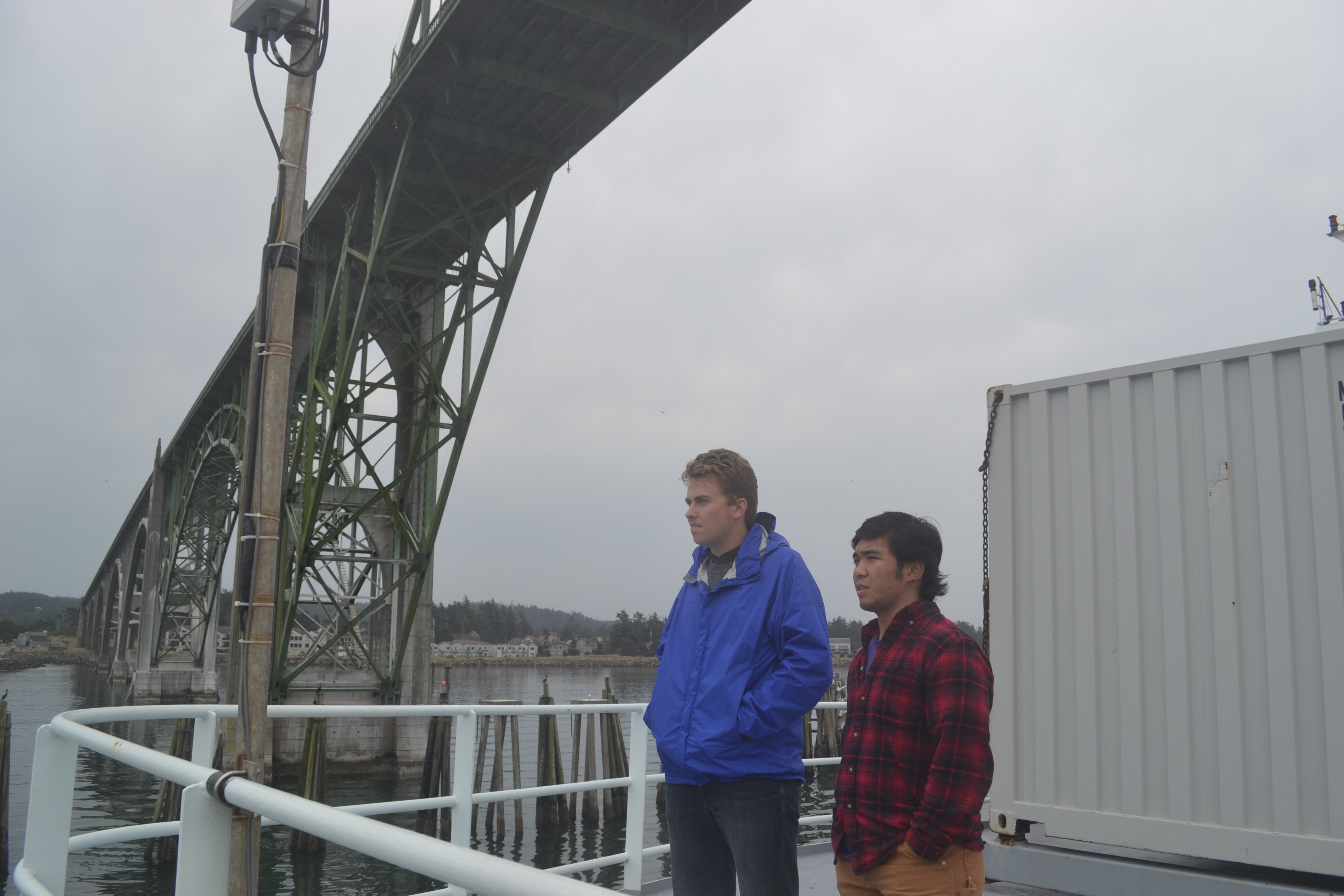
A seal sits on a buoy as the Thompson returns to Newport.
screenshot2014-08-11at10.02.02am
screenshot2014-08-11at9.56.51am
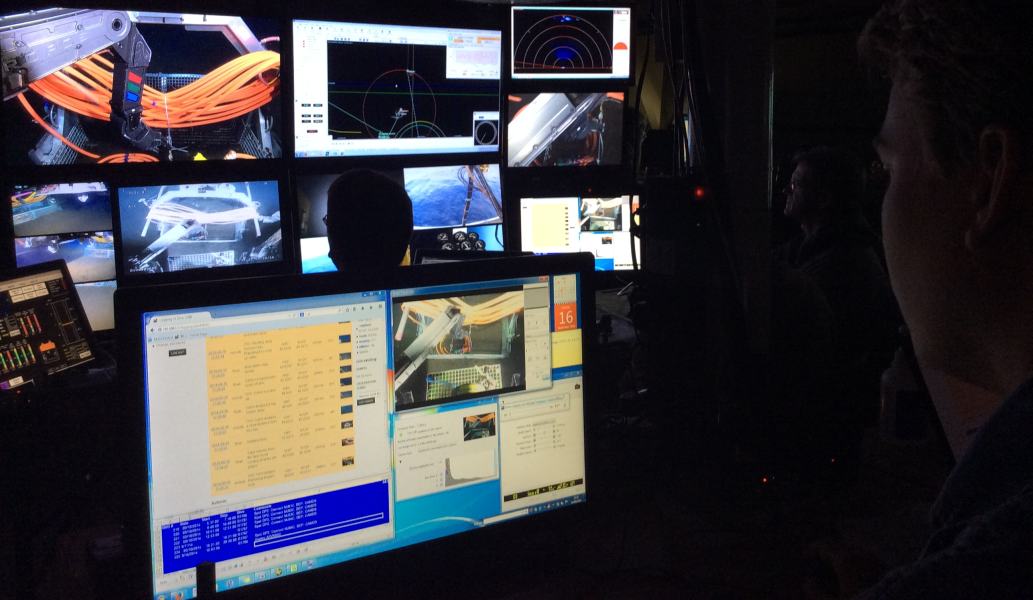
This is the ROPOS control room
The Deep Profiler at Axial Base docked in its charging station at the bottom of the mooring. The yellow profiler vehicle climbs up and down the mooring wire between the seafloor and the top buoy, collecting oceanographic data on thin layers in the water column. Photo Credit: NSF-OOI/UW/CSSF, Dive 1742, VISIONS14
All Axial Base seafloor infrastructure is now connected to Primary Node PN3A. Photo Credit: NSF-OOI/UW/CSSF, Dive 1742, V14
An octopus hanging out next to primary node PN3A at Axial Base, 2600 meters deep. Credit: UW/NSF-OOI/CSSF, ROPOS Dive R1742, V14.
An octopus hanging out near primary node PN3A at Axial Base, 2600 meters deep. Credit: UW/NSF-OOI/CSSF,ROPOS Dive 1742, V14.
A close up shot of a Peniagone sea cucumber and two ophiuroids (brittle stars) at Axial Base, 2600 m deep. Photo Credit: NSF-OOI/UW/CSSF, Dive 1742, V14
- Anemone
- Animal
- Arthropod
- ASHES
- Axial
- Axial Base
- Axial Biology
- Axial Caldera
- Bacteria
- Basalt Lava
- BEP
- Biofouling
- biolgoy
- Biology
- Camds
- Camera
- Camhd
- Central Caldera
- Ciliates
- Cnidaria
- Coastal Biology
- Crab
- Deep Profiler Mooring
- Dive Highlights
- Eastern Caldera
- Echinoderms
- Endurance Array
- Engineering Team
- ENLIGHTEN 10
- Exploratorium
- Fish
- Geology
- HD Camera
- HPIES
- Hydrate Ridge
- Hydrates
- Hydrophone
- Hydrothermal Vents
- Illustration
- Inshore 80 Meters
- Instrument
- International District
- J-BOX
- Jason
- Jellyfish
- Junction Box
- K12
- Lava
- Mollusk
- Moorings
- Nodes
- Nudibranch
- Octopus
- OOI
- Oregon Offshore
- Oregon Offshore 600 m
- Oregon Shelf
- Oregon Slope Base
- People
- PN1B
- PN1D
- Polychaetes
- PPSDN
- Primary Node
- RASFL
- ROCLS
- ROPOS
- ROPOS Dives
- ROV Team
- RV Revelle
- RV Sikuliaq
- RV Thompson
- Salp
- Sample
- SC13
- Science Team
- Sea Cucumber
- Sea Star
- Sea Urchin
- Seafloor
- Seismometer
- Sensors
- Shallow Profiler Mooring
- Shark
- Shipboard
- Shore Station
- Slope Base
- Smoker
- Soft Coral
- Southern Hydrate Ridge
- Sponge
- Squid
- Students
- Students & Guest Participants
- Tmpsf
- Tubeworms
- VISIONS 11 Leg 1
- VISIONS 11 Leg 2
- VISIONS 11 Viewers
- VISIONS 13
- VISIONS 14
- VISIONS 15
- VISIONS 16
- VISIONS 17
- VISIONS 18
- VISIONS 20
- VISIONS 22
- VISIONS 23
- Visualization