Image Archive


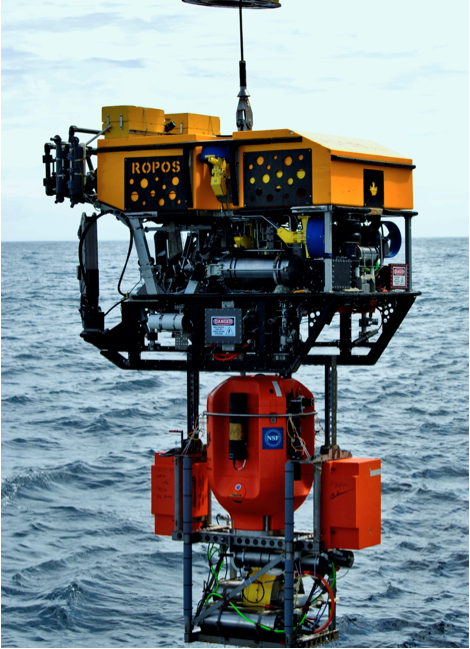
The deployment of the HPIES (Horizontal Electrometer Pressure Inverted Echosounder) instrument off the fantail of the Thompson at the Axial Base site. The instrument was designed to freefall to the seafloor from the surface, and did so successfully. Photo Credit: Ed McNichol, Mumbian Enterprises, Ltd.
Eleven students from the University of Washington, University of Oregon, and Boston University are participating on Leg 2 of the VISIONS'14 expedition as part of the School of Oceanography experiential learning course 'Ocean 411'. Also shown is John Delaney (Chief Scientist - University of Washington) and Kendra Daly (Co-Chief Scientist - University of South Florida). Photo Credit: Ed McNichol, University of Washington, and Mumbian Enterprises; V14.
A crinoid on a stalk at the Axial Base site, 2600m depth. Photo Credit: NSF-OOI/UW/CSSF, Dive 1739, V14
The HPIES experiment about to be dropped to the seafloor from the surface. It is kept balanced by a series of weights attached to the bottom, so the equipment doesn't tip over on its way down.
An RSN deep profiler is prepared by engineers on board the Thompson to be deployed to study the deep ocean.
A Pacific Flatnose fish seen on arrival at the Axial Base site (2600m) during Dive R1739. Cable AXVMW3 is seen on the left. Photo Credit: NSF-OOI/UW/CSSF, Dive 1739, V14
The HPIES instrument is being lowered over the side of the R/V Thompson for installation at the base of Axial Seamount. The HPIES (Horizontal Electrometer Pressure Inverted Echosounder) measures the horizontal electrical field, the bottom pressure, and the acoustic travel time from the seafloor to the sea surface to characterize the properties of the water column.
screenshot2014-08-07at10.58.45am
screenshot2014-08-07at10.51.09am
screenshot2014-08-07at10.42.58am
Southern Hydrate Ridge is located ~ 100 km west of Newport Oregon at a water depth of 780 m. Credit: University of Washiington, Center for Environmental Visualization.
The carbonate bioherm at Southern Hydrate Ridge rises ~ 60 m above the seafloor. Credit. University of Washington, Center for Environmental Visualization.
Hydrate 3
The carbonate bioherm at Southern Hydrate Ridge rises ~ 60 m above the seafloor. Credit. University of Washington, Center for Environmental Visualization.
Hydrothermal
Endeavor Vent Field
Vent Field Mechanics
A close-up picture of the skinny fish seen at 565m depth at the Axial Base site. It has been tentatively identified as Bathylychnops exilis or a Paralepidid by Brian Sidlauskas and Ben Frable (OSU) Photo Credit: NSF-OOI/UW/CSSF, Dive 1738, V14
A small cranchiid squid at the Axial Base site at 1318 m water depth. Tentatively identified as Taonius by cephalopod expert Stephanie Bush (MBARI). Credit: UW/NSF-OOI/CSSF, ROPOS Dive R1738, V14.
An orange Peniagone cucumber swimming past ROPOS during the AXVMW3 cable lay at Axial Base (2600m) Photo Credit: NSF-OOI/UW/CSSF, Dive 1738, V14
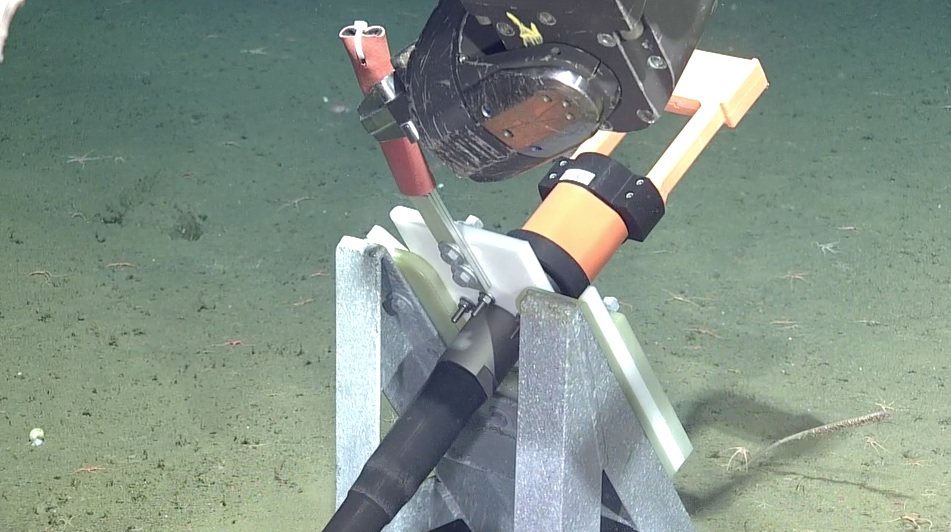
Attaching a strain relief line to the Yale grip on cable AXVMW3 at Axial Base. Photo Credit: NSF-OOI/UW/CSSF, Dive 1738, V14
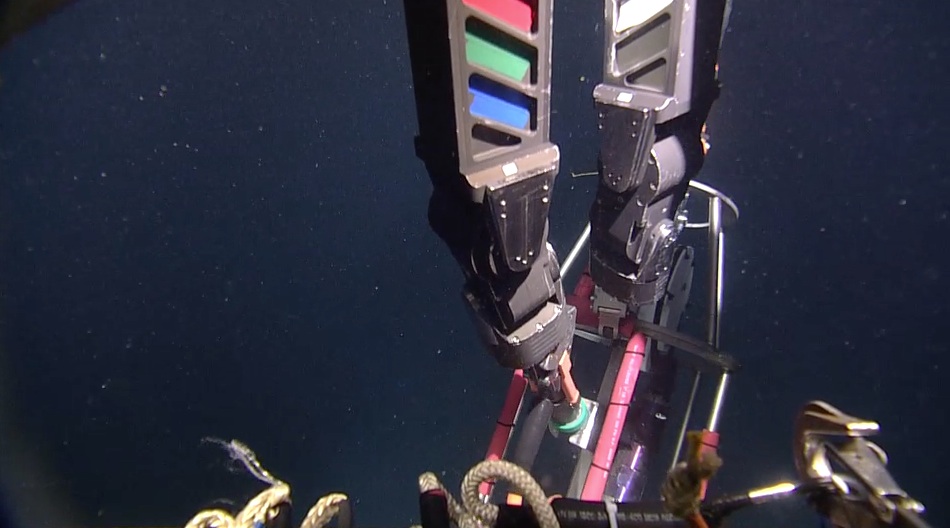
ROPOS removing the bungee holding slack cable from AXVMW3 onto ROCLS, at the Axial Base site. Photo Credit: NSF-OOI/UW/CSSF, Dive 1738, V14
The port manipulator of ROPOS ROV removing the brake from the ROCLS cable laying system at the Axial Base site (2600 m depth). Photo Credit: NSF-OOI/UW/CSSF, Dive 1738, V14
A large rattail swims beside LJ03A and LV03A at the Axial Base site (2600 meters deep). Photo Credit: NSF-OOI/UW/CSSF, Dive 1738, V14
A red siphonophore encountered during the descent to the Axial Base site, at 729 meters depth. Photo Credit: NSF-OOI/UW/CSSF, Dive 1738, V14
A skinny fish (either Bathylychnops exilis or a Paralepidid) seen during the ROPOS descent to the Axial Base site, at 565 meters. Photo Credit: NSF-OOI/UW/CSSF, Dive 1738, V14
ROPOS about to go for a night dive
Rachel with a Velella velella jellyfish
- Anemone
- Animal
- Arthropod
- ASHES
- Axial
- Axial Base
- Axial Biology
- Axial Caldera
- Bacteria
- Basalt Lava
- BEP
- Biofouling
- biolgoy
- Biology
- Camds
- Camera
- Camhd
- Central Caldera
- Ciliates
- Cnidaria
- Coastal Biology
- Crab
- Deep Profiler Mooring
- Dive Highlights
- Eastern Caldera
- Echinoderms
- Endurance Array
- Engineering Team
- ENLIGHTEN 10
- Exploratorium
- Fish
- Geology
- HD Camera
- HPIES
- Hydrate Ridge
- Hydrates
- Hydrophone
- Hydrothermal Vents
- Illustration
- Inshore 80 Meters
- Instrument
- International District
- J-BOX
- Jason
- Jellyfish
- Junction Box
- K12
- Lava
- Mollusk
- Moorings
- Nodes
- Nudibranch
- Octopus
- OOI
- Oregon Offshore
- Oregon Offshore 600 m
- Oregon Shelf
- Oregon Slope Base
- People
- PN1B
- PN1D
- Polychaetes
- PPSDN
- Primary Node
- RASFL
- ROCLS
- ROPOS
- ROPOS Dives
- ROV Team
- RV Revelle
- RV Sikuliaq
- RV Thompson
- Salp
- Sample
- SC13
- Science Team
- Sea Cucumber
- Sea Star
- Sea Urchin
- Seafloor
- Seismometer
- Sensors
- Shallow Profiler Mooring
- Shark
- Shipboard
- Shore Station
- Slope Base
- Smoker
- Soft Coral
- Southern Hydrate Ridge
- Sponge
- Squid
- Students
- Students & Guest Participants
- Tmpsf
- Tubeworms
- VISIONS 11 Leg 1
- VISIONS 11 Leg 2
- VISIONS 11 Viewers
- VISIONS 13
- VISIONS 14
- VISIONS 15
- VISIONS 16
- VISIONS 17
- VISIONS 18
- VISIONS 20
- VISIONS 22
- VISIONS 23
- Visualization