Image Archive


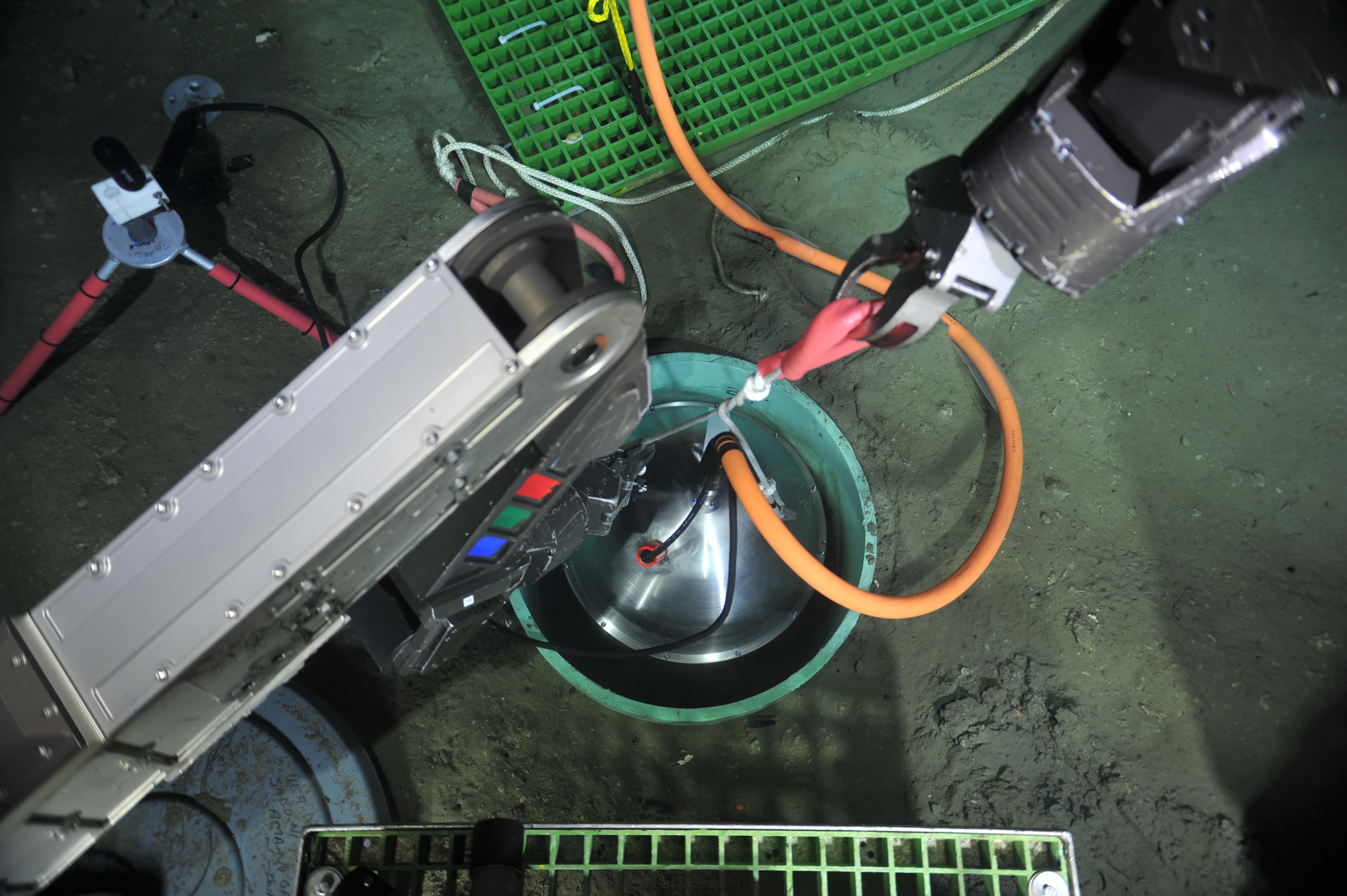
ROPOS connecting cable AXVMW4 and strain relief to the junction box on the Deep Profiler mooring at Axial Base. Photo Credit: NSF-OOI/UW/CSSF, Dive 1742, V14
An action shot of the modified McLane Deep Profiler at the Axial Base site crawling up the mooring wire. The yellow profiler vehicle climbs up and down the mooring wire between the seafloor and the top buoy, collecting oceanographic data on thin layers in the water column. Credit: UW/NSF-OOI/CSSF, Dive 1742, V14.
On August 8, 2014 all Secondary Infratructure at the summit of Axial Seamount was connected to Primary Node PN3B. Here, cable RS03W9 is being plugged into the SP1 port on PN3B. Photo Credit: NSF-OOI/UW/CSSF, Dive 1741; V14.
ROPOS collecting the dummy plugs and parking brakes from plugging infrastructure into primary node PN3B at Axial Caldera. A spider crab can be seen in the background. Photo Credit: NSF-OOI/UW/CSSF, Dive 1741, V14
Cable RS03W6 successfully plugged into SP3 on primary node PN3B at Axial Caldera. Photo Credit: NSF-OOI/UW/CSSF, Dive 1741, V14
ROPOS attempting to plug seafloor cable RS03W8 into SP4 on primary node PN3B at Axial Caldera. Photo Credit: NSF-OOI/UW/CSSF, Dive 1741, V14
Primary Node PN3B at Axial Caldera, along with cable RS03W9. Photo Credit: NSF-OOI/UW/CSSF, Dive 1741, V14
r1740_thumb
r1739_thumb
A line attached from the top float of the Axial Base deep profiler mooring to the winch on ROPOS, prior to a recovery to diagnose and repair the mooring connector. Photo Credit: NSF-OOI/UW/CSSF, Dive 1740, V14
ROPOS attaching a line to the flotation sphere at the top of the deep profiler mooring at Axial Base, prior to recovery to fix a connector problem. Photo Credit: NSF-OOI/UW/CSSF, Dive 1740, V14
ROPOS uses rebar "staples" to secure the hydrophone cable into the seafloor at the Axial Base site. The hydrophone is mounted on the pink tripod on the right side of the frame. Photo Credit: NSF-OOI/UW/CSSF, Dive 1739, V14
ROPOS using a suction tube to vacuum out the caisson for the broadband seismometer at Axial Base. Credit: UW/NSF-OOI/CSSF, ROPOS Dive 1739, V14
A purple ctenophore seen near the bottom (2608 meters) at Axial Base site Photo Credit: NSF-OOI/UW/CSSF, Dive 1739, V14
A beautiful shot of a Rattail fish at 2564 meters depth at Axial Seamount. Credit: UW/NSF-OOI/CSSF, ROPOS Dive R1739, V14.
The connectors for the deep profiler mooring and wire AXVMW4, with a photobomb from a Peniagone sea cucumber. Photo Credit: NSF-OOI/UW/CSSF, Dive 1739, V14
Cable AXVMW3 and assorted invertebrates (pom pom anemone, Scotoplanes, Benthodytes, ophiuroids) during dive R1739 at Axial Base (2600 meters). Photo Credit: NSF-OOI/UW/CSSF, Dive R1739, V14
Tripod mounted CTD and optical attenuation sensors on the seafloor at the Axial Base site (2600m deep). Junction box LJ03A is visible in the background. Photo Credit: NSF-OOI/UW/CSSF, Dive 1739, V14
A bizarre sponge, Chondrocladia lampadiglobus, seen at Axial Base (2600m deep). First seen in 1960 in grainy black and white pictures, it was originally thought to be a Russian listening device by the US Navy, before it was eventually identified as an organism. Photo Credit: NSF-OOI/UW/CSSF, Dive 1739, V14
Two rattails, a Peniagone sea cucumber, and many ophiuroids at the Axial Base site (2600 meters). Photo Credit: NSF-OOI/UW/CSSF, Dive 1739, V14
Removing the pins holding the descent weights onto the HPIES platform at Axial Base. Photo Credit: NSF-OOI/UW/CSSF, Dive 1739, V14
The HPIES (Horizontal Electrometer Pressure Inverted Echosounder) instrument on the seafloor at Axial Base site (2600m depth). Photo Credit: NSF-OOI/UW/CSSF, Dive 1739, V14
A spider crab encountered at the Axial Base site (2600m deep) during a cable survey. Photo Credit: NSF-OOI/UW/CSSF, Dive 1739, V14
A sea pen, a colonial marine cnidarian belonging to the order Pennatulacea, seen at the Axial Base site (2600m depth) during a cable survey. Photo Credit: NSF-OOI/UW/CSSF, Dive 1739, V14
A dumbo octopus (Grimpoteuthis) at the Axial Base site at 2600 m water depth. Identified by cephalopod experts Stephanie Bush (MBARI) and Mike Vecchione (Smithsonian) Credit: UW/NSF-OOI/CSSF, Dive R1739, V14.
introtohydrothermalvents
APL/RSN engineer Eric Boget gently lowers the deep profiler package into the water during the mooring deployment. Photo Credit: Ed McNichol, Mumbian Enterprises, Inc.
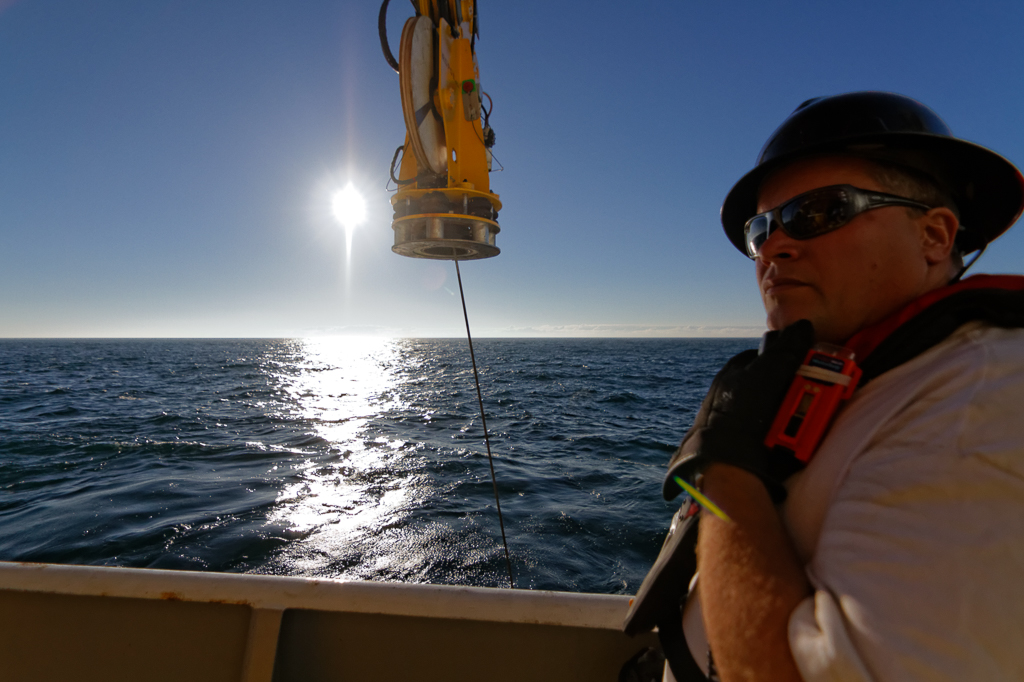
APL/RSN engineers attaching the deep profiler vehicle to the mooring line during deployment at the Axial Base site. Photo Credit: Ed McNichol, Mumbian Enterprises, Inc.
- Anemone
- Animal
- Arthropod
- ASHES
- Axial
- Axial Base
- Axial Biology
- Axial Caldera
- Bacteria
- Basalt Lava
- BEP
- Biofouling
- biolgoy
- Biology
- Camds
- Camera
- Camhd
- Central Caldera
- Ciliates
- Cnidaria
- Coastal Biology
- Crab
- Deep Profiler Mooring
- Dive Highlights
- Eastern Caldera
- Echinoderms
- Endurance Array
- Engineering Team
- ENLIGHTEN 10
- Exploratorium
- Fish
- Geology
- HD Camera
- HPIES
- Hydrate Ridge
- Hydrates
- Hydrophone
- Hydrothermal Vents
- Illustration
- Inshore 80 Meters
- Instrument
- International District
- J-BOX
- Jason
- Jellyfish
- Junction Box
- K12
- Lava
- Mollusk
- Moorings
- Nodes
- Nudibranch
- Octopus
- OOI
- Oregon Offshore
- Oregon Offshore 600 m
- Oregon Shelf
- Oregon Slope Base
- People
- PN1B
- PN1D
- Polychaetes
- PPSDN
- Primary Node
- RASFL
- ROCLS
- ROPOS
- ROPOS Dives
- ROV Team
- RV Revelle
- RV Sikuliaq
- RV Thompson
- Salp
- Sample
- SC13
- Science Team
- Sea Cucumber
- Sea Star
- Sea Urchin
- Seafloor
- Seismometer
- Sensors
- Shallow Profiler Mooring
- Shark
- Shipboard
- Shore Station
- Slope Base
- Smoker
- Soft Coral
- Southern Hydrate Ridge
- Sponge
- Squid
- Students
- Students & Guest Participants
- Tmpsf
- Tubeworms
- VISIONS 11 Leg 1
- VISIONS 11 Leg 2
- VISIONS 11 Viewers
- VISIONS 13
- VISIONS 14
- VISIONS 15
- VISIONS 16
- VISIONS 17
- VISIONS 18
- VISIONS 20
- VISIONS 22
- VISIONS 23
- Visualization